
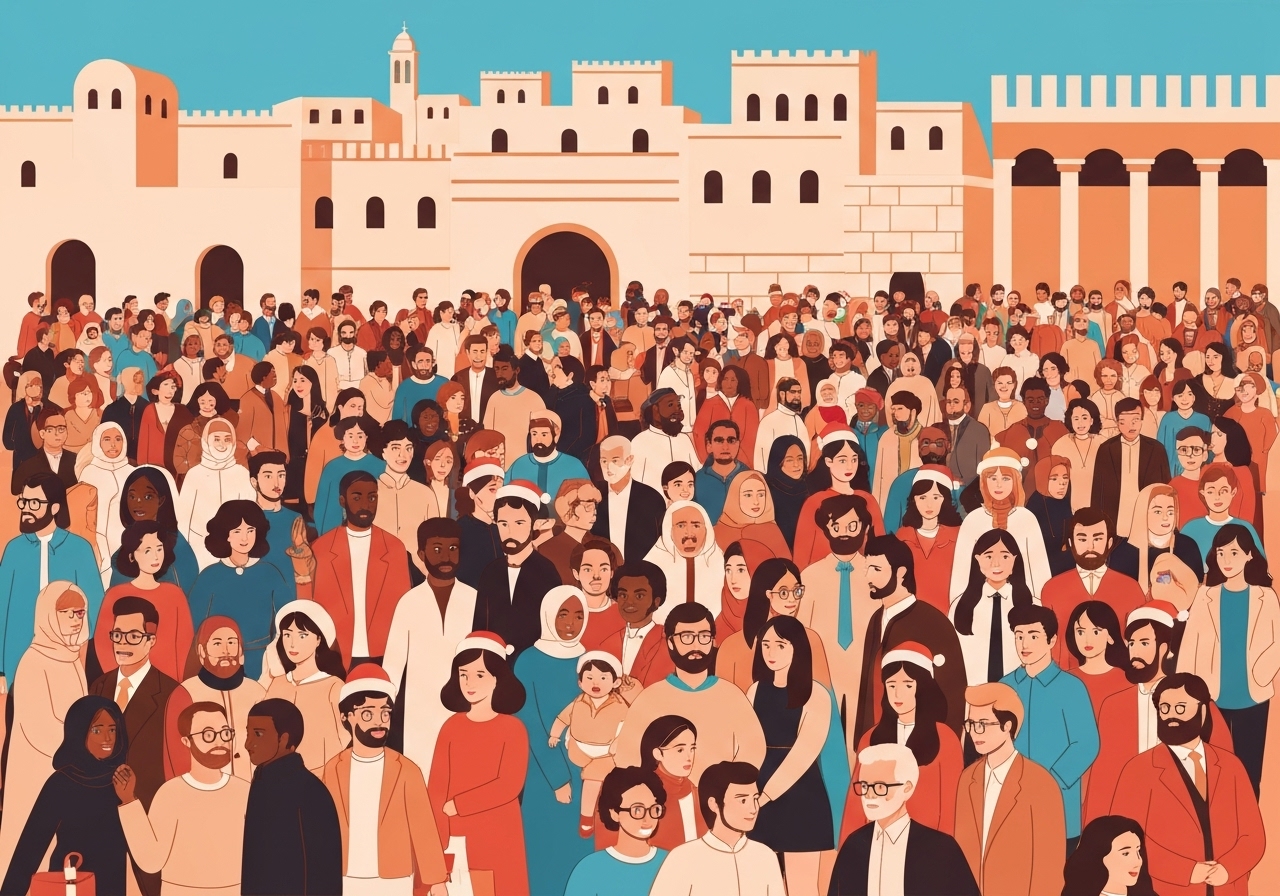
On Christmas Eve, thousands gathered in Bethlehem’s Manger Square as public celebrations returned after a two-year pause tied to the Israel–Hamas war in Gaza. The giant Christmas tree reappeared Wednesday, replacing a nativity display that last year featured baby Jesus amid rubble and barbed wire. Cardinal Pierbattista Pizzaballa led the traditional procession from Jerusalem and celebrated a pre-Christmas Mass for Gaza’s tiny Christian community, framing the events as a revival of light and hope. Residents and a limited number of foreign visitors said the scene marked the fragile beginning of a return to ordinary holiday life amid continuing security and economic strains.
Key takeaways
- Thousands of people gathered in Bethlehem’s Manger Square on Christmas Eve as public festivities resumed after two years of cancellation tied to the Israel–Hamas war in Gaza.
- The city restored its large Christmas tree on Wednesday; last year’s display had symbolized Gaza’s destruction with rubble and barbed wire.
- Local officials say Bethlehem’s unemployment surged from about 14% to roughly 65% during the crisis, and around 4,000 residents have left seeking work.
- Christians now make up less than 2% of the West Bank’s approximately 3 million people, a demographic decline underscored by recent departures.
- Although a Gaza ceasefire began in October, Israeli security raids and a spike in settler attacks reported since 2006 have kept tensions high across the West Bank.
- The majority of people at the celebrations were residents; tourism is returning only gradually, with international visitors still scarce.
Background
Bethlehem, inside the Israeli-occupied West Bank captured by Israel in 1967, is a focal point for global Christian pilgrimage and a local economy heavily dependent on visitors. Before the recent conflict, tourism and related services supported the livelihoods of roughly 80% of the city’s residents according to local officials. After the outbreak of large-scale hostilities, church leaders in Jerusalem urged congregations to forgo celebratory events and focus on prayer, and Bethlehem canceled its public Christmas festivities for two consecutive years.
The 2023–24 conflict in Gaza and the Israeli military response reverberated through the West Bank, where the Palestinian Authority retains limited autonomy in parts of the territory. Humanitarian monitors and local authorities report rising insecurity, including an uptick in attacks linked to Israeli settlers. Economic dislocation accelerated emigration from the city, particularly among Christian families who had already been leaving in prior decades.
Main event
The traditional procession from Jerusalem to Bethlehem was led by Cardinal Pierbattista Pizzaballa, the Catholic Church’s senior figure in the Holy Land, who called for “a Christmas full of light” and conveyed greetings from Gaza’s small Christian community. The giant tree was re-erected in Manger Square, and marching bands, scouts and families filled routes that had been quieter during the previous two holiday seasons.
Many attendees were local: long-time Bethlehem residents, family groups and youth. Tour guides such as Georgette and Michael Jackaman — members of Christian Bethlehem families spanning generations — said this was the first full, public Christmas for their young children. The Jackamans also described how they pivoted during the war to selling Palestinian handicrafts online to help sustain other households.
Security and access remained major practical constraints. Some visitors reported long waits at Israeli checkpoints, turning what had been a 40-minute drive into an early-morning ordeal. Scouts from towns across the West Bank marched with Palestinian flags; after two years of muted protest marches, this year’s parade resumed with music and visible celebration.
Analysis & implications
The return of public celebrations in Bethlehem carries symbolic and material weight. Symbolically, reviving the tree and procession signals resilience and a desire to restore normalcy for a city that is central to Christian identity worldwide. Materially, any uptick in local spending or visitor arrivals is critical: the sharp jump in unemployment to roughly 65% has depleted household incomes and prompted outward migration.
For Palestinian Christians, the event spotlights a longer-term demographic shift. Christians now account for under 2% of the West Bank’s roughly 3 million residents, and the mayor’s estimate that about 4,000 people have left Bethlehem for work reflects accelerating decline that could erode community institutions and local services if sustained.
Security trends will shape whether the revival endures. Despite a Gaza ceasefire that began in October, Israeli military raids and record levels of settler violence — relative to monitoring that began in 2006 — keep the risk of renewed disruption. Policymakers and community leaders face the challenge of balancing visible festivals with precautions and humanitarian support for families still recovering economically and psychologically.
Comparison & data
| Indicator | Before crisis | During crisis |
|---|---|---|
| Bethlehem unemployment | ~14% | ~65% |
| Christians in West Bank | — | <2% of ~3,000,000 |
| Residents who left Bethlehem | — | ~4,000 |
These figures, reported by local officials and documented in recent coverage, illustrate the depth of the shock to Bethlehem’s economy and population. The unemployment spike reflects both the immediate impact of conflict on tourism and broader constraints on movement and commerce across the West Bank.
Reactions & quotes
Cardinal Pizzaballa framed the gathering as a shared moral response to suffering and a gesture of solidarity with Gaza’s Christians and families affected by the war.
“We, all together, we decide to be the light, and the light of Bethlehem is the light of the world.”
Pierbattista Pizzaballa, Latin Patriarchate
Local residents described the day as an emotional step toward recuperation after two years of curbed festivities and economic strain.
“Today is a day of joy, a day of hope, the beginning of the return of normal life here.”
Georgette Jackaman, Bethlehem resident and tour guide
Foreign visitors said the trip was motivated by solidarity and understanding rather than leisure, underlining the city’s continued political and humanitarian significance.
“Christmas is like hope in very dark situations.”
Mona Riewer, visitor from France
Unconfirmed
- Precise visitor counts for Christmas Eve: officials and media reported thousands present, but an exact, independently verified total for international versus local attendees is not available.
- Long-term tourism recovery projections remain uncertain; claims that tourism is returning steadily are based on early signs rather than comprehensive industry data.
Bottom line
Christmas celebrations in Bethlehem this year offered a visible, emotional lift for residents and a tentative sign that civic life can re-emerge after two years of war-related disruption. The restored tree and packed Manger Square were powerful symbols of resilience, but they sit against a backdrop of elevated unemployment, population loss and ongoing security risks.
Whether this revival translates into sustained recovery depends on security stabilization, access for visitors, and economic measures to rebuild livelihoods. Observers should watch checkpoint patterns, tourism flows in the coming months, and policies that address both immediate humanitarian needs and longer-term community viability.
Sources
- Associated Press (news report summarizing on-the-ground reporting and official statements)