
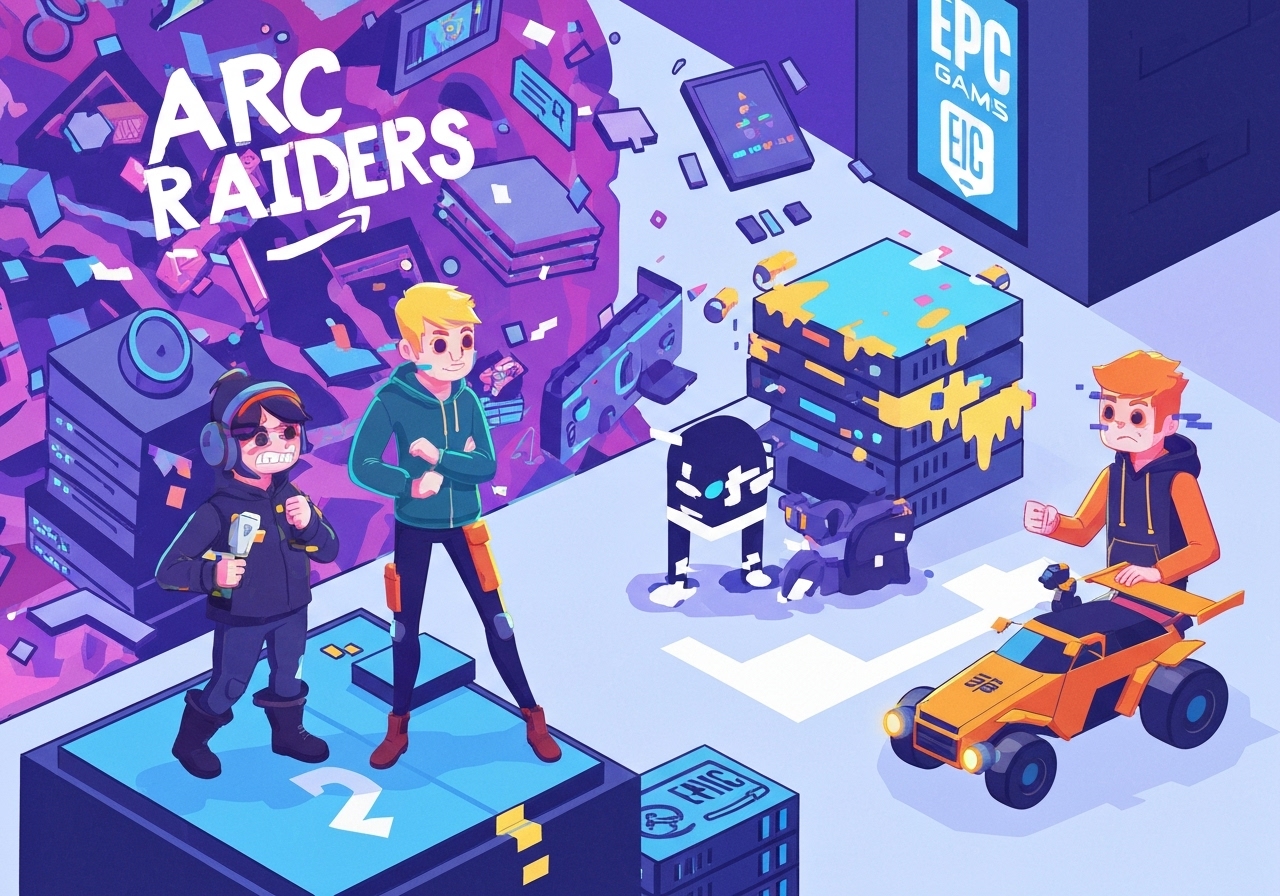
On Dec 25, 2025, a widespread Amazon Web Services (AWS) disruption knocked multiple online games and related services offline, impacting titles such as ARC Raiders, Fortnite and Rocket League. Downdetector reported roughly 4,000 user reports in the United States tied to AWS, while ARC Raiders alone saw spikes to nearly 35,000 reports. Players across platforms reported login failures, matchmaking errors and timeouts; Epic Games storefront functions and cross‑platform features were also intermittently affected. As of the latest checks, AWS had not published a root‑cause statement for the outage.
Key Takeaways
- Scope: The outage on Dec 25, 2025 affected multiple gaming services including ARC Raiders, Fortnite, Rocket League and other Epic Games titles, plus disruptions to PlayStation Network and Steam.
- Incident volume: Downdetector recorded about 4,000 AWS outage reports in the US and nearly 35,000 reports specifically for ARC Raiders during peak disturbance.
- Common errors: Reported issues included ART00004 network timeouts for ARC Raiders, EOS (Epic Online Services) timeouts for Rocket League, and widespread login/matchmaking failures for Fortnite.
- Storefront impact: The Epic Games Store reported problems with purchases and redemption flows, affecting transactions for some users.
- Response guidance: Operators and users were advised to monitor official status pages (status.epicgames.com) and avoid repeated login attempts to reduce account‑flagging risk.
- Historical context: AWS experienced a major outage in October 2025 tied to DNS/DynamoDB reachability problems, illustrating recurring systemic vulnerabilities in large cloud platforms.
- Typical resolution times: Past similar outages have been resolved within 1–3 hours, though message backlogs on some AWS services previously persisted longer.
Background
Many modern online games and storefronts rely on cloud providers for backend services such as authentication, matchmaking and in‑game persistence. Amazon Web Services is one of the largest providers and hosts critical components used by game publishers and platform operators, including Epic Games and smaller studios. When AWS components fail or become unreachable, client apps can be prevented from authenticating users, locating game servers, or completing payment operations.
Game developers increasingly stitch together third‑party services—matchmaking and player identity often route through cloud APIs that abstract away server infrastructure. That convenience, however, concentrates systemic risk: a provider‑level outage can cascade across many otherwise independent titles and platforms. The October 2025 incident, publicly attributed to DNS and DynamoDB path failures, is a recent example of how a single cloud fault can produce broad consumer impact.
Main Event
User reports and outage trackers first registered elevated error volumes on Dec 25, 2025, with players describing immediate inability to sign in or join multiplayer sessions. ARC Raiders showed the largest single‑title spike in reports—nearly 35,000—primarily citing the ART00004 Network Timeout error that prevents server connections. Fortnite players reported login rejections and matchmaking failures, while Rocket League users saw EOS timeout messages preventing match joins.
Social platforms carried real‑time accounts from frustrated players and a small number of studio notices, but major publishers had limited immediate explanations. One widely shared post on X summarized the user experience: services ranging from Fallout matches to in‑store purchases were affected. Downdetector’s aggregated data gave an early quantitative sense of scope, though the dataset reflects only self‑reported incidents rather than a complete telemetry view.
Beyond games, partial outages were reported for PlayStation Network and Steam, affecting cross‑platform play and storefront access for some users. Some studios issued brief advisories telling players to monitor official status pages; others simply marked multiplayer functionality as degraded. At the time of reporting, AWS had not posted a detailed incident report explaining the technical root cause of the disruption.
Analysis & Implications
Operationally, this outage highlights the fragility introduced by heavy dependence on a single cloud provider for critical infrastructure. Game publishers trade upfront infrastructure complexity for developer velocity; when that provider falters, the downstream impact can be sudden and far‑reaching. For player communities, outages during peak play periods—holiday windows, regional events—translate into immediate frustration and reputational risk for studios.
Economically, prolonged downtime can reduce live‑service revenues for games that monetize via microtransactions and time‑sensitive offers. Even short interruptions may depress daily revenue and increase customer support costs; repeated incidents also complicate retention efforts for subscription or live‑service titles. From a contractual standpoint, frequent or high‑impact outages may trigger SLA reviews between publishers and cloud providers or push larger studios to pursue multi‑region or multi‑provider mitigation strategies.
On the platform side, companies such as Epic Games and Sony must weigh engineering tradeoffs: invest in resilient architectures that tolerate provider outages, or accept simpler single‑provider deployments to speed feature delivery. Regulators and enterprise customers are also watching such outages as part of broader scrutiny on concentration risks in cloud markets. For end users, the practical implication is reliance on vendor status communications and developer transparency about mitigation timelines.
Comparison & Data
| Service | Reported Issue | Peak Reported Volume |
|---|---|---|
| ARC Raiders | ART00004 Network Timeout; server connections blocked | ~35,000 reports |
| AWS (US) | General service disruptions reported by users | ~4,000 reports |
| Fortnite / Rocket League | Login failures, matchmaking / EOS timeouts | Widespread reports (no consolidated peak provided) |
The table summarizes user‑reported volumes collected by public outage monitors during the incident window; these figures are derived from crowd‑sourced trackers and represent report counts rather than internal telemetry. ARC Raiders showed the most concentrated spike reported publicly, while Fortnite and Rocket League experienced broad functional degradation across matchmaking and sign‑in systems. Historical comparison: the October 2025 AWS outage involved DNS and DynamoDB reachability problems and produced cross‑service effects that took hours to fully resolve.
Reactions & Quotes
Players and community channels reacted immediately with troubleshooting requests and status checks; developers posted brief advisories asking for patience while engineers investigate. Outage trackers and news wires logged rapid spikes in reports as systems lost connectivity.
AWS is currently having an outage. Many services are being affected by it; Arc Raiders, Fortnite, Steam, Rocket League, Epic Games, Embark Studios, PlayStation Network, etc.
user on X (social post)
News outlets and wire services described the event as a significant cloud disruption while noting that formal vendor statements were pending.
AWS experienced a massive outage on Wednesday.
Reuters (news wire)
When AWS faced a major outage in October, the company issued a post‑incident statement describing service recovery and residual message backlogs; that language remains a reference point for stakeholders today.
all AWS services returned to normal operations. Some services such as AWS Config, Redshift, and Connect continue to have a backlog of messages that they will finish processing over the next few hours.
Amazon Web Services (official post, October 2025)
Unconfirmed
- No official AWS root‑cause report for the Dec 25 outage had been published at the time of reporting; the precise subsystem(s) implicated remain unconfirmed.
- Claims that PlayStation Network or Steam experienced total regional outages are not fully verified; public trackers showed partial disruptions but region‑by‑region impacts varied.
- Reports that repeated login attempts will definitively trigger account flags vary by service and operator policy, and such automatic flagging has not been uniformly confirmed for all affected platforms.
Bottom Line
The Dec 25, 2025 AWS disruption again underscored how concentrated reliance on major cloud providers can produce simultaneous failures across diverse consumer apps and games. For players, the immediate action is pragmatic: check official status pages, avoid repeated login attempts, and expect intermittent access until publishers or AWS confirm fixes.
For studios and platform operators, this incident reinforces the business case for greater operational resilience—multi‑region deployments, multi‑provider fallbacks, and clearer customer communication playbooks. Regulators and enterprise customers will watch cumulative incidents as they assess systemic risks tied to cloud concentration.
Sources
- Hindustan Times — news report summarizing outage effects (news)
- Downdetector — crowd‑sourced outage monitoring and report counts (outage monitoring)
- Epic Games Status — official service health updates for Epic Games ecosystem (official)
- AWS Service Health Dashboard — official AWS incident and status page (official)
- Reuters — wire coverage of cloud outages and industry reaction (news)