
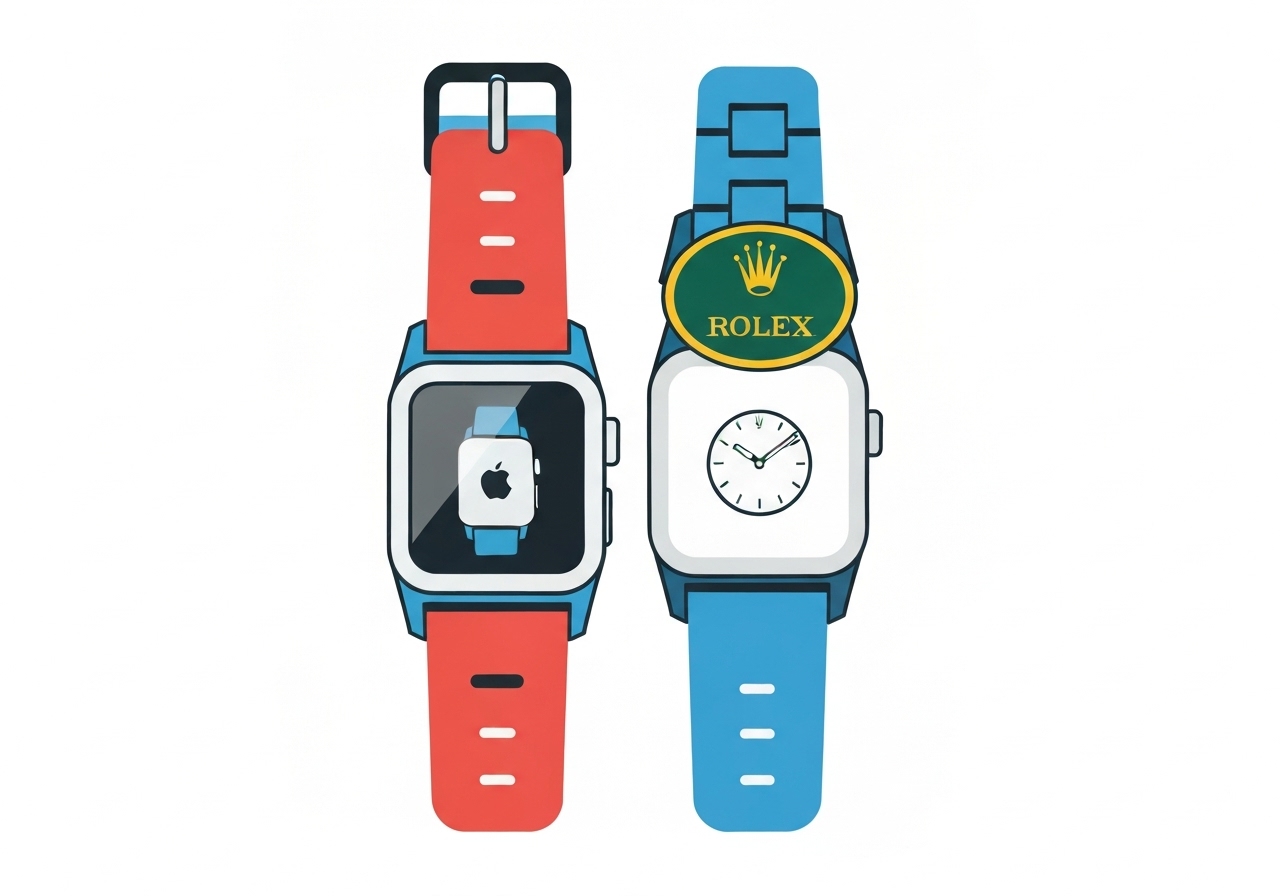
At CES 2026 in Las Vegas, Paris-based startup Smartlet unveiled a stainless-steel modular strap, priced from $418, that lets users mount a mechanical watch on the top of the wrist while tucking a smartwatch or fitness tracker underneath. The system supports a wide range of wearables — Apple Watch, Samsung Galaxy Watch, Google Pixel Watch, Garmin, Fitbit Charge and Whoop — and analog watches with lug widths from 18 to 24 mm. Founder David Ohayon framed the product as a way to stop choosing between a dress watch and a connected device, but Smartlet’s design adds 9–12 mm of thickness beneath the wrist, raising questions about comfort and scratch risk. The product is sold as the strap system only; neither the analog timepiece nor the smartwatch is included.
Key Takeaways
- Smartlet launched at CES 2026 in Las Vegas; the stainless-steel strap system starts at $418 and ships without watches or trackers.
- The band accepts analog watches with lug widths of 18–24 mm, covering models from Omega, Tudor, TAG Heuer and Rolex.
- It claims compatibility with most major smartwatches and bands, including Apple Watch, Samsung Galaxy Watch, Google Pixel Watch, Garmin, Fitbit Charge and Whoop.
- The assembly places a connected device on the underside of the wrist and adds roughly 9–12 mm of height once attached.
- Smartlet’s marketing targets luxury-watch owners who also want fitness and payment features from smartwatches.
- Practical concerns include increased bulk, abrasion risk from desks and armrests, and the ergonomics of wearing two devices on one wrist.
Background
Wristwear has bifurcated over the last decade: traditional mechanical and luxury watches emphasize craftsmanship and status, while smartwatches deliver notifications, health metrics and contactless payments. Many consumers who prize both aesthetics and functionality face a daily trade-off between wearing a classic analogue piece or a connected device. Accessory makers and microbrands have occasionally attempted hybrid solutions — offering smartwatch faces styled like mechanical dials or single-case hybrids — but few have focused on carrying both devices simultaneously.
Smartlet emerges from that persistent tension. The Paris startup positions its strap as a compromise: keep your investment-grade wristwatch visible while running your fitness or payment features from a hidden device. Founder David Ohayon has described the idea as pragmatic for users who alternate roles — gym-goer and formal meeting attendee — within a single day. The company presented the product at CES, a show known for conceptual and niche hardware that tests the bounds of mainstream appeal.
Main Event
At CES 2026, Smartlet displayed a polished stainless-steel strap system designed to accept a conventional watch head on its outer face and a smartwatch or tracker clipped into a recess under the wrist. The mechanism adapts to common lug widths (18–24 mm), which Smartlet says makes it compatible with many luxury models, and it offers adapters and plates to fit a broad set of wearable brands. The company emphasized the band’s finish and materials to reassure high-end-watch owners worried about mismatches with their investment pieces.
Price-wise, Smartlet set the strap at $418 for the stainless-steel variant; other finishes or editions were suggested but not priced at the show. Company material and on-stage demos made clear the system does not include either type of timepiece — buyers must supply their own analog watch and smartwatch or tracker. Presenters showed examples pairing a Rolex-style mechanical head with an Apple Watch and with a Whoop tracker installed below.
Operationally, Smartlet requires a connected device to sit beneath the wrist where it will regularly contact surfaces such as desks and armrests; the company estimates the added height at the underside to be between 9 and 12 mm when a device is attached. Demonstrations highlighted quick swapping of devices and a secure locking mechanism, but reviewers at the booth flagged the additional bulk and the potential for increased wear on both devices. Marketing language at the CES booth leaned into traditional watch-culture cues, pitched toward people who want to present a refined exterior while retaining smart features.
Analysis & Implications
Smartlet addresses a narrow but visible market wedge: affluent buyers who own mechanical watches yet want smartwatch functionality without sacrificing wrist appearance. For that cohort, the product could reduce friction in daily choices, allowing a single wrist to serve diverging social contexts. However, the ergonomics trade-off is material: adding 9–12 mm under the wrist changes how the arm contacts surfaces and could accelerate scratches or wear on both the smartwatch and the mechanical piece. Users who value the pristine condition of a luxury watch may find that trade unacceptable.
Durability and long-term customer experience will be decisive. The underside placement exposes sensors, glass, and metal edges to abrasion and impacts that most smartwatches avoid when worn on top. If Smartlet can demonstrate robust cushioning, reinforced frames, or replaceable impact surfaces, it may reduce buyer hesitation. Conversely, warranty, repair, and insurance implications for paired devices are murky: watchmakers and smartwatch makers may treat damage incurred while mounted in third-party accessories differently than ordinary wear.
From a market perspective, Smartlet could spur similar modular accessories or push luxury-watch owners toward integrated hybrid cases from established brands. The strap’s compatibility approach — adapters for many lug widths and tracker types — aims for scale, yet the variety of proprietary bands and watch case shapes may limit seamless fit for some models. Retail pricing at $418 places the product in a premium accessory tier, so adoption will likely skew to collectors and early adopters rather than mass-market buyers.
Comparison & Data
| Metric | Smartlet (announced) | Typical top-wrist smartwatch |
|---|---|---|
| Underside added height | 9–12 mm | N/A (worn on top) |
| Analog lug width supported | 18–24 mm | Depends on watch |
| Compatible trackers | Apple, Samsung, Pixel, Garmin, Fitbit Charge, Whoop | Model-dependent |
The table highlights Smartlet’s unique metric — added underside height — which has no direct analogue for a conventional top-worn smartwatch. Supporting 18–24 mm lugs covers a large subset of luxury watches, but not all vintage or specialty cases. These numbers clarify the trade-offs: compatibility breadth versus a tangible change in wrist profile.
Reactions & Quotes
Smartlet framed the product as a solution to a common consumer preference conflict. The founder’s short on-stage remark summed the company’s rationale; the context at CES underlined that Smartlet aims at style-conscious users who also demand connected features.
“I was tired of choosing between my analog and my smartwatch every morning,”
David Ohayon, Smartlet (founder, company statement)
At the booth, a CNET reviewer noted the cleverness of the concept but flagged practical reservations about wear and bulk. That reaction reflects a broader reviewer instinct to weigh novelty against everyday usability.
“It’s an elegant idea, but the extra thickness under the wrist could make daily life harder,”
Vanessa Hand Orellana, CNET (journalist)
Some industry observers suggested the product may prompt either aftermarket accessory development or motivate legacy watch brands to explore discreet connectivity solutions. Buyers and watchmakers will watch early user reports to assess whether the approach is a passing curiosity or a durable niche.
“Accessories that bridge analogue craft and digital utility will get attention, though adoption hinges on long-term durability,”
Independent watch industry analyst (comment)
Unconfirmed
- Long-term abrasion and scratch rates for watches mounted on Smartlet are not yet documented by independent testing.
- Claims of flawless fit across every model within listed brands remain unverified for some proprietary or older smartwatch variants.
- Pricing for additional finishes or future editions was hinted at but not officially confirmed at CES.
Bottom Line
Smartlet offers a distinctive answer to a real consumer dilemma: how to enjoy both a luxury analogue look and smartwatch functionality without swapping wrists. Its $418 stainless-steel strap and broad compatibility announcements make it immediately relevant to collectors who also use modern wearables. Yet the product’s ergonomics — notably the 9–12 mm underside build-up — and exposure to abrasion create practical concerns that will determine whether the band is a clever novelty or a durable accessory.
For buyers considering Smartlet, the decisive factors will be personal tolerance for extra bulk, how often the underside will contact hard surfaces, and whether the strap’s materials and locking mechanisms protect expensive devices. Early adopters should weigh warranty and repair implications and watch for independent durability reviews before committing to the accessory.