
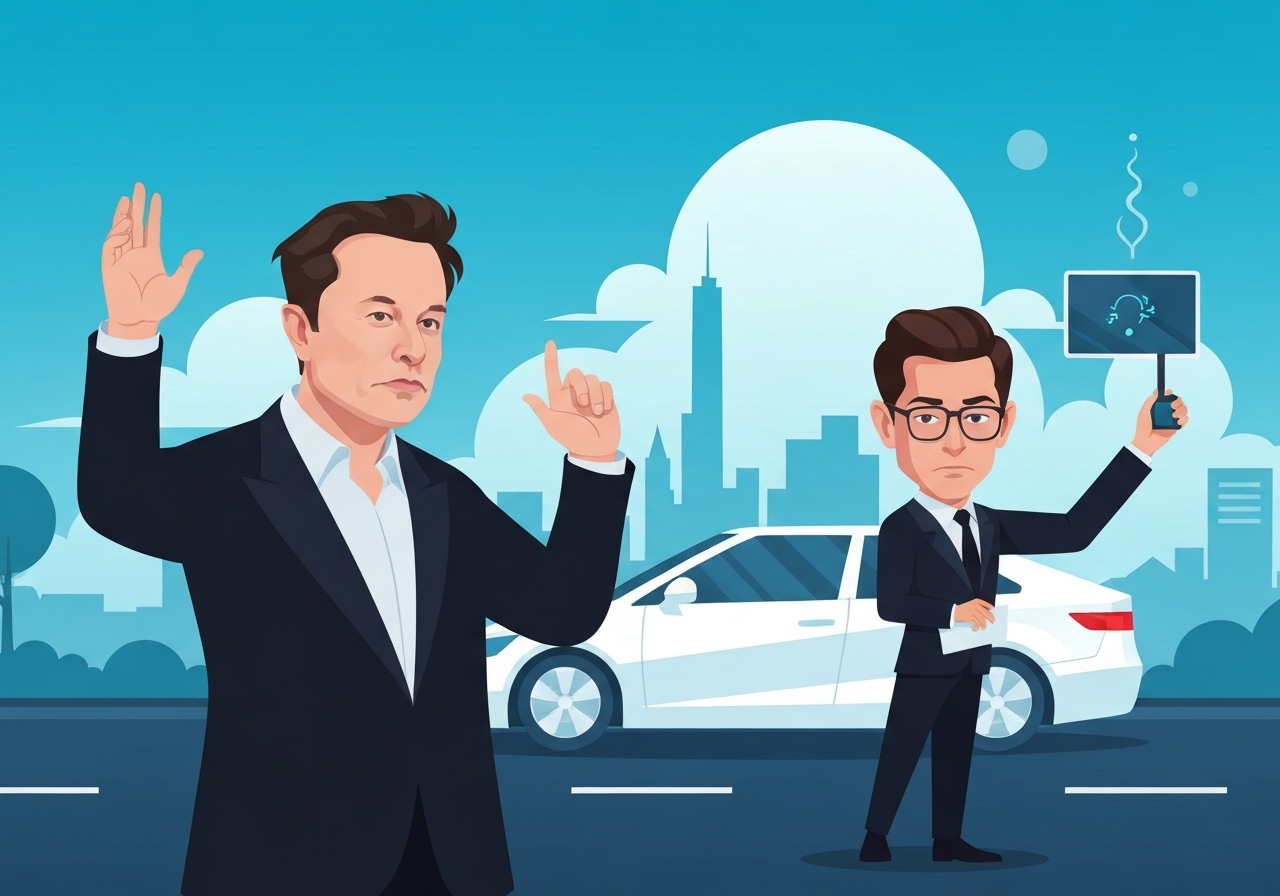
— Elon Musk and Tesla AI Director Ashok Elluswamy posted firsthand accounts and video from Robotaxi trips in Austin that ran without a safety monitor or occupant in the driver’s seat. Musk said the car drove him around Austin with “perfect driving,” while Elluswamy shared a two‑minute back‑seat video calling the ride “an amazing experience.” The posts follow multiple public sightings of unmanned Teslas and underline Tesla’s push toward unsupervised Robotaxi operation.
Key Takeaways
- Elon Musk and Ashok Elluswamy publicly disclosed unmanned Robotaxi runs in Austin on December 24–25, 2025, with Musk riding as a passenger.
- Elluswamy posted a two‑minute rear‑seat video showing empty front seats and smooth handling through live traffic.
- Musk previously estimated at an xAI Hackathon and company events that unsupervised Robotaxi operation in Austin could commence within about three weeks.
- Witness videos of unmanned Teslas on public roads had circulated on social platforms before the executives’ disclosures.
- Tesla launched its Robotaxi service earlier in 2025 and is now testing removal of in‑car safety monitors as it advances autonomy.
Background
Tesla introduced its Robotaxi service earlier in 2025 and has been iterating its Full Self‑Driving (FSD) and fleet learning systems through public deployments and fleet data. The company has prioritized a vision‑only approach, relying on cameras and neural net updates delivered over the air rather than lidar. That strategy has been controversial among regulators and industry peers but has produced rapid feature rollouts and frequent software revisions.
Through 2025 Tesla combined broad public beta tests with targeted demonstrations. Management statements at investor events and public forums set aggressive timelines for unsupervised operation, framing Robotaxi as a commercially material product. Stakeholders include Tesla riders, local regulators in cities such as Austin, insurance underwriters, and competing AV developers watching safety and liability precedents closely.
Main Event
On December 24–25, 2025, Musk and Elluswamy posted separate social updates describing Robotaxi drives in Austin that did not include a safety monitor in the driver’s seat. Musk wrote that a car with no safety monitor drove him around Austin while he sat in the passenger seat, describing the driving as flawless. Elluswamy followed with a two‑minute video filmed from the back seat showing the vehicle negotiating real traffic with empty front seats visible.
The executives’ disclosures came after several independent social posts showed Teslas operating without occupants in the front seats in Austin and other locations. Musk has publicly said tests involving no onboard safety monitor are underway; his comments at an xAI Hackathon and other events set expectations that unsupervised Robotaxis would appear in Austin within weeks of those remarks.
Tesla engineers and product leads have framed the recent activity as part of staged operational testing rather than a full commercial rollout. Company comments and videos emphasize controlled test parameters: defined geofenced areas, telemetry collection, and on‑call engineering oversight even when no safety monitor is physically present in the vehicle.
Analysis & Implications
Tesla’s move toward removing in‑car safety monitors is a major operational shift. If unsupervised Robotaxis scale safely, Tesla could reduce per‑ride labor costs and expand service capacity rapidly. That would alter urban mobility economics and put pressure on both traditional ride‑hailing firms and other autonomous vehicle developers to accelerate deployment timelines or differentiate on safety and regulatory compliance.
Regulatory and legal risk rises as well. Operating vehicles without a human safety monitor on public roads invites scrutiny from state and federal regulators, insurance providers, and city officials. Any incident involving an unmanned Robotaxi would likely prompt immediate investigations and could slow deployments or force stricter operating constraints.
Technically, Tesla’s reported progress highlights the strengths and limits of a vision‑only approach: continual neural‑net training from fleet data can improve behavior quickly in familiar environments, but edge cases—construction zones, rare object types, or unusual weather—remain the main challenge. Scaling beyond a single city will require demonstrable robustness across many rare scenarios.
Comparison & Data
| Milestone | Date | Notes |
|---|---|---|
| Robotaxi service launch | 2025 (earlier) | Initial commercial availability in limited areas |
| Public unmanned sightings | December 2025 | Multiple social videos reported, including Austin |
| Executive unmanned tests | Dec 24–25, 2025 | Musk passenger ride; Elluswamy rear-seat video |
| Management timing estimate | Late Dec 2025 | Musk: unsupervised in Austin in ~3 weeks (announced earlier) |
The table summarizes public milestones and executive statements. While fleet learning can rapidly reduce certain error classes, independent oversight and third‑party validation remain limited in public disclosures so far.
Reactions & Quotes
Official and expert reactions span cautious optimism to demand for regulatory clarity. Below are representative comments and the context in which they were made.
“A Tesla with no safety monitor in the car and me sitting in the passenger seat took me all around Austin on Sunday with perfect driving.”
Elon Musk — social post, Dec 24, 2025
Musk’s short post signaled confidence in the system’s performance while underscoring that he was present in the vehicle as an observer rather than a monitor.
“It’s an amazing experience!”
Ashok Elluswamy — video caption, Dec 24–25, 2025
Elluswamy’s video provides visual evidence of empty front seats and apparently smooth navigation; the clip does not, however, reveal behind‑the‑scenes telemetry or intervention records.
“Unsupervised is pretty much solved at this point.”
Elon Musk — public remarks at xAI Hackathon, Dec 2025
That earlier remark set expectations for near‑term unsupervised testing but is a managerial assessment rather than an independent safety certification.
Unconfirmed
- Precise test protocols, geofenced boundaries, and remote‑operator support levels for the disclosed unmanned runs have not been publicly released.
- No independent, third‑party safety audit or regulator statement confirming readiness for widespread unsupervised operation in Austin has been published.
- Public video evidence does not reveal whether the vehicles experienced unreported interventions, soft faults, or near‑miss events during the demonstrated trips.
Bottom Line
Tesla’s executive posts and accompanying social videos indicate meaningful progress toward running Robotaxis without in‑car safety monitors in Austin. The disclosures align with management’s recent timeline estimates and show the company is actively testing unsupervised operation beyond staged demonstrations.
However, social posts and short videos are not substitutes for formal safety validation. Regulators, insurers, and independent testers will be watching closely; any serious incident involving an unmanned vehicle would likely trigger rapid policy and enforcement responses that could affect deployment speed and operating models.