
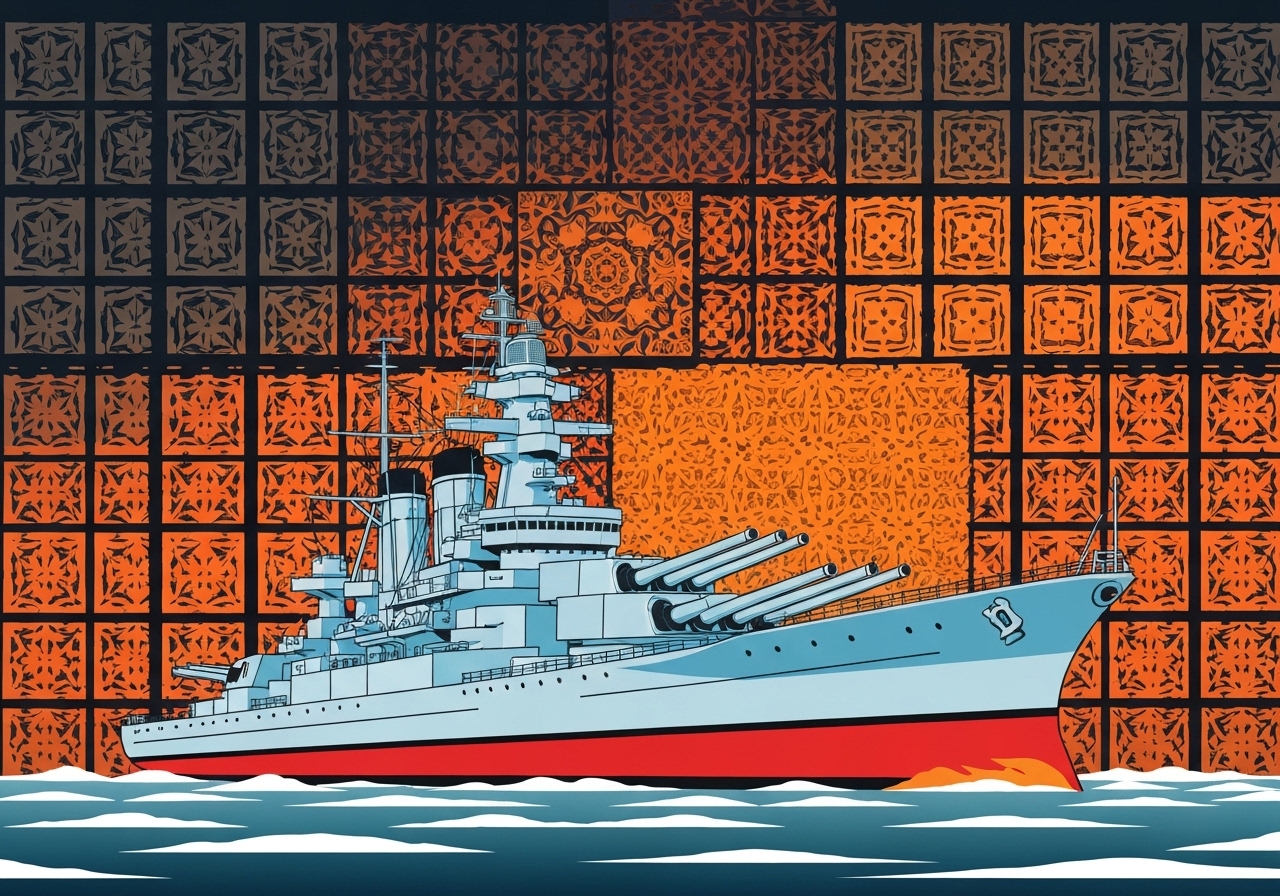
Lead: On December 22, 2025 at Mar-a-Lago in Palm Beach, Florida, President Donald Trump announced a plan for a new so-called Trump-class battleship, hailing it as vastly more powerful and faster than any previous battleship. The administration described the vessel as part of a new Golden Fleet and said it would carry guns, missiles, railguns, lasers and even nuclear and hypersonic weapons. Defense analysts quickly pushed back, calling the concept strategically outdated and financially unrealistic given modern naval doctrine and recent procurement setbacks. The core dispute is whether a few very large surface combatants would strengthen U.S. maritime power or undermine the Navy’s shift toward distributed, resilient forces.
Key Takeaways
- Announcement date and place: December 22, 2025, Mar-a-Lago, Palm Beach, Florida; described as a new Trump-class within a Golden Fleet program.
- Presidential claim: described as the fastest, biggest, and 100 times more powerful than any battleship ever built, intended to project lethal surface firepower worldwide.
- Proposed size and armament: administration materials cite a displacement in excess of 35,000 tons, a length over 840 feet, and systems including conventional guns, missiles, electronic railguns, directed-energy weapons, and capacity for nuclear and hypersonic missiles.
- Historical context: U.S. battleship construction ended more than 80 years ago; the last U.S. battleships were retired nearly 30 years ago and last saw combat in 1991.
- Expert skepticism: CSIS senior adviser Mark Cancian wrote on December 23 that the program is unlikely to proceed because of time, cost, and mismatch with distributed operations.
- Cost signals: with current destroyer hulls at roughly 2.7 billion USD each, analysts estimate a Trump-class hull could cost two to three times that, implying single-ship procurement costs upward of 8 billion USD before lifecycle costs.
- Program risk examples: Zumwalt-class destroyer procurement fell from 32 to three hulls due to cost overruns; recent frigate designs have faced cancellations and workforce problems.
Background
Battleships once dominated naval thinking through the first half of the 20th century because their heavy guns and armor could decide sea battles. The U.S. Navy built its last battleship, the Iowa-class, during World War II; the class saw limited action in later decades and was retired permanently by the mid 1990s. Since then, aircraft carriers, submarines and missile-armed surface combatants have been the principal instruments of naval power, while air power and stand-off precision strike have reduced the battlefield role for heavily armored gunships.
From the Cold War through the present, American naval strategy has shifted toward distributed lethality and networked platforms that can present dispersed, redundant firepower and resilience against anti-access threats. That doctrine informed recent procurement choices, including smaller numbers of high-end ships optimized for networked missile warfare and the cancellation or truncation of programs that proved too costly or inflexible. Political leaders periodically revive analogies to past icons of sea power, but building very large, concentrated platforms carries different operational and budgetary trade-offs today.
Main Event
The administration unveiled the Trump-class concept as part of a Golden Fleet initiative, with public statements promising dramatic performance gains and formidable weapon suites. Officials and supporters emphasized deterrence and symbolic power, presenting the ships as visible proof of American maritime dominance. The plan included descriptions of advanced systems such as electronic railguns and laser point defenses alongside traditional missiles and guns, and even flagged potential carriage of nuclear and hypersonic strike options.
Defense specialists responded almost immediately. Mark Cancian at the Center for Strategic and International Studies argued that the program would be prohibitively expensive and slow to field, and that it would run counter to the Navy’s distributed operations model which favors many smaller, networked units over a few large assets. Bernard Loo of RSIS described the proposal as primarily a prestige project, comparing the attraction of super-sized warships to the historic Yamato and Musashi, which proved vulnerable to carrier aviation.
Other analysts noted historical precedents where symbolic or politically driven naval investments produced limited operational returns. Bryan Clark of the Hudson Institute pointed out how four World War II battleships were briefly recommissioned in the 1980s during a fleet-expansion era, but that reprise required large budgets and specific strategic conditions. The most recent combat employment of U.S. battleship firepower was in 1991, when Iowa-class hulls provided shore bombardment and missile fires during the first Gulf War.
Analysis & Implications
From a technical and operational perspective, a very large surface combatant carrying mixed conventional, nuclear and novel directed-energy systems would be complex to design, integrate and test. Advanced weapons such as electromagnetic railguns and high-energy lasers remain developmental and require significant power generation, cooling and materials solutions that have not yet matured for sustained, shipboard operational use. Integrating hypersonic weapons and survivable nuclear delivery options would add further certification, legal and command-and-control complexity.
Strategically, concentrating high-end capability in a small number of large hulls raises vulnerability concerns. Modern anti-ship systems, long-range precision fires and networked targeting increase the risk that a flagship asset could be targeted from great distances. Analysts emphasize that distributed architectures, including missile-armed frigates, unmanned vessels, submarines and air/missile defenses, can create redundancy and complicate an adversary’s targeting calculus in ways that a few very expensive ships cannot.
Budgetary constraints are likely the decisive factor. Recent U.S. surface combatant programs have demonstrated how cost growth, industrial limits and workforce shortages yield smaller fleets than intended. If an individual Trump-class hull approaches or exceeds 8 billion USD to build, the Navy must weigh whether that investment buys more combat power than a package of many less costly, networked platforms. Lifetime crewing, maintenance, modernization and depot support could further multiply the fiscal burden.
Comparison & Data
| Class | Displacement (tons) | Length (feet) | Typical procurement cost |
|---|---|---|---|
| Iowa-class (historic) | ~45,000 | ~887 | Historic program; not comparable in modern dollars |
| Zumwalt-class | ~15,000 | ~610 | Program led to 3 hulls after costs rose dramatically |
| Arleigh Burke (DDG) | ~9,000 | ~510 | Approximately 2.7 billion USD per ship |
| Proposed Trump-class | >35,000 (announced) | >840 (announced) | Analyst estimate: 2–3x modern destroyer cost, potentially 8+ billion USD per hull |
The table shows how the proposed displacement and length would place the new design between historic battleships and the largest present-day surface combatants, but modern mission sets, survivability needs and cost per hull differ significantly. Historical analogies are informative for scale, yet they do not reflect contemporary sensor, missile and electronic-warfare environments that shape today’s ship design priorities.
Reactions & Quotes
This ship will never sail.
Mark Cancian, Center for Strategic and International Studies (commentary, Dec 23, 2025)
Cancian framed the program as unlikely to survive budget scrutiny or strategic review in subsequent administrations, arguing that program timelines and costs would doom the effort.
A prestige project more than anything else.
Bernard Loo, S. Rajaratnam School of International Studies
Loo emphasized the symbolic appeal of very large ships and warned that their size can make them attractive targets rather than decisive combat assets.
Size matters in perception, but not always in modern combat effectiveness.
Bryan Clark, Hudson Institute
Clark urged focus on the weapons, sensors and networking a ship carries rather than the label assigned to it, noting that capability mix determines operational value.
Unconfirmed
- Exact combat payloads and operational employment: government materials assert nuclear and hypersonic carriage but have not published verified engineering or concept-of-operations documents for these capabilities.
- Feasibility of shipboard railgun and laser systems at scale: technical readiness levels for sustained, combat-grade shipboard use are not publicly confirmed.
- Precise program cost and schedule: public estimates vary and no official procurement budget or timeline has been released for full-rate production.
- Long-term political durability: whether a future administration would cancel, scale, or redirect the program remains speculative.
Bottom Line
The Trump-class announcement foregrounds a recurring tension in defense procurement between legacy symbolism and contemporary operational realities. While a handful of very large, heavily armed ships would make a visual statement, analysts argue the approach diverges from a defense posture that prizes distributed, networked and resilient capabilities against today’s long-range threats. Technical obstacles around novel weapons and the prospect of multi-billion-dollar unit costs reinforce skepticism among defense planners and budget officials.
Ultimately, the program’s future will turn on hard trade-offs: whether political appetite and funding will sustain an expensive, long-duration development effort, and whether the resultant platforms would deliver more combat value than alternative investments in numbers, networking and survivability. For now, experts advise treating the announcement as a conceptual political signal rather than a validated, executable shipbuilding program.
Sources
- CNBC — news report summarizing announcement and expert reactions (journalism)
- Center for Strategic and International Studies (CSIS) — think tank commentary by Mark Cancian referenced in public commentary (think tank)
- S. Rajaratnam School of International Studies (RSIS) — expert analysis and commentary by Bernard Loo (academic/think tank)
- Hudson Institute — expert perspectives on naval strategy and force structure (think tank)
- U.S. Navy — official site for program statements and force-structure context (official)