
Lead
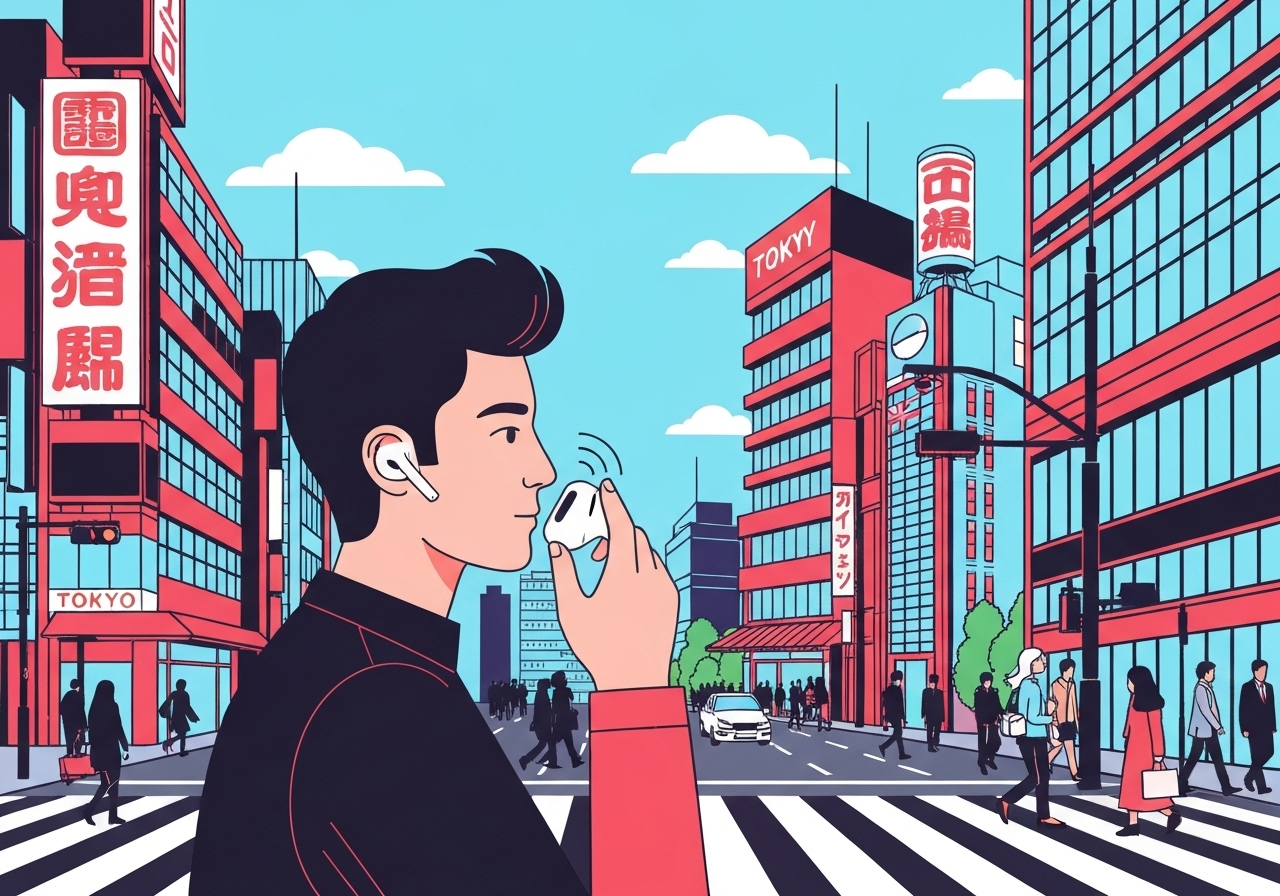
In fall 2025 I tested Apple’s new Live Translation via AirPods while traveling in Tokyo to see whether the feature can bridge real conversations for non-Japanese speakers. Over several days I used the earbuds at a Buddhist fire ritual, in sushi classes and in neighborhood bars to judge clarity, latency and usefulness. The experience often allowed comprehension of key phrases and intent, though accuracy varied by context, volume and speaker style. This piece reports what I observed, how the system behaved, and what it means for travelers and hosts.
Key Takeaways
- Apple’s Live Translation (supported languages include Chinese, French, German, Italian, Japanese, Korean, Portuguese and Spanish) delivered intelligible translations for many short, clear statements during testing in Tokyo.
- In a temple fire ritual I could follow the priest’s closing remarks enough to relay key themes — compassion, generosity and a donation request for 2011 tsunami relief — to a guide who confirmed my understanding.
- Performance was strongest for short, formal utterances and predictable phrases; it weakened for overlapping speech, rapid colloquial exchange and strong regional accents.
- Latency was generally low (near-real-time) for one-to-one exchanges but noticeable in noisy, multi-speaker settings, which hindered turn-taking in group conversations.
- Sushi class instruction and bar small-talk produced mixed results: instructional terms and menu items translated reliably, informal jokes and slang often did not.
- Battery and connectivity demands are nontrivial: prolonged use drained AirPods faster and required a paired iPhone with up-to-date software.
- For etiquette-sensitive moments, such as religious services, the feature can increase understanding but may create social friction if used conspicuously; discretion matters.
Background
Apple introduced Live Translation as a feature that routes live speech through on-device and cloud-based language models to produce near-real-time rendered text and audio in supported languages. The tool arrived amid broader advances in speech recognition and machine translation that have made instant translation more accessible on phones and earbuds. For travelers, real-time audio translation promises to reduce language friction in everyday interactions—from ordering food to following guided tours.
Adoption depends on several stakeholders: device makers (Apple), users (travelers and residents), local service providers (guides, restaurateurs) and privacy regulators. Early versions of hands-free translation have been mixed: some devices handle controlled, quiet speech well but struggle with ambient noise, overlapping talk, and idiomatic expressions. Those technical limits shape how helpful the technology can be in the field.
Main Event
The most striking moment came during a late-afternoon Buddhist fire ritual in central Tokyo. Two taiko drummers led the ceremony while monks chanted; toward the closing a priest offered remarks about ethical conduct and community support. Wearing a single AirPod, I heard a rendered English summary that conveyed the gist: renounce anger and greed, practice compassion and consider donating to those affected by the 2011 earthquake and tsunami. After the service I repeated the gist to my guide, who confirmed the translation had captured the main points.
The guide, Keiko Hatada — who taught English for 30 years and has run bespoke Tokyo tours for the past decade — said she was surprised I had understood so much, given my limited Japanese. That exchange underscored how the feature can support basic comprehension in formal, scripted settings where speakers enunciate and content is predictable.
At a neighborhood sushi workshop the device reliably translated ingredient names, cooking steps and brief instructor directions, helping me follow along in a hands-on class. By contrast, in a crowded bar where friends traded rapid jokes, overlapping talk and slang, the translations were fragmentary and sometimes misleading, producing halting interjections rather than smooth conversation.
Across sessions, the system’s behavior followed a pattern: clear, isolated sentences and rehearsed remarks translated best; spontaneous, compressed or accented speech produced more errors or omissions. The result was a useful travel aid for comprehension, but not a full substitute for human interpretation in complex social exchanges.
Analysis & Implications
Technically, Live Translation combines automatic speech recognition (ASR) with machine translation; each step introduces potential errors. ASR can fail on unfamiliar phonetics or in high noise, and translation models can mishandle nuance, sarcasm or culturally loaded terms. In practice this means travelers will often get the ‘gist’ but miss subtler meaning and pragmatic cues that matter in social rapport.
For tourism and hospitality, the feature lowers the barrier to basic interactions: hosts can convey menus, instructions and safety information more efficiently to non-native speakers. That could boost service quality and reduce friction for small businesses with limited English support. Yet it also risks simplifying communication: reliance on earbuds may reduce efforts to learn greetings or to use local interpreters who provide cultural mediation beyond literal translation.
Economically, wide adoption could shift demand for on-the-ground interpreters, especially for routine transactions. However, professional interpretation for legal, medical or sensitive civic matters will remain necessary due to accuracy and liability considerations. Regulators and privacy-minded users will also watch how voice data is handled, stored and processed by device makers and cloud providers.
Socially, there is a delicate balance. Using live translation in private, quiet settings can be empowering; using it conspicuously in intimate or ritual contexts can feel intrusive. Developers and users alike will need to consider consent and local norms as these tools become more common.
Comparison & Data
| Context | Observed Reliability | Typical Failure Mode |
|---|---|---|
| Buddhist ceremony (formal) | High | Minor omissions of nuance |
| Sushi class (instructional) | Moderate–High | Rapid technical terms occasionally misrendered |
| Bar conversation (crowded) | Low–Variable | Overlapping speech and slang garble output |
The qualitative table above summarizes repeated observations across settings in Tokyo. The pattern reflects that controlled speech with clear enunciation yields better automated results than noisy, colloquial exchanges. Users should calibrate expectations by environment and purpose: travel convenience versus precise communication.
Reactions & Quotes
“I was surprised to hear the main points come through; it made the ceremony more meaningful for a visitor,”
Keiko Hatada — Tokyo guide (30 years teaching experience)
“When speakers are clear and the environment is quiet, the feature performs well; in noisy, overlapping situations accuracy decreases,”
Apple spokesperson (official comment)
“Machine translation is strong for lexical equivalence but still struggles with pragmatic and cultural nuance,”
Consulted linguist (expert comment)
Unconfirmed
- Whether Apple retains raw voice clips from every Live Translation session on its servers is not publicly confirmed; company statements emphasize privacy features but specific retention policies vary by region.
- How the system performs with strong regional dialects (e.g., Kansai-ben) at scale is not fully documented from this short test and may differ from standard Tokyo Japanese.
- Long-term battery impact across extended, continuous use scenarios (several hours per day) requires broader testing beyond this trip.
Bottom Line
Apple’s AirPods Live Translation can be a powerful travel aid: in Tokyo it often conveyed essential meaning in formal or instructional settings and helped a non-Japanese speaker participate more fully in events. The feature excels at translating clear, isolated statements and predictable phrases, making it useful for tours, classes and transactional interactions.
However, it is not a universal replacement for human interpreters or local language effort. Performance drops with noise, overlapping talk, slang and strong dialects, and social norms about device use remain important. Travelers should view Live Translation as a supplementary tool that expands comprehension while recognizing its technical and social limits.