
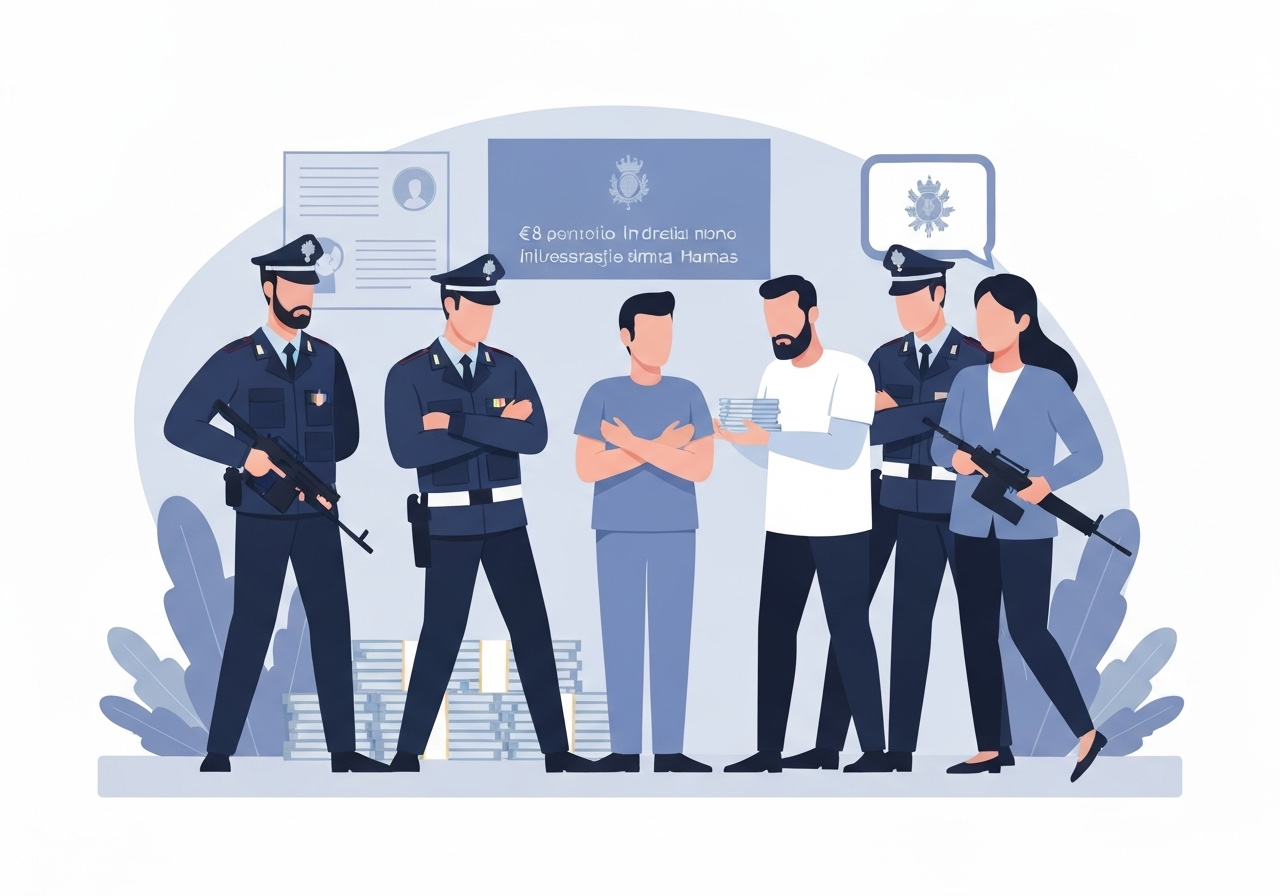
Italian authorities in late December 2025 arrested nine people and seized more than €8 million in assets in an inquiry prosecutors say targeted a network that raised at least €7.3 million for Hamas. The operation, coordinated by Genoa’s District Anti‑Mafia and Anti‑Terrorism Directorate and executed by the police and the Guardia di Finanza, followed an investigation that began before the 7 October 2023 Hamas‑led attack on southern Israel. Officials said the probe identified three Italian associations based in Genoa and Milan that routed donations overseas; prosecutors allege most of the money was sent to organisations Israeli authorities regard as linked to Hamas. The arrests and seizures were announced publicly on 27–28 December 2025 as authorities moved to freeze suspected illicit financing channels.
- Nine arrest warrants were issued; seven were executed in Italy and two suspects are believed to be abroad (Turkey and Gaza), according to Genoa prosecutors.
- Investigators seized more than €8 million in assets and say the charities under scrutiny raised at least €7.3 million for Gaza‑area entities.
- Prosecutors allege over 71% of donations collected by the main charity, ABSPP, and related associations went to groups or persons Israeli authorities associate with Hamas.
- Three Italian associations are named in the case: ABSPP (1994), a second ABSPP entity (2003) and La Cupola d’Oro (December 2023, Milan).
- Authorities used phone intercepts, financial monitoring and cross‑border cooperation, including contacts with the Netherlands and other European partners, to build the case.
- Prosecutors claim the transfers reached organisations in Gaza, the West Bank or Israel that Israeli authorities have declared illegal, and in some instances directly to named Hamas figures.
- The U.S. Treasury designated Mohammad Hannoun and ABSPP as terrorist financiers in 2023; Genoa prosecutors say Hannoun, 63, led the Italian cell and posed a flight risk.
Background
The probe grew from long‑running scrutiny of charitable transfers to Gaza and the West Bank and intensified after high‑profile security events in the region, including the 7 October 2023 Hamas‑led attack on southern Israel. Prosecutors say the investigation predates that attack but that subsequent developments sharpened focus on informal donor networks and cross‑border intermediaries that can be used to move funds outside normal banking channels. Banks including UniCredit, Crédit Agricole and Poste Italiane reportedly closed accounts linked to the primary suspect after receiving alerts from foreign authorities, prompting investigators to trace new associations and alternative routes for transfers.
Civil society organisations, diaspora groups and humanitarian charities operate in a tense regulatory environment where legitimate relief work and illicit diversion can overlap, complicating oversight. In Italy, the Guardia di Finanza handles financial crimes and works with prosecutors on money‑laundering and terrorism‑financing cases; the Genoa anti‑mafia and anti‑terrorism office coordinated this probe. The case also reflects enhanced international information‑sharing: prosecutors cite cooperation with European law‑enforcement partners and formal sanctions or designations from the U.S. Treasury as part of the evidence trail.
Main Event
Police and the Guardia di Finanza executed arrest warrants in late December 2025, detaining seven people in Italy and listing two others as believed to be outside the country. Prosecutors said their investigation identified a “complex network” of transfers that moved donations through three Italian associations and onward via foreign intermediaries to organizations in Gaza, the West Bank or Israel. Court documents allege that some recipients were entities Israeli authorities have declared illegal because of alleged Hamas connections, and that transfers at times reached individuals prosecutors name as linked to Hamas’ infrastructure.
Investigators singled out Mohammad Hannoun, 63, president of the Association of Palestinians in Italy and founder of the Associazione Benefica di Solidarietà con il Popolo Palestinese (ABSPP), as the alleged leader of the Italian cell. In a 306‑page custody order, Judge Silvia Carpanini wrote that Hannoun represented a “concrete and immediate flight risk,” citing intercepted communications and what prosecutors describe as preparations to relocate to Turkey. Prosecutors also refer to a December meeting in Turkey attended by Hannoun and a figure identified in court papers as Ali Baraka, whom investigators describe as a senior Hamas foreign‑operations official.
According to the charging documents cited by prosecutors, more than 71% of donations collected by ABSPP and related organisations were forwarded to entities controlled by or linked to Hamas. Authorities say some transfers were routed through intermediaries in other countries after banks closed accounts associated with Hannoun. Prosecutors assert that money helped support families of people involved in attacks or imprisoned on terrorism charges, which they say reinforced Hamas’ operational resilience—an allegation presented as part of the case rather than an independently adjudicated finding.
Analysis & Implications
The operation underscores growing pressure on cross‑border charitable channels that operate in conflict zones. From a compliance perspective, banks’ account closures and subsequent creation of new associations illustrate a common pattern investigators say helps evade banking controls; regulators will likely scrutinise how financial institutions, charities and regulators balance anti‑money‑laundering rules with the need to facilitate legitimate humanitarian aid. The case could prompt faster adoption of tighter monitoring for transfers to Gaza and the West Bank and greater use of targeted sanctions or designation lists.
Politically, the arrests give the Italian government evidence to show action against alleged terrorism financing; Prime Minister Giorgia Meloni and Interior Minister Matteo Piantedosi publicly welcomed the operation. That reaction may strengthen domestic support for stricter oversight of diaspora organisations, but it also risks straining relations with communities and NGOs that fear overreach or collective stigmatization. Courts will need to weigh investigative evidence against protections for freedom of association and charity law.
Internationally, the probe highlights the role of multilateral intelligence and financial cooperation: prosecutors cite assistance from European partners and earlier U.S. Treasury designations. If courts confirm the allegations, prosecutions could encourage more preemptive information‑sharing among banks and authorities in the EU and beyond. Conversely, contested or poorly substantiated claims could spark legal appeals and diplomatic friction, especially where suspects are believed to be outside Italy.
| Metric | Reported value |
|---|---|
| Assets seized | More than €8.0 million |
| Funds investigators say were raised | At least €7.3 million |
| Share alleged sent to Hamas‑linked entities | About 71% (per prosecutors) |
| Key organisation founding year | ABSPP founded 1994; related ABSPP entity 2003; La Cupola d’Oro established Dec 2023 |
The table summarises the principal figures cited by prosecutors and in court papers. The seized amount exceeds the minimum sum prosecutors say was raised, which may reflect seized reserves, frozen accounts and additional assets identified during searches. The cited 71% figure is drawn from prosecutor calculations presented in charging documents and frames the core allegation that a dominant portion of donations was redirected to recipients their investigation associates with Hamas.
Reactions & Quotes
Officials and defence representatives offered sharply contrasting accounts in the hours after the operation. Government leaders framed the action as evidence of effective law‑enforcement work, while defence counsel emphasised donor intent and disputed interpreting transfers as criminal.
“I express appreciation and satisfaction for the work done by the authorities in this operation.”
Prime Minister Giorgia Meloni (statement)
Meloni’s comment was used by Interior Ministry sources to highlight cross‑agency coordination; the government presented the operation as part of wider efforts to block channels that may finance terrorism. Such statements are political and not evidence of guilt, which will be decided in court.
“This operation lifted the veil on activities that used humanitarian initiatives to conceal support for terrorist organisations.”
Interior Minister Matteo Piantedosi (statement)
Piantedosi’s framing focuses on the alleged deceptive use of charity structures; prosecutors cited intercepted communications and financial flows to support that interpretation. The minister called for continued vigilance across financial institutions and NGOs dealing with conflict‑zone relief.
“The case rests on an interpretation of movements of money; the funds were collected peacefully for humanitarian purposes.”
Fabio Sommovigo, lawyer for Mohammad Hannoun (agency report)
Hannoun’s lawyer told news agencies the donations were for humanitarian ends and questioned reliance on foreign authorities’ readings of complex transfer chains. Defence arguments are likely to challenge attribution of funds and contested interpretations of intercepted communications during pretrial proceedings.
Unconfirmed
- Two suspects are described as “believed to be” in Turkey and Gaza; their precise locations and involvement have not been independently verified in Italian court records available publicly.
- Press reports citing court documents say Hannoun attended a December meeting in Turkey with Ali Baraka, a figure prosecutors identify as a senior Hamas official; independent external confirmation of that meeting is limited in public sources.
- Prosecutors assert funds reached named Hamas members and supported families of attackers; those assertions are central to the charges but remain subject to judicial assessment and potential defence rebuttal.
Bottom Line
The Genoa‑led operation marks a high‑profile test of Italy’s capacity to detect and disrupt alleged terror‑financing channels that use civil‑society structures as conduits. Prosecutors offer specific figures and wire‑trail allegations, while defence counsel stresses humanitarian intent and questions interpretations of the evidence. How Italian courts weigh the intercepted communications, the financial tracing and the role of foreign designations will determine whether the arrests lead to convictions or protracted litigation.
For policymakers and banks, the case will reinforce incentives to tighten monitoring of donations to conflict zones, while raising difficult questions about collateral impacts on legitimate humanitarian work. International cooperation will remain essential for tracing cross‑border flows, but authorities must balance security needs with legal safeguards to avoid undue restriction on lawful aid and association.