
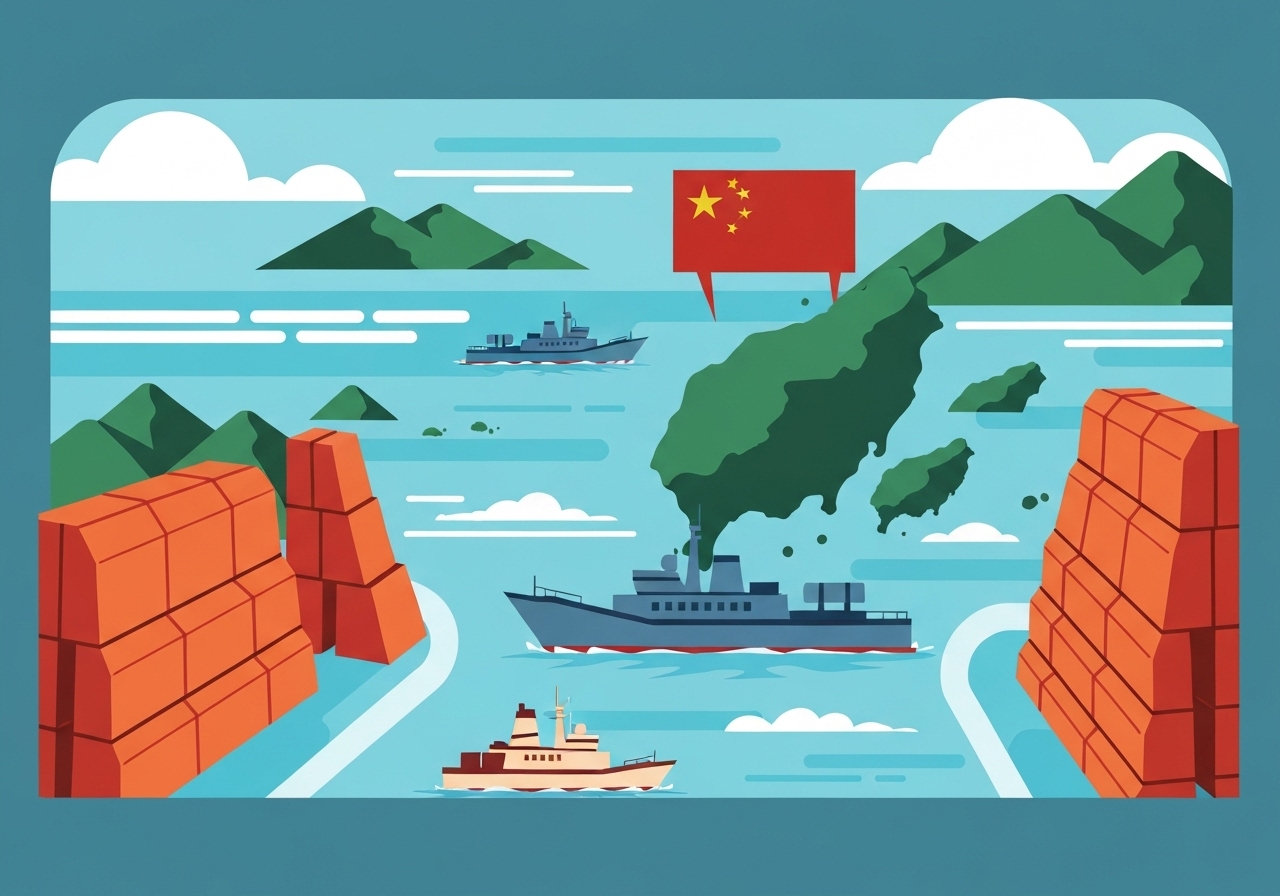
On Tuesday, Dec. 30, 2025, China’s People’s Liberation Army (PLA) continued large-scale drills around Taiwan in a second day of operations that included live-fire exercises, naval maneuvers and airborne patrols. The Eastern Theater Command deployed destroyers, frigates, fighters, bombers and ground-based long-range artillery to waters north and south of the island to practice sea‑air coordination and blockade tactics. Taiwan reported detecting 130 Chinese aircraft, 14 military ships and eight other official vessels between 6 a.m. Monday and 6 a.m. Tuesday, with roughly 90 aircraft crossing the median line; authorities also said a Chinese balloon was spotted. The maneuvers disrupted civil aviation and fishing, heightened cross‑strait tensions and elicited official statements from Beijing, Taipei and regional capitals.
Key Takeaways
- China conducted a second day of drills under the label “Justice Mission 2025,” deploying surface ships, combat aircraft and long‑range artillery near Taiwan.
- Taiwan’s Defense Ministry reported 130 Chinese aircraft, 14 military ships and eight other official vessels in the area between 6 a.m. Monday and 6 a.m. Tuesday.
- About 90 Chinese aircraft crossed the median line of the Taiwan Strait, while live rounds from PLA artillery impacted zones roughly 44 km (24 nautical miles) off Taiwan’s north coast.
- Civil aviation was affected: Taiwan’s airport schedules showed more than 100 international and domestic flights revised, delayed or canceled on Tuesday afternoon.
- Beijing framed the operations as a warning to “Taiwan independence” forces and foreign backers; Taipei warned the drills were destabilizing and disruptive to maritime and air traffic.
- Economic and local impacts were reported: fishing communities halted operations and reported losses after exclusion areas were established.
- U.S.–China and China–Japan tensions were referenced in official statements, and Beijing announced sanctions last week on U.S. defense companies tied to proposed arms sales to Taiwan.
Background
China and Taiwan have been governed separately since 1949, when nationalists retreated to the island after the Chinese civil war. Beijing considers Taiwan part of its territory and has long warned against moves toward formal independence; Taipei maintains a democratically elected government and asserts its de facto autonomy. Cross‑strait interactions routinely include military posturing, diplomatic friction and sensitive visits or arms transfers that raise tensions between Beijing, Taipei and third parties.
In recent years, PLA patrols near Taiwan have become more frequent and complex, with flights and naval transits probing air and maritime boundaries. Beijing’s rhetoric has hardened alongside actions such as targeted sanctions and public comms framing Taiwan’s ruling party as pursuing secession. At the same time, Taipei has sought to strengthen deterrence through arms purchases and international outreach, a dynamic that Beijing often cites as justification for drills.
Main Event
On Dec. 30, the Eastern Theater Command announced coordinated sea, air and missile training it called part of “Justice Mission 2025.” The command said destroyers, frigates, fighters and bombers were mobilized to test joint blockade and sea‑air coordination, while ground forces conducted long‑range live‑fire exercises to the north of Taiwan and simulated joint strikes to the south. Taiwan’s Defense Ministry said its sensors recorded 130 aircraft and multiple naval vessels in the surrounding waters within a 24‑hour window and that coastal missile systems, ships and aircraft were deployed in response.
According to Taiwan, approximately 90 of the Chinese aircraft crossed the informal median line of the Taiwan Strait. The ministry also reported that rounds fired by a PLA long‑range artillery unit in Fujian landed in impact zones about 44 kilometers off Taiwan’s northern coast. A Chinese military balloon was additionally detected, the ministry said, adding an aerial surveillance dimension to the exercises.
Civilian effects were immediate: Taiwan’s Civil Aviation Administration was notified of seven temporary “dangerous zones” across the strait, and airport schedule pages showed over 100 flights with altered times, delays or cancellations on Tuesday afternoon. Fishing communities near Keelung and other ports were advised to stay clear of exercise areas; local leaders described hourly radio bulletins to warn vessels and cited lost income as crews stayed in port.
Analysis & Implications
The drills demonstrate a continuing PLA emphasis on integrated maritime‑air operations and blockade rehearsal. By combining surface ships, combat aircraft and long‑range artillery, the command tested the coordination necessary for interdiction or area denial—activities that could complicate third‑party military access or civilian transits. Rehearsing those capabilities near key air and sea lanes sends a signal about the practical challenges of reinforcing Taiwan in a crisis.
Operationally, the reported scale—130 aircraft and multiple surface units—points to an ability to sustain pressure over days, increasing the logistical and diplomatic costs for Taipei and any external supporters. For Taiwan, routine detection and response strain defense inventories and require constant readiness, while civilian disruption to flights and fishing adds political pressure domestically. For regional states, repeated exercises raise contingency planning and insurance costs for commercial operators.
Politically, Beijing’s framing of the drills as a response to “separatism” and foreign arms sales tightens its narrative linking external support to escalation. That rhetoric complicates diplomatic space: countries considering defense cooperation with Taiwan must weigh possible economic or political retaliation. Conversely, Taipei’s measured public posture—stressing restraint while bolstering defenses—aims to avoid an uncontrolled spiral while preserving international support for its security.
Comparison & Data
| Element | Reported figure | Notes |
|---|---|---|
| Chinese aircraft in 24‑hour window | 130 | Includes fighters and bombers, per Taiwan Defense Ministry |
| Chinese military ships | 14 | Reported as military vessels near strait |
| Other Chinese official ships | 8 | Listed separately by Taiwan authorities |
| Aircraft crossing median line | ~90 | Informal median line breached in multiple sorties |
| Artillery impact distance | 44 km (24 nm) | Impact zones reported off Taiwan’s north coast |
| Flights affected | >100 | International and domestic schedule changes reported |
The figures above come from Taiwan’s official statements and public airport schedules, and they indicate a scale above typical day‑to‑day patrols. The reported crossing of the median line by roughly 90 aircraft is notable because that informal boundary has historically served as a de‑escalatory marker. Flight disruptions and fisheries impacts translate these military measures into measurable economic and social effects.
Reactions & Quotes
Taiwan’s president and defense officials emphasized responsible restraint for Taiwan while condemning Beijing’s actions as destabilizing.
“China has recently escalated military pressure in a frequent manner; this is not conduct expected of a responsible major nation.”
President Lai Ching‑te
President Lai’s statement, posted on social media, appealed for calm at home while urging the international community to note the intensifying military pressure. Taipei emphasized defensive measures including missile batteries, patrol ships and air sorties to monitor the situation.
“The exercises are a stern warning to ‘Taiwan independence’ separatist forces and external forces. We will respond to actions that attempt to sever China’s territorial integrity.”
Chinese Defense Ministry spokesperson Zhang Xiaogang
Zhang’s remarks, carried by state outlets, framed the drills as targeted at both Taipei and unspecified foreign supporters. Chinese official commentary also criticized Taiwan’s ruling party for seeking closer security ties with external powers.
“The Chinese military exercises have prevented fishermen from fishing, which is their livelihood. The inability to fish has had a significant impact and caused economic losses.”
Chen Wen‑chin, Keelung District Fishermen’s Association
Local testimony highlights the immediate human costs of maritime exclusion zones, with hourly radio bulletins and lost income prompting community appeals for clearer notification and support.
Unconfirmed
- Whether the drills were intended to provide a direct rehearsal for a full maritime blockade remains an analyst assessment rather than an explicitly stated PLA objective.
- The operational reach and duration of any follow‑on China deployments beyond the reported 24‑hour window have not been independently verified.
- Reports of the Chinese balloon’s mission and payload remain publicly unconfirmed beyond Taiwan Defense Ministry detection statements.
Bottom Line
The Dec. 30 drills reflect an ongoing pattern in which Beijing pairs hard military maneuvers with political messaging to signal resolve on Taiwan. The combined use of ships, aircraft and long‑range fires demonstrates tactical priorities—area denial, blockade rehearsal and integrated strike coordination—that complicate third‑party support calculations and raise costs for Taipei’s defenders.
For Taiwan, the immediate challenges are operational readiness and mitigating civilian harm from disrupted flights and hindered fishing. For regional and global actors, the episode underscores the fragility of cross‑strait stability and the importance of clear crisis communication channels to reduce the risk of miscalculation.
Sources
- NPR (news outlet reporting AP dispatches)
- Taiwan Ministry of National Defense (official statements)
- Xinhua News Agency (Chinese state media)