
Lead
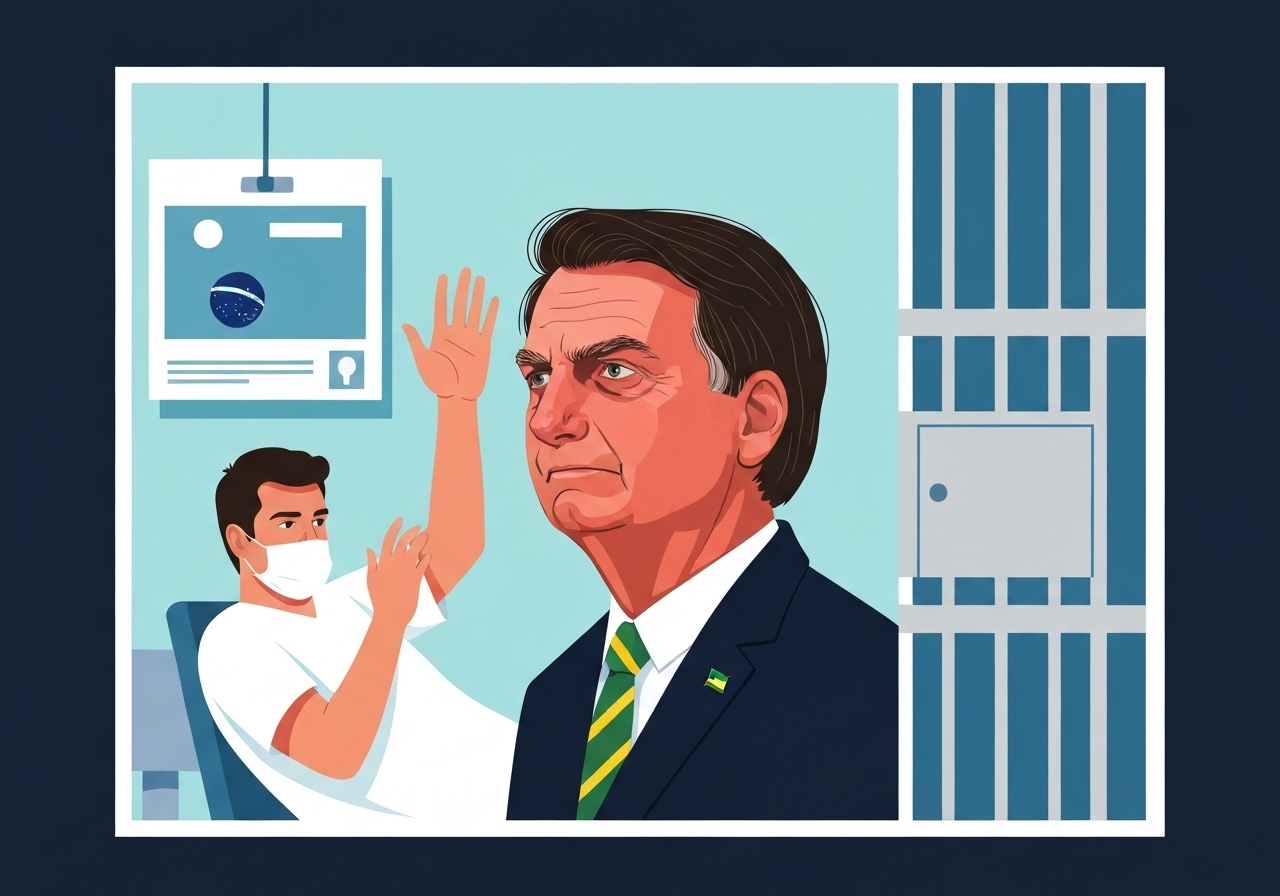
Former Brazilian president Jair Bolsonaro left a Brasilia hospital on Thursday, one week after undergoing a double hernia operation, and was taken by car back to the federal police headquarters where he is serving a 27-year prison term. Hospital DF Star confirmed he was discharged after additional minor procedures following the hernia surgery, which the hospital said was completed without complications. Brazil’s Supreme Court approved his temporary release for the operation but a justice denied a request to transfer him to house arrest when he left the medical facility. Bolsonaro, who governed from 2019 to 2022, remains convicted in cases tied to an attempted post-election coup and other crimes; he denies wrongdoing.
Key Takeaways
- Bolsonaro left Hospital DF Star in Brasilia on Thursday, about seven days after a double hernia surgery.
- He was returned to federal police custody at the Brasilia headquarters where he is serving a 27-year sentence for leading an attempted coup d’etat.
- The hospital reported the hernia operation was completed without complications and that he underwent some minor follow-up procedures before discharge.
- Supreme Court Justice Alexandre de Moraes authorized the medical leave but refused Bolsonaro’s request for house arrest after the hospital release.
- Bolsonaro is kept largely isolated at the federal police facility; his cell measures roughly 130 square feet and includes a bed, private bathroom, air conditioning, television and a desk.
- In December, Bolsonaro named his eldest son, Senator Flavio Bolsonaro, as his party’s presidential candidate for next year, intensifying a political rivalry with President Luiz Inacio Lula da Silva.
- In September, a panel of Supreme Court justices convicted Bolsonaro and several allies of plotting to overthrow democratic institutions, including plans cited by the court to target political leaders and provoke an insurrection in early 2023.
- Bolsonaro has a documented history of medical procedures after a 2018 stabbing at a campaign event and has repeatedly denied the charges against him.
Background
Jair Bolsonaro, president from 2019 until his 2022 electoral defeat, has remained a polarizing figure in Brazilian politics. After losing the 2022 election to Luiz Inacio Lula da Silva, Bolsonaro and a network of allies were investigated for actions following the vote; the inquiry culminated in convictions this past September for attempts to dismantle democratic rule. Those convictions include allegations of organizing armed groups and plotting violence against senior officials, matters that have reshaped Brazil’s post-election legal and political landscape.
Bolsonaro’s health history is relevant public context. He was stabbed in the abdomen during a 2018 campaign rally and has since undergone several medical procedures tied to that wound. The Supreme Court granted temporary release from custody to permit the recent hernia surgery, a mechanism the court has used in other high-profile inmate medical cases, while balancing concerns about security and the rule of law.
Main Event
The former president underwent a double hernia repair about a week before leaving Hospital DF Star, according to hospital statements reported publicly. Hospital officials said the procedure went smoothly and that he received additional minor care before being certified medically fit for discharge. After the hospital release on Thursday, a police vehicle transported Bolsonaro back to the federal police complex in Brasilia where he remains in custody.
At the federal police headquarters Bolsonaro occupies a small, single-occupancy room of roughly 130 square feet. Authorities say he has no contact with the few other inmates there and that the cell includes basic amenities such as air conditioning and a television. The Supreme Court had authorized the short-term medical leave but Justice Alexandre de Moraes denied the request to convert the release into house arrest, citing legal and security considerations.
Bolsonaro has repeatedly disputed the criminal findings against him. His legal team has signaled plans to continue appeals, and political allies have continued to rally in his support. Meanwhile, the decision to return him to custody came amid ongoing political maneuvers, including the selection of his son Flavio as his party’s presidential standard-bearer for the next election cycle.
Analysis & Implications
The medical discharge and return to jail underline a complex intersection of legal process, health care access, and political theater. For the judiciary, allowing temporary medical leave preserves an appearance of due process and humane treatment, while the denial of house arrest reinforces the court’s stance on preventing perceived risks to public order and the integrity of sentencing. This balancing act will be closely watched by both Bolsonaro supporters and opponents as a test of institutional independence.
Politically, Bolsonaro’s brief hospital episode is unlikely to change the legal trajectory but could affect optics on the campaign trail. His party’s nomination of Flavio Bolsonaro in December keeps the Bolsonaro brand prominent in national politics and preserves his influence even while incarcerated. That dynamic may heighten polarization in the run-up to next year’s election and could complicate alliances among right-leaning factions.
Internationally, the handling of a former head of state convicted for anti-democratic actions draws scrutiny about Brazil’s democratic resilience. Domestic and foreign observers will monitor whether security protocols, legal procedures and medical accommodations are being applied consistently and transparently. Any perception of preferential treatment or arbitrary restriction could have reputational and diplomatic effects.
Comparison & Data
| Item | Detail |
|---|---|
| Prison term | 27 years (federal convictions) |
| Recent surgery | Double hernia operation, completed without complications |
| Room size | Approximately 130 square feet, private bathroom and basic amenities |
| Post-2022 legal outcome | Convicted in September for plotting to overthrow democratic order |
The table summarizes the principal factual metrics reported about Bolsonaro’s custody, health intervention and convictions. Contextually, a 27-year federal sentence places Bolsonaro among those facing long-term incarceration for crimes against the state, while the institutional choice to allow a brief medical leave parallels practices used in other high-profile cases to balance treatment needs with custody obligations.
Reactions & Quotes
The following statements capture official and personal responses reported after the hospital discharge.
there is a Brazil of good people which loves you and prays for you. We will beat the bad days
Michelle Bolsonaro, former first lady via social media
the surgery was completed without complications and he underwent minor additional procedures before discharge
Hospital DF Star, medical statement reported by media
Unconfirmed
- Any private medical details beyond the hospital’s public statement, including long-term prognosis, remain confidential and unverified.
- Claims about special privileges or security arrangements inside the federal police facility beyond basic amenities reported are not independently confirmed.
- Alleged direct communications between Bolsonaro and external operatives while in custody have not been substantiated in public records.
Bottom Line
Bolsonaro’s return to custody after a medically authorized hospital stay highlights the judiciary’s effort to reconcile inmate health needs with enforcement of a lengthy sentence tied to efforts to subvert Brazil’s democratic system. The Supreme Court’s refusal to permit house arrest signals a firm judicial posture toward high-impact political crimes and sets a precedent for handling similar requests going forward.
For Brazilian politics, the episode keeps Bolsonaro at the center of public attention while he remains physically absent from the campaign trail. Observers should watch legal appeals, security protocols around his detention, and the political performance of his appointed successor as potential barometers of how this case will influence Brazil’s democratic institutions and electoral dynamics in the months ahead.