
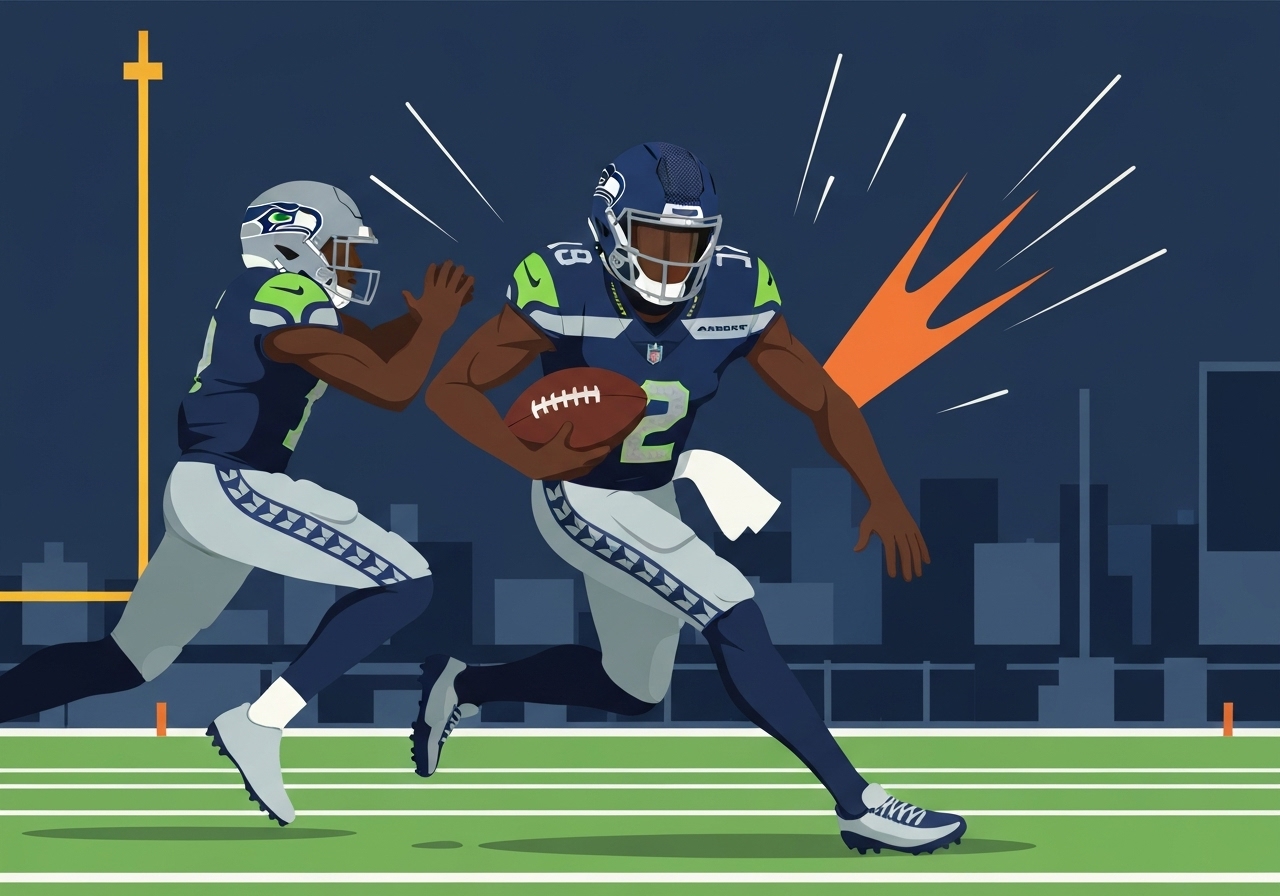
In the Week 18 regular-season finale at Levi’s Stadium in Santa Clara on Saturday night, the Seattle Seahawks built an early lead over the San Francisco 49ers in a high-stakes NFC West showdown. Seattle opened with a drive that stalled at the 1-yard line, then struck on a 27-yard rushing touchdown by Zach Charbonnet to go up 7-0. Jason Myers missed a 47-yard attempt but later converted a 45-yard field goal; San Francisco responded with a 48-yard Eddy Piñeiro field goal before halftime. As of late in the third quarter the Seahawks led 10-3, with Seattle’s run game and defense controlling much of the game.
Key takeaways
- Score/setting: Seahawks lead 10-3 late in the third quarter at Levi’s Stadium; the game decides the NFC West champion and the NFC’s No. 1 seed.
- Early drives: Seattle’s opening drive reached the 1-yard line but ended with a turnover on downs; the second possession produced Zach Charbonnet’s 27-yard TD.
- Rushing dominance: Seattle held a 115-23 advantage in rushing yards through the first half and led about 196-69 in total yards at halftime.
- Third-down battle: San Francisco entered the week leading the NFL in third-down conversions (51%); through the first half they were 0-for-3 against a Seattle defense that ranks among the league leaders in stopping third downs.
- Kicker milestones: Jason Myers missed a 47-yard attempt (his first miss since Nov. 16) but later made a 45-yarder and sits among kickers with 40+ field goals in a season.
- Injuries/lineup: Seahawks LT Josh Jones, listed questionable, played and later went to the tent after a right-leg roll-up; 49ers LT Trent Williams was inactive, replaced by Austen Pleasants.
- Playoff consequences: Winner earns the NFC West title and No. 1 seed with a first-round bye; the loser would drop to the 5-seed and travel for a wild-card game next weekend.
Background
This Week 18 matchup on Saturday, Jan. 4, 2026, carried outsized importance: the winner would claim the NFC West crown and the conference’s No. 1 seed, earning a bye into the divisional round. Both franchises entered the game with playoff berths already secured, but seeding and home-field advantages were still at stake. Seattle sought its first division title since 2020 and the franchise’s fourth No. 1 seed historically; San Francisco aimed to protect home-field hopes and the advantage of higher seeding for its postseason push.
The game also featured roster storylines that shaped expectations. San Francisco was missing veteran left tackle Trent Williams (hamstring), a significant absence for an offensive line that had been tested by injuries. Seattle countered with Josh Jones stepping in at left tackle after Charles Cross was ruled out with a hamstring injury; Jones’s availability was monitored closely during pregame warmups. Coaches and media framed the matchup as a classic clash of Seattle’s revitalized running game and defensive front against San Francisco’s high-powered offense led by Brock Purdy and Christian McCaffrey.
Main event
The Seahawks received the ball to begin the game after the 49ers won the toss and deferred. Seattle’s first drive reached the 1-yard line following a pass-interference call but stalled when Sam Darnold was sacked and the Seahawks declined to kick on fourth-and-goal, turning it over on downs from the 4. The decision set up a dramatic sequence: two plays later, Seattle forced a three-and-out, gained excellent field position and turned it into a three-play touchdown drive.
Zach Charbonnet finished that sequence with a 27-yard rushing touchdown to give Seattle a 7-0 lead with 4:29 left in the first quarter. Seattle continued to run effectively, and the first half statistics reflected the physical nature of their attack: a dominant advantage on the ground and a higher yards-per-play mark. Jason Myers had a rare miss from 47 yards early in the second quarter but rebounded with a 45-yard field goal to stretch the lead to 10-0.
San Francisco finally put points on the board with Eddy Piñeiro’s 48-yard field goal just before halftime, cutting the deficit to 10-3. Through the first half the 49ers struggled to generate chunk plays: Christian McCaffrey had only nine touches and 38 scrimmage yards through two quarters and part of the third, well below his recent production. Seattle’s defense continued to apply pressure in the second half: Jarran Reed recorded a sack on Brock Purdy and the 49ers repeatedly faced short-yardage and third-down challenges.
Injury developments included Josh Jones being rolled up on mid-third-quarter play after pre-existing ankle and knee issues; he walked to the medical tent but was replaced on the line by Amari Kight, a recent elevation from the practice squad. For San Francisco, Austen Pleasants continued to fill in at left tackle for the inactive Trent Williams, a substitution with clear matchup implications for the game’s tempo and pass-protection battles.
Analysis & implications
At this stage, Seattle’s approach — leaning on the run and winning the line of scrimmage — has been effective both to control the clock and to blunt San Francisco’s offensive rhythm. The Seahawks’ ground attack (115 first-half rushing yards) not only produced the game’s first touchdown but also set up manageable third-down situations, improving long-term offensive efficiency for the team. If Seattle sustains that identity into the fourth quarter, it will limit Brock Purdy’s possessions and the 49ers’ ability to mount a comeback.
Defensively, Seattle’s game plan to take away big plays has paid dividends: San Francisco entered the week as the league leader in third-down conversions, yet the 49ers were held without a third-down conversion in several early series. Winning that matchup mitigates San Francisco’s playmaking weapons and forces longer drives, which increases the Seahawks’ opportunities to win the time-of-possession battle. The performance to this point suggests Seattle’s defensive front and corner rotation have found the right mix to handle Green Bay-style pressure on intermediate routes.
For the 49ers, the absence of Trent Williams and a limited Christian McCaffrey workload indicate two layers of stress: protection issues that affect the pocket for Purdy and a diminished ground complement that usually opens the play-action passing game. San Francisco will need to adjust play calling to create quick passes and take advantage of mismatches in space if they hope to overcome Seattle’s front. Conversely, a Seattle inability to convert red-zone opportunities — the opening-drive turnover on downs is a cautionary example — could leave points off the board and invite a late comeback.
Playoff ramifications remain straightforward but consequential. The winner secures the NFC West title and a first-round bye; the loser drops to the 5-seed and must travel for a wild-card game next weekend, with the specific opponent (Carolina or Tampa Bay) dependent on the NFC South outcome. That reality increases the margin for error for both coaching staffs: conservative play to avoid turnovers may be as important as aggressive attempts to close out the opponent.
Comparison & data
| Metric | Seahawks | 49ers |
|---|---|---|
| Total yards (1H) | 196 | 69 |
| Rushing yards (1H) | 115 | 23 |
| Yards-per-play (1H) | 5.8 | 3.5 |
| Score (late 3Q) | 10 | 3 |
Context: the Seahawks’ 115 rushing yards in the first half matched their best early-season ground production and followed recent games of 163 and 171 rushing yards over the prior two weeks. San Francisco’s 23 first-half rushing yards underline how Seattle’s front has contained Christian McCaffrey and limited the run-to-pass balance that typically fuels the 49ers’ offense. These box-score edges explain why Seattle leads despite some red-zone miscues.
Reactions & quotes
Coaches and beat writers framed the game around execution and seizing matchup advantages; the tone among Seattle’s reporters emphasized the defense’s control and the offense’s effectiveness on the ground.
“It should be 10-0 Seattle at the very least,”
Tim Booth, reporter
That assessment followed multiple missed opportunities on Seattle’s opening drive and highlights how early-game decisions—like going for it at the 4-yard line—shaped the scoreboard despite Seattle’s statistical dominance.
“He was making progress,”
Mike Macdonald, Seahawks coach (on Josh Jones)
Coach Macdonald’s comment during the week explained Jones’s activation and clarified why the team trusted him to start at left tackle despite ankle and knee questions.
“We’ve contained the chunk plays so far,”
Chris Cole, sideline reporter
Reporters pointed to sustained defensive pressure and disciplined tackling as reasons San Francisco struggled to produce explosive gains against Seattle’s unit.
Unconfirmed
- Long-term status of Josh Jones: he walked to the tent after being rolled up on his right leg; final imaging and an official timetable for his return are pending.
- Trent Williams recovery timeline: Williams was inactive with a hamstring injury; the precise recovery window and whether he will be available in the divisional round (if San Francisco advances) remain unclear.
- Exact wild-card opponent for the Seahawks if they lose: while the loser becomes the No. 5 seed, the precise opponent (Carolina or Tampa Bay) depends on the NFC South outcome on Sunday and subsequent tiebreakers.
Bottom line
Seattle’s game plan—dominate on the ground, control third downs defensively and limit San Francisco’s big plays—has produced a lead and clear statistical advantages. The early turnover on downs at the 1-yard line is a reminder that red-zone execution still matters; if Seattle converts those chances consistently, the margin for late-game variance shrinks dramatically.
For the 49ers, adjustments to protect Brock Purdy and more creative ways to involve Christian McCaffrey are urgent priorities as they try to overturn the deficit. The absence of Trent Williams and San Francisco’s inability so far to make explosive gains put additional pressure on play calling and personnel adjustments. With playoff seeding on the line, both teams must balance risk and conservatism down the stretch to secure the outcome that best positions them for January’s postseason.
Sources
- The Seattle Times — media coverage and live updates (primary source for in-game reporting)
- Seattle Seahawks — official team communications and roster status (team site)
- San Francisco 49ers — official team communications and inactive list (team site)
- ESPN/ABC — broadcast partner and game coverage (broadcaster)
- NFL.com — official league statistics and game summaries (official league)