
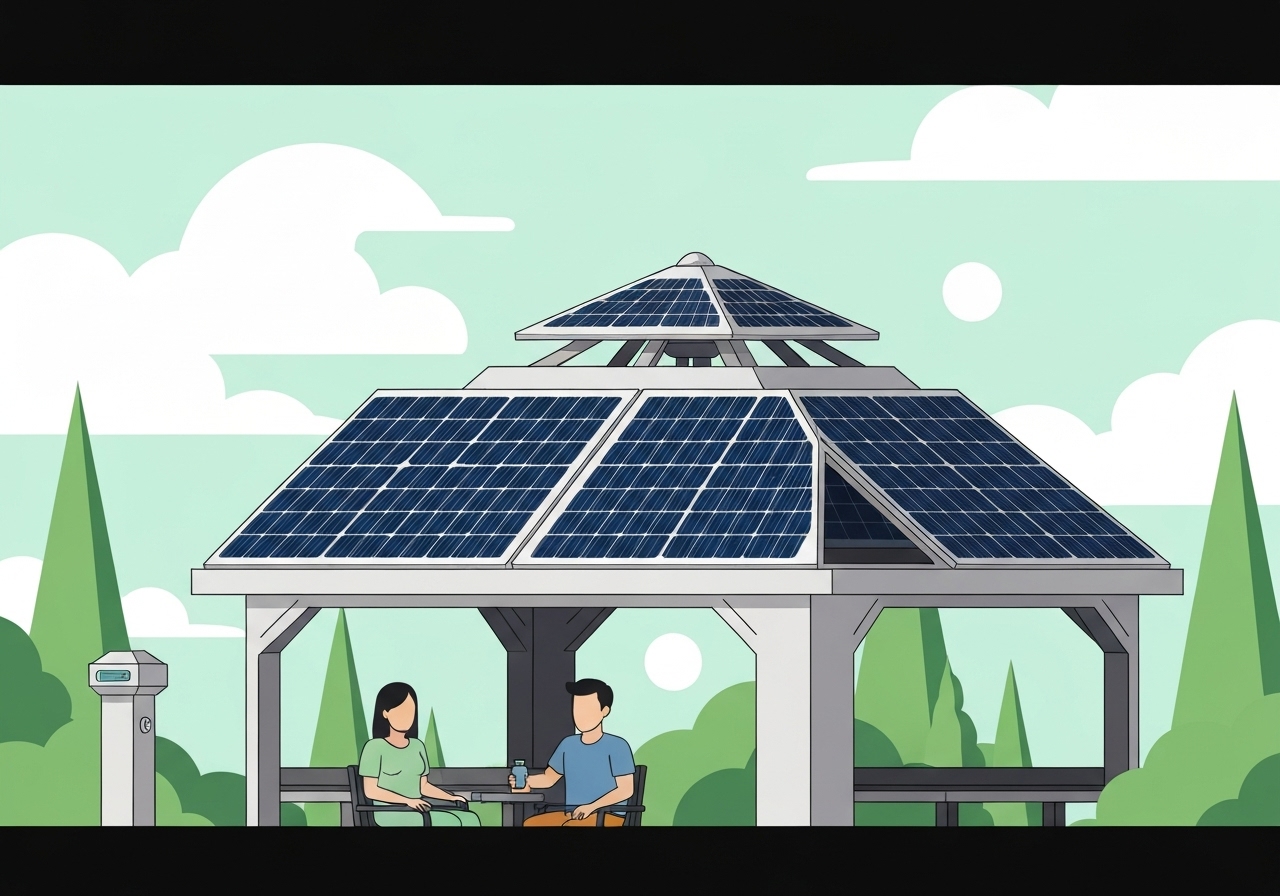
Lead: Jackery announced a prefabricated, solar-powered aluminum gazebo at CES that it says will ship in the second half of the year, beginning in California. The 4.5m x 3m x 2.7m structure (14ft 9in x 9ft 10in x 8ft 10in) is fitted with 2,000W of integrated solar capacity, lighting, a pull-down projector screen and weather-resistant AC outlets. Jackery expects the stand-alone gazebo shell to cost roughly $12,000–$15,000 before any battery storage is added. Observers note this is a compelling turnkey idea — but also one that consumers could recreate themselves with off-the-shelf panels and power stations.
Key Takeaways
- Jackery displayed a 4.5m x 3m x 2.7m aluminum Gazebo at CES with 2,000W of integrated solar panels and built-in lighting.
- The company quoted an estimated price range of $12,000–$15,000 for the gazebo shell, excluding battery storage and installation costs.
- Included features: pull-down projector screen and two weather-resistant AC outlets suitable for outdoor electronics.
- Jackery recommends pairing the unit with portable batteries such as its IP65-rated Explorer 1500 Ultra to run a fridge, TV/projector, sound system and lights for several hours.
- For longer runtimes buyers can add larger HomePower-series batteries or third-party packs from brands like Anker, EcoFlow, and Bluetti.
- CES provenance: similar concept products have been announced at CES before and not always reached market, prompting caution about shipping timelines.
Background
Jackery has built a name supplying consumer portable power stations and solar panels aimed at outdoor recreation and emergency backup. The company has expanded from compact battery packs to integrated systems and now to larger lifestyle products intended to merge living spaces and renewable power. The gazebo announcement continues a recent industry trend of bundling solar arrays with ready-made outdoor structures — a market niche targeting backyard upgrades, glamping, and small-event uses.
CES has become a testing ground for attention-grabbing concepts: vendors often unveil ambitious hardware that may be delayed or revised before customer availability. In the portable-power category, makers also lean on cross-selling: a shelter-like enclosure showcases how panels and batteries work together, and it gives manufacturers an opportunity to sell both hardware and batteries. Customers weighing a purchase must consider the gazebo price separately from the battery capacity required for desired runtimes.
Main Event
At CES, Jackery presented a framed aluminum Gazebo measuring roughly 4.5 by 3 by 2.7 meters, with integrated rooftop solar rated at about 2,000 watts. The shell includes fixed lighting, a pull-down projector screen and two weatherproof AC outlets designed to keep outdoor electronics powered. Company representatives said the initial availability would begin in California in the second half of the year and that the quoted $12,000–$15,000 range applies to the gazebo shell alone, before adding batteries or installation.
Jackery suggested pairing the Gazebo with one of its power stations, for example the newly announced Explorer 1500 Ultra, which carries an IP65 rating for dust and water resistance. With a suitably sized portable battery, the company said the Gazebo can run a small refrigerator, TV or projector, a sound system and lighting for several hours — runtime depends on appliance draw and battery capacity. For extended off-grid use, customers would choose larger HomePower batteries or compatible units from other manufacturers.
During the demo, the Gazebo was positioned as a turnkey outdoor retreat that reduces the complexity of sourcing panels, mounts and weatherproof outlets. Jackery framed the product for use cases such as backyard movie nights, tailgates, and modest off-grid gatherings. The company did not publish final shipping dates, installation details or nationwide rollout plans beyond the initial California focus, leaving some practical questions for later updates.
Analysis & Implications
Product strategy: the Gazebo functions as both a showcase and a sales channel. By offering a branded, preassembled structure, Jackery reduces friction for customers who lack time or expertise to design their own system. That convenience can command a premium: the $12,000–$15,000 range positions the Gazebo as an aspirational lifestyle purchase rather than a basic DIY kit.
Market impact: the Gazebo could broaden adoption of consumer solar if it lands at announced price and availability, because it packages panels, wiring and outlets in a single buy. However, the overall value depends heavily on the cost and capacity of the battery paired with the shell. Buyers who need multi-day runtimes will face substantially higher total costs once high-capacity batteries are included.
Competitive dynamics: Jackery faces competition from established panel-and-battery companies selling modular kits. Third-party batteries from Anker, EcoFlow, Bluetti and others can match or exceed runtime at different price points, giving consumers alternatives to Jackery’s HomePower lineup. If Jackery prices the full solution competitively and provides reliable delivery and installation, it could create a new niche between portable solar kits and professionally installed backyard PV systems.
Comparison & Data
| Item | Footprint / Size | Solar Capacity | Estimated Price (shell) | Battery pairing |
|---|---|---|---|---|
| Jackery Gazebo | 4.5m x 3m x 2.7m (14ft 9in x 9ft 10in x 8ft 10in) | 2,000W | $12,000–$15,000 | Explorer 1500 Ultra, HomePower series (or third-party) |
The table summarizes the demonstrable specs released at CES. The 2,000W rating is notable because, under ideal sun, it can produce a substantial energy haul during peak hours; actual on-site generation will vary by location, orientation and weather. Consumers should calculate expected daily energy needs (fridge, AV gear, lights) and match battery capacity accordingly, rather than relying on headline watts alone.
Reactions & Quotes
“We expect availability in the second half of the year, starting in California,”
Jackery (company statement reported at CES)
Jackery framed the timeline and initial market as a company claim at the show. The statement signals a phased rollout but leaves details — including shipping windows and installation services — undefined. Prospective buyers should await formal sales pages and order windows for precise fulfillment information.
“CES announcements of concept or lifestyle hardware often gain attention but do not always reach retail as shown,”
Industry observers (general commentary)
Analysts and reporters often caution that prototypes or concept products at trade shows can be revised, delayed or cancelled. Past CES reveals in the portable-solar and accessory space have included high-profile items that later stalled, so moderate skepticism is common among reviewers and buyers.
Unconfirmed
- Exact ship dates beyond “second half of the year” were not published and remain unverified.
- Whether the $12,000–$15,000 price will include any basic battery or installation is unconfirmed; Jackery described that figure as the gazebo shell price.
- Nationwide availability and pricing outside California have not been confirmed and may change at launch.
Bottom Line
Jackery’s solar Gazebo packages a useful set of features — large integrated panels, weatherproof outlets, built-in lighting and a projector screen — into a single, aspirational product. For consumers who want a turnkey outdoor power-and-entertainment solution and can absorb a $12,000–$15,000 shell price plus batteries, it could be attractive. However, the full cost to achieve the advertised runtimes depends on added battery capacity and any installation fees.
For DIY-minded buyers, the Gazebo’s concept is easy to replicate by combining third-party panels, mounts and power stations, often at lower total cost but with more procurement and assembly work. Given CES’s history of conceptual announcements, prospective purchasers should wait for confirmed sales pages, clear shipping timelines and third-party reviews before committing to a high-ticket prebuilt unit.