
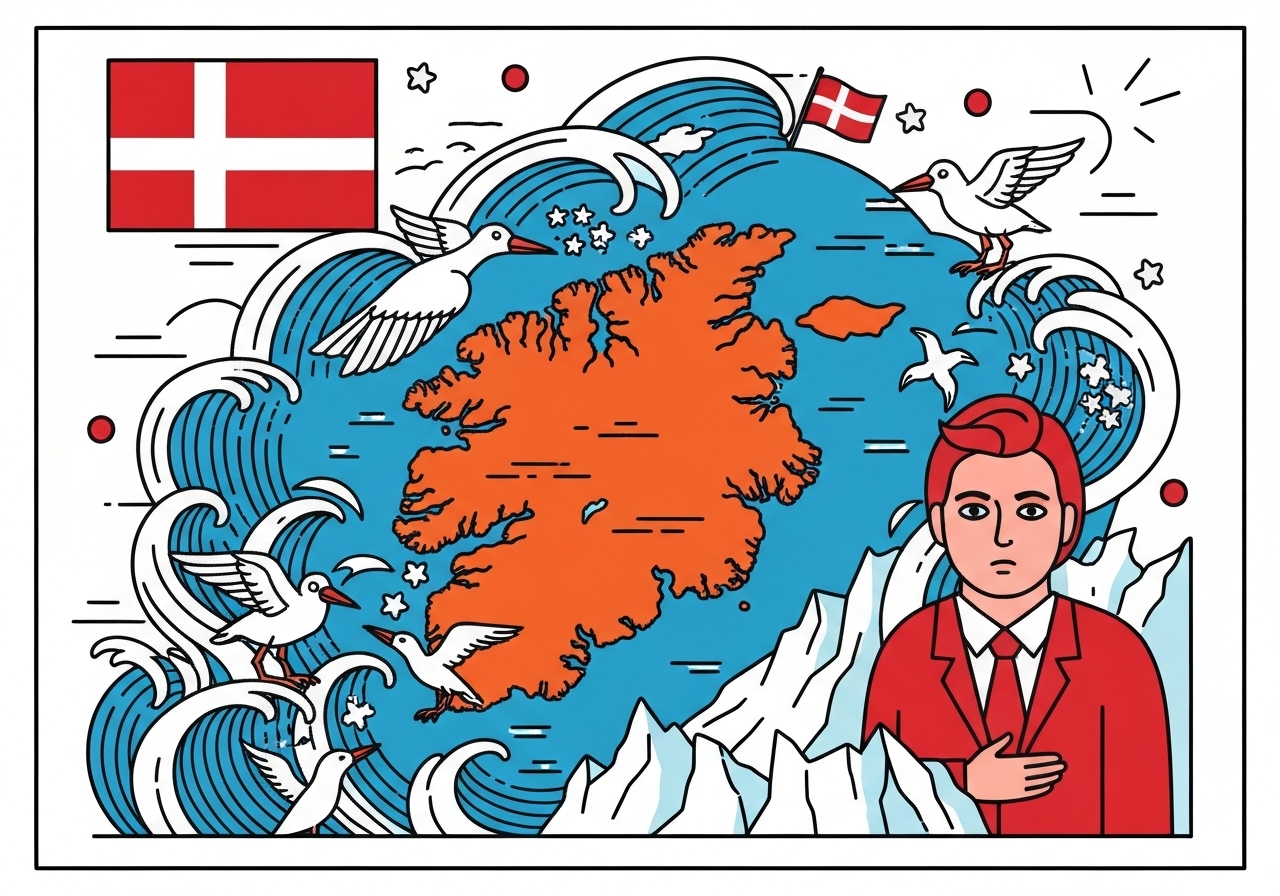
Denmark on Saturday called for respect for its territorial integrity after Katie Miller, wife of the US deputy chief of staff, posted an altered map of Greenland in US flag colours accompanied by the word “SOON”. Danish ambassador to Washington Jesper Møller Sørensen reposted the image with a reminder of close defence ties and Denmark’s expectation that allies respect the Kingdom’s borders. The episode revives tensions over US interest in Greenland, where defence and foreign policy remain Danish responsibilities despite extensive home rule. Officials framed the exchange as a diplomatic prompt to maintain calm between NATO partners rather than an escalation.
Key Takeaways
- Katie Miller shared an image of Greenland in US-flag colours with the caption “SOON”; she is married to the US deputy chief of staff and is a former Trump aide.
- Danish ambassador Jesper Møller Sørensen reposted the image and stressed that “US security is also Greenland’s and Denmark’s security,” noting NATO ties.
- Denmark says it increased defence spending in 2025 by $13.7bn (£10.2bn) to bolster Arctic and North Atlantic security.
- Greenland has had extensive self-government since 1979; defence and foreign affairs remain under the Kingdom of Denmark’s authority.
- Greenland’s population is about 57,000; polls indicate broad opposition to becoming part of the United States despite some support for eventual independence from Denmark.
- The episode follows a recent US appointment of a special envoy to Greenland, which had already angered officials in Copenhagen.
- Statements from Copenhagen framed the post as provocative but treated the matter through diplomatic channels rather than public recrimination.
Background
The US has periodically signalled interest in Greenland for strategic and resource reasons, most famously during President Donald Trump’s 2019 public musings about a potential purchase. Greenland’s location in the Arctic and its mineral wealth give it geopolitical significance amid competition over Arctic shipping routes and critical minerals. Although Greenlanders have extensive local autonomy, Copenhagen retains responsibility for defence and foreign policy, a status that shapes how Denmark responds to external moves concerning the island. Recent US actions, including the appointment of an envoy to Greenland, rekindled Danish concerns about respect for the Kingdom’s territorial arrangements.
Relations between Denmark and the United States are long-standing and anchored in NATO cooperation and bilateral defence agreements, including US facilities on Greenland that support Arctic surveillance and missile warning systems. In 2025 Denmark pledged $13.7bn (£10.2bn) toward defence capabilities that can be deployed in the Arctic and North Atlantic, a commitment Copenhagen cites when asserting shared security responsibilities. Greenlanders themselves are divided on their future: while many favour eventual independence from Denmark, public opinion polls consistently reject integration with the United States. Those internal dynamics mean any external overture toward Greenland carries political sensitivity in both Nuuk and Copenhagen.
Main Event
Late on Saturday, Katie Miller posted an image on X (formerly Twitter) that depicted Greenland coloured like the US flag and included the single word “SOON.” Miller, identified in public reports as a right-leaning podcaster and a former Trump aide, is married to the president’s deputy chief of staff, which gave the post heightened visibility. The Danish ambassador to the US, Jesper Møller Sørensen, reshared the post and added a concise diplomatic reminder stressing continued alliance and shared security interests. His repost underscored Denmark’s stance that Greenland’s territorial integrity must be respected by partners.
Copenhagen’s official response emphasised diplomatic channels and concrete defence cooperation rather than recriminatory rhetoric. Officials pointed to Denmark’s recent defence spending increase and existing NATO commitments as evidence of joint security priorities in the Arctic. The exchange occurred amid other heightened US foreign-policy moves this weekend that drew international attention, prompting Danish authorities to reiterate long-standing legal and political arrangements. Government spokespeople framed their message as a reminder to allies of the norms that govern sovereign territory.
Media and analysts noted the symbolic weight of the image: social-media posts by figure connected to senior US officials can amplify perceptions of policy direction even if they do not reflect formal government moves. Danish diplomats emphasised that formal US-Danish engagement continues through established channels and that such matters should be handled between governments. Copenhagen also signalled readiness to defend its constitutional responsibilities for Greenland’s external affairs if necessary. For now, the response remained measured and rooted in public reminders of legal and military ties.
Analysis & Implications
The incident highlights how social media can shape international perceptions and escalate sensitivities between allies. A single provocative image shared by a close relative of a senior official can be interpreted as signaling intent or provocation, even absent formal policy action. That dynamic pressures diplomats to respond publicly to reassure domestic audiences and to clarify legal arrangements. Denmark’s quick emphasis on defence spending and NATO membership sought to translate symbolic concern into concrete deterrence messaging.
Strategically, Greenland sits at the intersection of Arctic security, global supply chains for critical minerals, and great-power competition. Control or influence over Greenland would carry implications for Arctic surveillance, submarine and missile warning systems, and access to rare-earth and other critical resources. Copenhagen’s insistence on territorial integrity aims to protect those strategic equities while preserving Greenlandic self-determination processes. Any change in the status quo would require complex domestic and international negotiations that Denmark and Greenlanders would need to lead.
Politically, Copenhagen must balance signalling resolve to domestic and Greenlandic audiences with the need to maintain alliance cohesion with the United States. Public reminders of shared security obligations are a form of soft deterrence designed to prevent unilateral moves that could inflame public opinion in Greenland or within Denmark. For US policymakers, the episode is a caution about the reputational effects of off-hand or symbolic gestures by officials and affiliates. Moving forward, both capitals are likely to rely on formal, state-level channels to manage the issue.
Comparison & Data
| Metric | Value |
|---|---|
| Greenland population | 57,000 |
| Denmark 2025 defence increase (announced) | $13.7 billion (£10.2 billion) |
| Self-government since | 1979 |
| NATO membership | Denmark & Greenland (as part of the Kingdom of Denmark) |
The figures above provide a concise context: Greenland’s small population contrasts with the strategic attention it receives, and Denmark’s recent defence budget increase is presented as proof of its commitment to Arctic security. The 1979 self-government milestone frames Greenland’s long trajectory toward political autonomy, while NATO membership anchors the island within broader transatlantic defence arrangements. These data points explain why symbolic gestures generate outsized diplomatic responses.
Reactions & Quotes
Officials in Copenhagen responded promptly to ensure the matter remained framed as a diplomatic reminder rather than a bilateral dispute.
“Just a friendly reminder about the US and the Kingdom of Denmark: We are close allies and should continue to work together as such.”
Jesper Møller Sørensen, Danish ambassador to the US
This repost by the ambassador followed Miller’s image and reiterated shared security responsibilities, stressing NATO ties and Denmark’s recent defence commitments for the Arctic and North Atlantic.
“US security is also Greenland’s and Denmark’s security.”
Jesper Møller Sørensen (statement)
Ambassador Sørensen used this line to link any potential shifts in Greenland’s status directly to alliance obligations, framing territorial respect as integral to collective defence rather than a narrow bilateral issue.
“SOON”
Katie Miller (social post)
Miller’s single-word post and the altered map generated wider discussion because of her proximity to senior White House staff; observers cautioned that personal posts can be misread as policy signals. The brevity of the post left room for interpretation, which Denmark chose to address through formal diplomatic reassurance.
Unconfirmed
- The report that the US carried out a major military operation capturing Venezuelan president Nicolás Maduro and relocating him to New York is unverified in primary Danish and mainstream sources and requires confirmation from official US or Venezuelan authorities.
- There is no public, formal US government declaration that the image posted by Katie Miller reflects an official policy or imminent action regarding Greenland.
- Any assertion that a single social-media post signals an imminent annexation or formal territorial claim should be treated as speculation until substantiated by official statements or policy documents.
Bottom Line
This episode underlines how symbolic acts on social media can produce diplomatic ripples between close allies. Denmark responded quickly with reminders of legal authority, defence cooperation and recent budget commitments to pre-empt misinterpretation and reassure domestic and Greenlandic audiences. For now, the interaction remains in the realm of public rhetoric rather than policy change, and Copenhagen appears to prefer measured, state-level engagement over escalation.
Looking ahead, both Denmark and the United States are likely to emphasise formal diplomatic channels to manage Arctic issues and avoid letting social-media incidents shape strategic outcomes. Greenland’s status and future remain matters for Greenlanders and the Kingdom of Denmark, and any substantive shift would require transparent, multilateral diplomacy rather than symbolic gestures alone.
Sources
- BBC News (media report summarising diplomatic responses and statements)
- Reuters (newswire; background on US-Greenland interest and prior reporting)
- Danish Ministry of Defence (official; information on defence spending and Arctic commitments)