
Lead
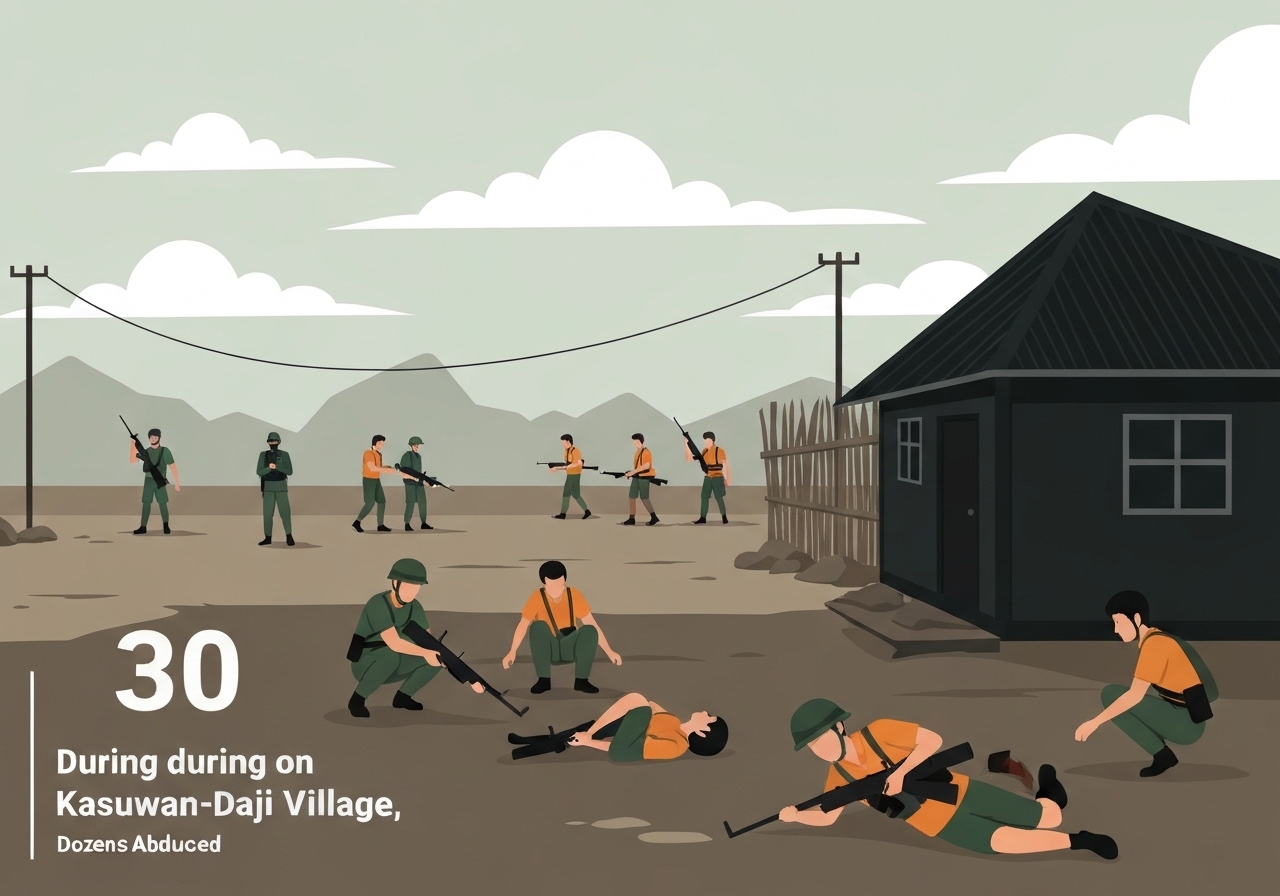
Gunmen attacked Kasuwan-Daji village in Niger state on Saturday evening, killing at least 30 villagers and abducting several others, police and local sources said. The assailants also burned the local market and multiple homes during the raid, which survivors said lasted up to three hours. Local residents and a diocesan spokesman reported higher death tolls and missing people, while government officials said security forces were deployed to search for the kidnapped. President Bola Tinubu condemned the assault and ordered security agencies to pursue the perpetrators and rescue the hostages.
Key Takeaways
- At least 30 people were confirmed killed by Niger state police after a Saturday evening raid on Kasuwan-Daji village in Borgu local government area.
- Two residents and a local priest reported higher tolls — residents put deaths at 37, the Catholic Church spokesman said more than 40 — and additional people remain missing.
- Attackers razed the village market and several houses and abducted multiple villagers, including children, according to local accounts.
- Survivors said the assault lasted up to three hours and that gunmen had been observed around nearby communities for about a week before the raid.
- Police said officers had been deployed to search for abductees; residents contend security forces had not arrived and bodies remain unrecovered.
- Authorities reported the attackers came from the National Park Forest along Kabe district, matching a frequent pattern of armed groups using forest reserves as hideouts.
- The incident occurred near Papiri, the site of a November abduction in which more than 300 schoolchildren and teachers were seized from a Catholic school.
Background
Northern Nigeria has seen repeated attacks by loosely organized armed gangs often described as “bandits,” who target remote communities for killings, kidnappings and theft. Vast and sparsely policed forest reserves across states such as Niger provide cover and mobility for these groups, complicating security operations. Local economies in affected areas rely on small markets and subsistence farming; repeated raids destroy livelihoods and increase displacement. The November mass kidnapping in the Papiri area, where over 300 schoolchildren and teachers were taken, underscored how educational institutions and rural settlements remain especially vulnerable.
State and federal authorities have frequently pledged tougher responses, but security capacity is stretched and coordination between local communities and security services varies. Perpetrator identities are often unclear: some attacks are attributed to criminal gangs seeking ransom, others to militants with political aims. Niger state officials say the assailants in Saturday’s raid entered from an adjacent national park corridor, a commonly cited vector that security analysts say enables hit-and-run operations. The intensity and frequency of such attacks have drawn growing domestic criticism and calls for better intelligence and community protection measures.
Main Event
According to the Niger state police, gunmen stormed Kasuwan-Daji in Borgu LGA on Saturday evening and opened fire on residents, then set fire to the local market and several homes. Police spokesman Wasiu Abiodun issued a statement confirming at least 30 fatalities and saying officers were deployed to search for abducted villagers. Survivors and local sources contradicted the deployment claim, reporting that security forces had not yet arrived and that bodies remained uncollected the following day.
Multiple witnesses described attackers arriving from forested areas near the Kabe district and moving through the community for up to three hours, killing residents and seizing people from homes and public spaces. A Catholic Church spokesman for Kontagora Diocese told local media the toll could exceed 40 and that children were among those taken. Village residents said gunmen had been observed around neighboring settlements for about a week, and that the raid followed a period of mounting fear and limited mobility.
Survivors who spoke to local reporters said they fled into bushland as the attack unfolded, leaving behind the injured and dead. The razing of the market and homes has deprived many families of basic shelter and income, and people remain afraid to return to recover bodies or belongings without visible security protection. Government statements have emphasized a forthcoming crackdown, while local appeals stress the immediate need for rescue, medical care and forensic accounting of victims.
Analysis & Implications
This raid highlights persistent gaps in rural security where armed groups exploit terrain and weak state presence. Forest corridors such as the one along Kabe district frequently serve as staging grounds and escape routes, making rapid response and area denial difficult for conventional forces. The discrepancy between official casualty figures and higher local estimates is typical in initial stages of such incidents, but it also feeds distrust between communities and authorities.
The recurrence of mass abductions — most notably the November seizure of more than 300 pupils and teachers near Papiri — raises acute concerns about the safety of schools and the long-term impact on education. Families may keep children at home, undermining schooling and fueling cycles of poverty. Economically, attacks that destroy markets and homes worsen food insecurity and reduce local trade, compounding humanitarian need in already marginal areas.
Politically, President Tinubu’s directive to hunt down perpetrators signals federal attention, but success will depend on coordination with state forces, intelligence sharing and addressing long-standing sheltering of militants in remote reserves. A hardened security posture alone may not suffice; analysts argue a mix of measures — community-police partnerships, targeted patrols, and efforts to reduce grievances exploited by armed groups — will be necessary. International partners and regional security mechanisms may be called upon for training, intelligence and logistical support if attacks continue to escalate.
Comparison & Data
| Source | Reported Deaths | Reported Abductions |
|---|---|---|
| Police statement (Niger state) | At least 30 | Several (unspecified) |
| Local residents | 37 (residents’ estimate) | Several / multiple |
| Catholic Church (Kontagora Diocese) | More than 40 | Several, including children |
The table shows divergent tallies common in the immediate aftermath of rural attacks. Official figures tend to be conservative initially; local and religious leaders often report higher counts based on on-the-ground observations. Confirmed numbers may change as rescue teams access the site, bodies are recovered and missing-person reports are reconciled. Monitoring groups recommend independent verification and transparent reporting to build community trust.
Reactions & Quotes
“These terrorists have tested the resolve of our country and its people. They must face the full consequences of their criminal actions.”
President Bola Tinubu (official statement)
The president’s brief statement framed the attack as an affront to national security and ordered security agencies to pursue the perpetrators. Officials said a hunt was underway while promising legal action against anyone who aids the attackers.
“The bodies are there. If we don’t see any security, how can we go there?”
Unnamed Kasuwan-Daji resident (local witness)
The resident’s remark encapsulates local fear and frustration with delayed or absent protection. Multiple survivors told reporters they were too fearful to return to the village without visible security deployment.
“They killed more than 40 people and also abducted several others, including children.”
Rev. Fr. Stephen Kabirat (Catholic Church spokesman, Kontagora Diocese)
The diocesan spokesman’s higher toll and mention of child abductions amplified local alarm and prompted church-led appeals for urgent rescue and humanitarian support.
Unconfirmed
- Exact death toll: figures vary between police (30), local residents (37) and the Catholic Church (more than 40); an official, verified total is not yet publicly available.
- Precise number and identities of those abducted, including the number of children, remain unverified pending rescue or family reports.
- Whether all claimed security deployments arrived at the scene or conducted sustained searches has not been independently confirmed.
- The formal organizational affiliation of the attackers and any links to wider militant networks are unconfirmed.
Bottom Line
The Kasuwan-Daji raid is another stark example of how armed groups exploit weakly policed rural terrain to carry out mass killings and abductions, inflicting heavy human and economic costs on vulnerable communities. Immediate priorities are the rescue of abductees, recovery of the dead, medical aid for survivors and protection of remaining residents to prevent further displacement.
Longer term, the incident underscores the need for sustained security reforms: better intelligence and rapid-response capabilities, protection for schools and markets, and partnership with local communities to reduce the hideouts and avenues that enable such attacks. Observers should watch for independent casualty verification, progress on rescues, and whether federal and state authorities can demonstrate coordinated, effective action.
Sources
- AP News — news report (wire service reporting initial police, resident and church statements)
- Catholic Church of Kontagora Diocese — local church statement (reported in AP)