
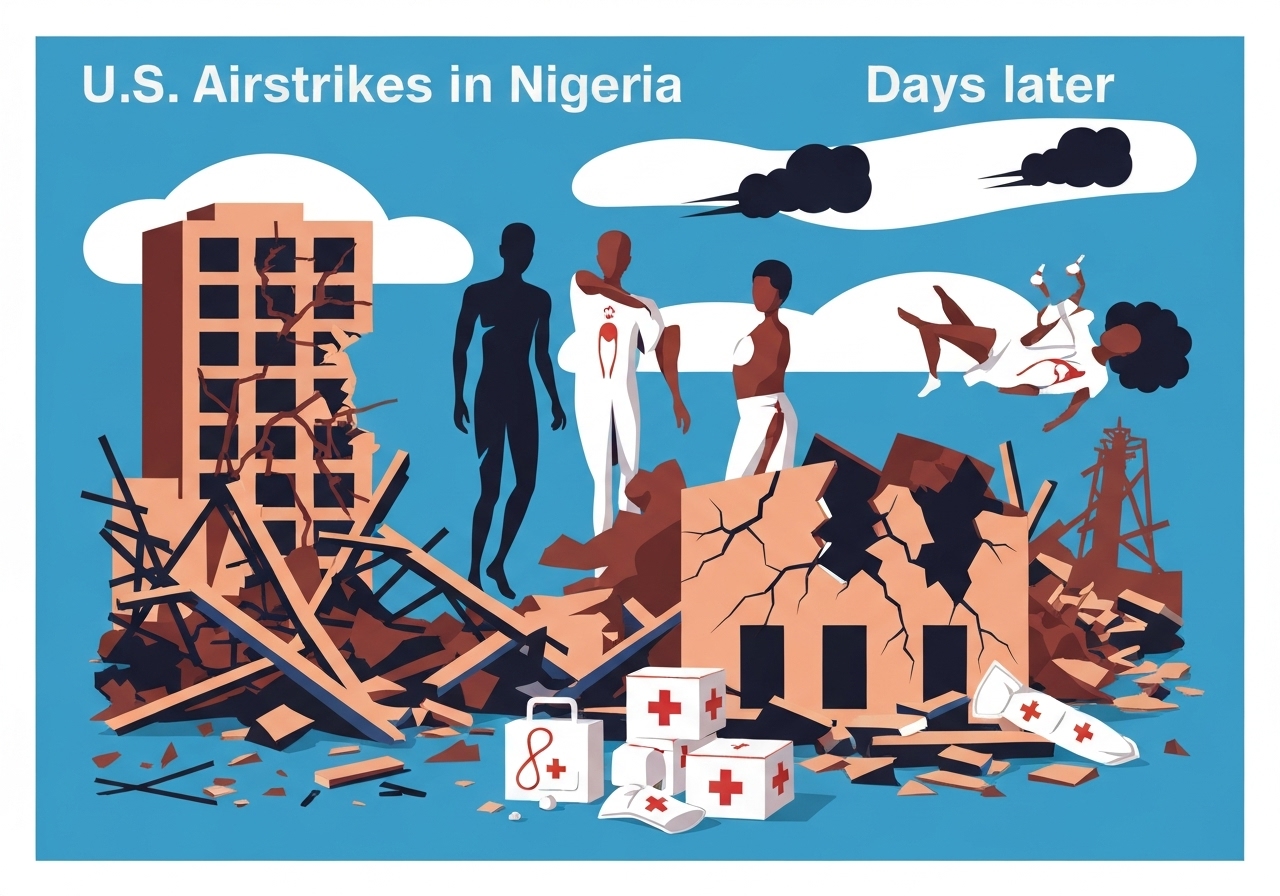
Lead: On Jan. 4, 2026, unidentified gunmen attacked two neighboring villages in Niger State, Nigeria, killing dozens and abducting several people, officials and residents said. The assault came within days of U.S. airstrikes in the region over the Christmas period, a sequence that Nigerian authorities say may be linked to the violence. Police reported more than 30 dead, while local residents put the toll at at least 42 across the two villages. Some abducted were students from St. Mary’s Catholic School, recently the site of a large November kidnapping.
Key Takeaways
- Attack date and location: The raids occurred on Jan. 4, 2026, in Kasuwa Daji and Kaima, villages in Niger State, northwest Nigeria.
- Fatalities: A police spokesman, Wasiu Abiodun, said “over 30” were killed; residents reported at least 37 deaths in Kasuwa Daji and five in Kaima, totaling 42.
- Abductions: An unspecified number of people were taken, including some pupils from St. Mary’s Catholic School, which had more than 300 students kidnapped in November 2025 and later released.
- Security context: Villages had been besieged for about a week, with residents sleeping outdoors to avoid attacks.
- Possible perpetrators: No group has publicly claimed responsibility; authorities pointed to armed groups fleeing Sokoto and Zamfara after recent U.S. strikes.
- U.S. strikes timing: The U.S. military conducted airstrikes around Christmas (reported in different statements as Dec. 24–25, 2025) targeting groups active along the Niger border.
- Government position: The presidency, via adviser Bayo Onanuga, described the attackers as “terrorists suspected to be fleeing” following the U.S. action.
Background
Nigeria’s northwestern states have faced years of violence from loosely organized armed groups—variously called bandits, armed militias or local insurgents—who conduct raids, kidnappings for ransom and cattle rustling. The area along the border with Niger has seen recurring cross-border movement of fighters and weapons, complicating security operations. In November 2025, more than 300 students were abducted from St. Mary’s Catholic School in Papiri and were released weeks later; that incident intensified local fear and criticism of security lapses. The U.S. military reported strikes in late December targeting a group known locally as the Lakurawa, a faction implicated in cross-border attacks; Nigerian officials have since suggested a link between those strikes and a wave of retaliatory or displaced fighters moving into civilian areas.
Local communities often rely on informal defenses or relocate temporarily when threats rise, but prolonged sieges erode livelihoods and access to services. State security forces in parts of Niger State are thinly spread, authorities and residents say, leaving many villages exposed. The Nigerian government under President Bola Ahmed Tinubu has faced pressure to improve rural security even as it balances cooperation with international partners on counterterrorism. These dynamics set the stage for episodic spikes of violence when armed groups shift tactics or territory.
Main Event
Residents said the two villages had been under siege for at least a week, with people abandoning homes and sleeping in nearby bushland to avoid nightly incursions. According to police spokesman Wasiu Abiodun, “over 30” people were killed in the attacks; independent accounts from villagers reported at least 37 deaths in Kasuwa Daji and five in Kaima. The attacks included both killings and abductions; some of those taken were students linked to St. Mary’s Catholic School in Papiri, the site of the larger November kidnapping.
No armed group immediately claimed responsibility. Local sources and national officials pointed to the Lakurawa and other armed elements that operate between Nigeria’s northwest and neighboring Niger. The presidency issued a statement, carried by Bayo Onanuga, saying the assailants were “terrorists suspected to be fleeing from Sokoto and Zamfara following the United States’ airstrike on Christmas Eve,” framing the violence as the movement of fighters displaced by recent strikes.
Villagers described chaotic scenes as attackers came from surrounding bush and forested areas. One resident, Abraham Peter, told reporters that fighters have been “coming out of the forest and angrily attacking communities at free will because there is no security presence here.” Local leaders urged immediate deployment of security forces and humanitarian assistance for displaced families and survivors.
Analysis & Implications
The timing of the attack — days after U.S. air operations — raises difficult questions about counterterrorism strategy in porous border regions. Military strikes can degrade armed groups’ command-and-control or safe havens, but they may also displace fighters, scatter units and produce short-term spikes in local violence as groups move or retaliate. In this case Nigerian officials have linked the assault to fighters fleeing strikes in Sokoto and Zamfara; independent verification of that causal chain is not yet available.
For Nigeria, the incident underscores persistent gaps in rural security provisioning: thin manpower, limited rapid-response capacity and fragile intelligence networks. The recurrence of large-scale kidnappings and village raids damages community trust in state protection and can prompt local self-defense efforts that further complicate stabilization. International partners face a trade-off between direct kinetic actions and investments in local policing, intelligence and community resilience.
Regionally, violence that pushes fighters across the Niger border risks rekindling cross-border networks and complicating cooperation with Nigerien authorities. Humanitarian consequences are immediate: families displaced, crops and livestock at risk, and interrupted schooling—especially traumatic in areas recently affected by mass abductions. Politically, the Tinubu administration will likely face scrutiny over its coordination with foreign partners and the sequencing of strikes versus civilian protection measures.
Comparison & Data
| Event | Date | Reported deaths | Reported abducted |
|---|---|---|---|
| Attack on Kasuwa Daji & Kaima | Jan. 4, 2026 | Police: >30; Residents: 42 | Unspecified, includes some St. Mary’s pupils |
| St. Mary’s school kidnapping (Papiri) | Nov. 2025 | 0–(mass abductions; later released) | Over 300 students (released weeks later) |
The table highlights two recent security shocks in the same locality: the large November school abduction and the January village killings. Both events show persistent targeting of civilians and schools, and the January incident adds a lethal dimension with several dozen killed. These data points indicate escalation in lethality even as large-scale abductions remain a chronic risk.
Reactions & Quotes
Community leaders and officials responded with calls for prompt security action and investigation.
“For the past one week, they have been coming out of the forest and angrily attacking communities at free will because there is no security presence here.”
Abraham Peter, local resident
Peter’s remark reflects longstanding local frustration over gaps in protection and the immediate fear driving displacement. Villagers described nights spent in bushland and disrupted access to food and schooling.
“Over 30 persons were killed and some persons kidnapped in Kasuwa Daji,”
Wasiu Abiodun, police spokesman
Abiodun’s figure aligns with official tallies but differs from some resident counts, illustrating the difficulty of rapid casualty verification in remote areas. The police statement also signaled an ongoing investigation.
“Terrorists suspected to be fleeing from Sokoto and Zamfara following the United States’ airstrike on Christmas Eve.”
Bayo Onanuga, special adviser to the president (government statement)
The presidency framed the attack as connected to recent U.S. air operations; that attribution is the subject of further verification by security analysts and independent monitors.
Unconfirmed
- No independent confirmation yet links the attackers directly to the forces targeted by the U.S. strikes; government assertions are preliminary.
- The exact number of people abducted in the Jan. 4 attacks remains unclear; local and official counts differ and are still being reconciled.
- Attribution to a named group such as Lakurawa is reported by officials and local sources but has not been independently verified by international monitors.
Bottom Line
The Jan. 4 killings in Niger State are a sharp reminder that military strikes alone cannot eliminate the threat of violence against civilians and may produce short-term displacement of fighters that increases risk to nearby communities. Accurate, timely casualty and abduction figures remain scarce, but the human impact—killed villagers, abducted students, displaced families—is clear and immediate.
Policy responses should prioritize protection for vulnerable villages, rapid humanitarian relief, and transparent investigations into who carried out the attacks and whether recent external strikes altered militant behavior. Observers should watch for: additional displacements, claims of responsibility, security deployments by federal authorities, and any coordinated regional response with Niger.
Sources
- The New York Times — U.S. news organization reporting on the Jan. 4, 2026 attacks and related statements