
Lead
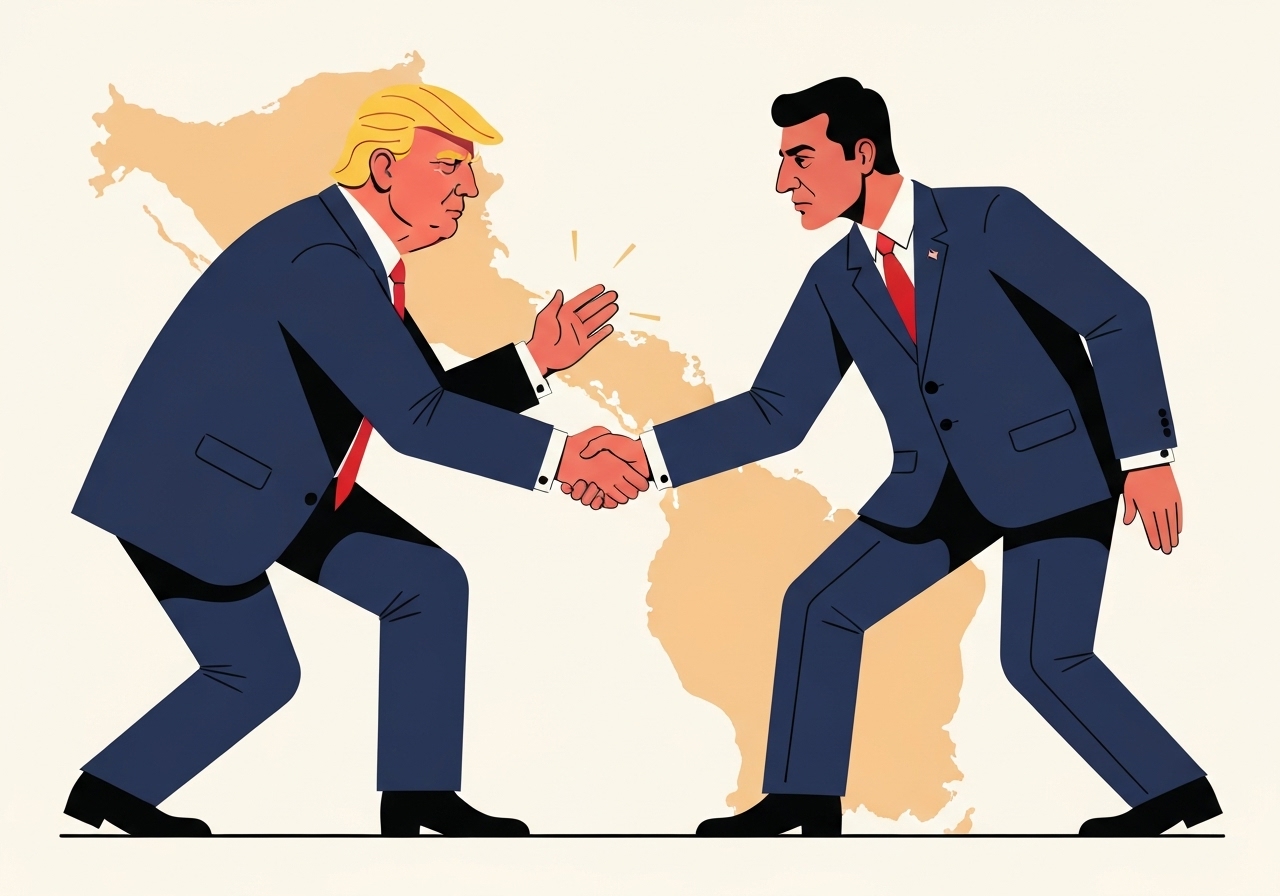
On Jan. 3, 2026, U.S. forces captured Venezuela’s president, Nicolás Maduro, setting off urgent diplomatic consultations across Latin America. Governments from Mexico to Brazil scrambled to define a public stance, exposing sharp ideological and strategic divisions. Left-leaning governments in the region criticized the U.S. operation, while several right-leaning administrations welcomed it or kept quiet. The episode has rapidly reordered regional alliances and prompted a widespread recalculation of how states protect sovereignty and political survival.
Key Takeaways
- Jan. 3, 2026: The United States conducted an operation inside Venezuela that resulted in the capture of President Nicolás Maduro, triggering an immediate regional diplomatic crisis.
- Brazil, Mexico and Colombia—among the region’s largest states—issued public criticism or concern about the U.S. action, signaling strain among left-leaning governments.
- Argentina, El Salvador and Ecuador were publicly more favorable to the U.S. move, reflecting a growing bloc of right-leaning governments receptive to Washington’s approach.
- Smaller states such as Guatemala and Peru adopted muted or noncommittal postures, aiming to avoid drawing Washington’s ire or regional reprisals.
- Communication channels—especially encrypted messaging apps like WhatsApp—were flooded with urgent government-to-government exchanges in the hours after the operation.
- Regional organizations and diplomats warned of legal and normative impacts, citing risks to sovereignty norms and potential escalation of bilateral tensions.
Background
Latin America’s political landscape has shifted significantly over the past decade, with a mix of left- and right-leaning governments governing neighboring capitals. Longstanding grievances over economic inequality, migration and corruption have repeatedly reshaped voter preferences, producing a patchwork of alliances that do not neatly map onto geography. Venezuela’s political and humanitarian crisis predates the January 2026 operation and has been a focal point for U.S. policy and regional debate for years.
Historically, outside interventions in the hemisphere are deeply sensitive; international law and the principle of nonintervention are pillars of regional diplomacy. Yet the last decade saw growing U.S. rhetorical assertiveness and occasional covert activity in pursuit of counterinsurgency, narcotics interdiction and regime change objectives. Latin American capitals now face competing pressures: pressure from domestic constituencies and ideology, and the practical need to manage relations with Washington.
Main Event
According to multiple accounts, U.S. forces crossed into Venezuelan territory on Jan. 3 and detained President Nicolás Maduro. The operation’s public announcement produced near-immediate reactions: presidential offices and foreign ministries across the hemisphere issued statements, summoned envoys or convened emergency meetings. In capitals such as Brasília, Mexico City and Bogotá, statements emphasized legal process and sovereignty concerns, while in others the tone favored the outcome.
Diplomatic choreography unfolded rapidly. Some governments released formal condemnations; others issued cautious calls for information and transparent legal procedures. Several right-leaning presidents lauded the result as a victory against authoritarianism and corruption, framing it as consistent with broader regional security goals. Smaller governments sought to limit exposure by delaying comment or issuing neutral language that neither endorsed nor condemned the operation.
Beyond official statements, the capture reshaped intra-regional diplomacy: trade and security dialogues were paused or reframed; multilateral meetings were rescheduled; and embassies braced for protests. Civil society groups in multiple countries warned of spillover effects—including increased polarization and a potential crackdown on domestic opposition under the pretext of countering external meddling.
Analysis & Implications
The immediate political consequence is a realignment of tactical alliances. Governments that historically cooperated on trade or migration may now find themselves at odds over core principles—most notably sovereignty and the acceptable limits of foreign operations. This divergence could complicate regional responses to crises such as migration flows from Venezuela and Haiti, where common policy approaches are already fragile.
Economically, the shock may prompt market volatility, affect investor confidence and disrupt supply chains connected to Venezuela’s energy exports. Countries that depend on remittances or migrant labor may face short-term pressures if diplomatic ties with the United States or neighboring states deteriorate. Financial markets in the region are likely to price in heightened geopolitical risk while global energy markets watch for changes in Venezuelan output or sanctions policy.
Strategically, Washington’s willingness to conduct an operation inside another hemisphere’s state signals a more interventionist posture that could embolden allies and alarm others. Regional institutions will be tested: whether they can mediate tensions, uphold legal norms, and provide forums for de-escalation remains uncertain. Domestic politics will also be affected; leaders may use the episode to rally bases, justify security measures, or reposition themselves ahead of elections.
Comparison & Data
| Country | Geopolitical Weight | Public Response |
|---|---|---|
| Brazil | Largest population in the region | Criticized the U.S. operation |
| Mexico | Major economy and diplomatic actor | Expressed concern and called for legal clarity |
| Colombia | Key regional U.S. partner | Raised questions about sovereignty |
| Argentina | Influential economy | More favorable to the U.S. action |
| El Salvador | Smaller state, strategic U.S. ties | Expressed support |
| Guatemala, Peru | Smaller regional actors | Neutral or muted responses |
The table above summarizes public orientations observed in the immediate aftermath. While headline positions were visible, behind-the-scenes diplomacy was dynamic: several governments issued follow-on clarifications, and some initial statements were refined as legal and intelligence details emerged.
Reactions & Quotes
Governments and analysts offered sharply divergent assessments within hours of the operation. Below are representative statements and the contexts in which they were made.
“Any operation that crosses international borders raises profound legal and diplomatic questions for the hemisphere.”
Ministry of Foreign Affairs of Brazil (statement)
Brazil’s comment framed its response around international law and the potential precedent set by unilateral cross-border actions, signaling concern about sovereignty norms.
“This action advances accountability against an authoritarian leader accused of serious abuses.”
Office of the U.S. President (briefing summary)
The U.S. administration characterized the operation as a targeted measure to remove a leader it judged illegitimate and criminal, emphasizing legal outcomes and security rationales in its messaging.
“Regional politics have been reordered overnight; countries must now weigh safety, principle and alliance calculus.”
Independent regional analyst
An analyst emphasized the broader strategic ripple effects, noting that governments will now balance normative commitments against immediate national interests.
Unconfirmed
- Claims that multiple regional militaries coordinated with the U.S. ahead of the Jan. 3 operation remain unverified and lack public documentary evidence.
- Reports of clandestine arrests of opposition figures in neighboring countries tied to the operation have surfaced on social media but have not been independently confirmed.
Bottom Line
The U.S. capture of Nicolás Maduro on Jan. 3, 2026, has had an outsized geopolitical effect across Latin America by forcing governments to state positions that reveal deeper ideological cleavages and practical anxieties. Major regional players—Brazil, Mexico and Colombia—chose to foreground sovereignty and legal process, while a set of right-leaning governments welcomed the result, illustrating a swift realignment on key security questions.
Looking ahead, the incident is likely to shape diplomatic relations, multilateral cooperation and domestic politics for months if not years. Observers should watch for changes in migration, trade flows and security cooperation, as well as for how regional bodies respond to potential legal challenges and whether new norms emerge to address the precedent set by cross-border operations.
Sources
- The New York Times — news report documenting regional reactions and timeline (original reporting).
- White House Briefing Room — official U.S. statements and policy rationale (official announcement and briefings).
- Organization of American States (OAS) — regional organization’s statements and legal frameworks for inter-American relations (regional institution).