
Lead
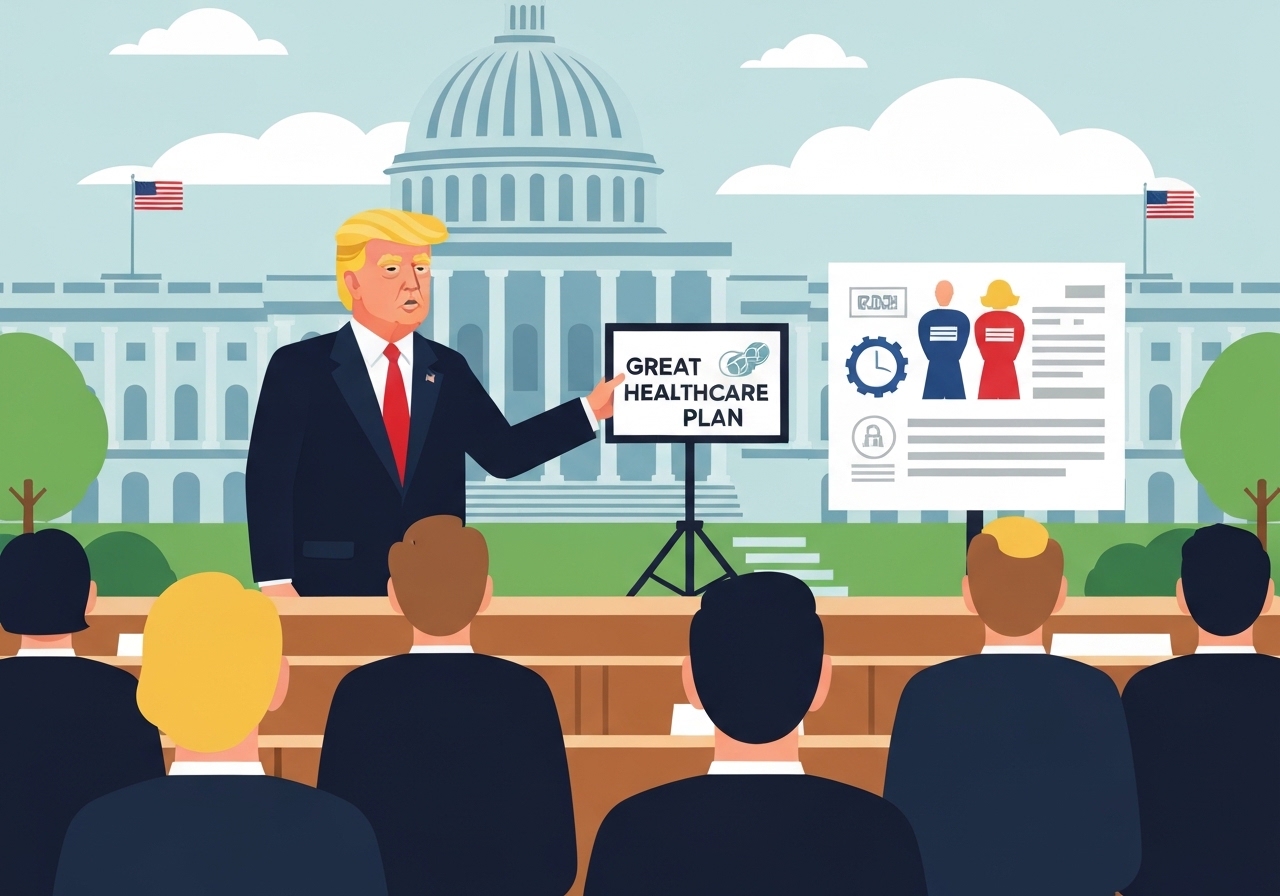
On Thursday, the Trump administration unveiled a package called ‘The Great Healthcare Plan’ aimed at lowering US health care costs as Affordable Care Act open enrollment closed in most states. The proposal emphasizes direct payments to patients, lower prescription prices and expanded price transparency, but offers few implementation details and would require congressional action. Administration officials said they want funds routed to consumers rather than insurers, while health policy experts warned the outline could destabilize ACA marketplaces. With enhanced ACA tax credits having expired on Dec. 31 and signups running about 800,000 lower than a year ago, the proposal faces steep political and technical hurdles.
Key Takeaways
- The administration announced ‘The Great Healthcare Plan’ on Thursday, focusing on direct payments to patients, drug price rules and price transparency reforms.
- Enhanced ACA tax credits expired Dec. 31; federal data show ACA signups are roughly 800,000 lower than at the same point last year.
- Direct payments to patients, as proposed, would require new legislation from Congress and face uncertain timelines.
- CMS Administrator Dr. Mehmet Oz and the administration described routing funds to health savings accounts as a likely vehicle for payments.
- Experts including Cynthia Cox (KFF) and Art Caplan (NYU) warned the plan lacks crucial details and could undermine marketplace stability or leave people with pre-existing conditions at risk.
- The Senate is scheduled to begin a week-long recess, reducing the immediate prospects for swift congressional action on the proposal.
Background
The Biden-era Affordable Care Act established premium tax credits that were temporarily expanded during the pandemic; those enhanced credits expired on Dec. 31, 2025. The lapse contributed to higher premiums for many consumers and prompted lawmakers to debate extensions in both chambers of Congress. Republicans and Democrats remain divided over the form and funding of any extension, with the House passing a three-year extension and the Senate working on its own version. President Trump has repeatedly promised a new health care blueprint, framing his administration’s effort as an alternative to what he calls the ‘Unaffordable Care Act.’
Health policy experts have long noted that federal premium subsidies are applied to consumer premium bills each month rather than paid directly to insurers; changing that mechanism would represent a major shift in how affordability is achieved. Meanwhile, drug pricing remains a bipartisan concern; the administration has pursued measures such as ‘most favored nation’ comparisons and voluntary agreements with manufacturers. The policy context combines political pressure from rising out-of-pocket costs with operational complexity in administering subsidies and ensuring coverage continuity for people with pre-existing conditions.
Main Event
On a conference call with reporters on Thursday, administration officials described the outline for ‘The Great Healthcare Plan’ but declined to provide granular details about payment size, eligibility or distribution mechanisms. Officials framed the initiative as freeing up government subsidies to land in consumers’ hands, potentially via health savings accounts or other direct-payment mechanisms. Dr. Mehmet Oz, administrator of the Centers for Medicare & Medicaid Services, said the approach would allow eligible Americans to buy coverage or place funds in HSAs to offset deductibles and copays.
President Trump reiterated the direct-payment idea in a White House video, saying ‘the government is going to pay the money directly to you,’ and that recipients could then choose their own coverage. Administration officials said they were leaving ‘broad’ latitude to Congress to design the specifics, but emphasized a preference for moving funds directly to people. They also touted drug-pricing initiatives, including the ‘most favored nation’ effort and a new self-pay prescription platform called TrumpRx due to launch later this month.
Experts and advocates pushed back during and after the briefing. Cynthia Cox, director of the program on the ACA at KFF, described the proposal as ‘very light on details’ and warned it could push ACA marketplaces toward instability. Art Caplan of NYU Grossman School of Medicine argued that sending cash to consumers assumes a level of market savvy and choice that many patients cannot exercise in urgent or complex care situations.
Analysis & Implications
The centerpiece idea of redirecting subsidies from insurers to consumers would change how financial assistance for coverage is delivered. Today, premium tax credits are applied to monthly bills to lower what enrollees pay; sending funds directly would shift the timing and risk of nonpayment onto consumers unless mechanisms are put in place to guarantee premium coverage. Such a shift could increase the number of uninsured if recipients do not or cannot use payments to maintain continuous insurance, especially among lower-income people and those with chronic conditions.
Policy experts warn of a potential ‘death spiral’ dynamic in ACA marketplaces if subsidies are detached from monthly premium billing and if many people become unable to pay premiums. Insurers price risk based on enrollment and utilization; unpredictable flows of insured individuals could lead insurers to raise prices or exit markets, further worsening affordability. The administration argues that direct payments would spur consumer choice and competition, but the health care market often fails to behave like a transparent retail market due to urgent care needs, opaque pricing and variation in provider networks.
On drug pricing, measures such as most-favored-nation benchmarking and voluntary manufacturer agreements can exert downward pressure on list prices for certain drugs, but their reach is limited by legal, clinical and supply considerations. TrumpRx, the self-pay platform, may benefit uninsured or underinsured people for select medicines, yet insured patients typically already access negotiated or government prices that can be lower than retail self-pay rates. Overall, the combination of proposals is likely to produce some targeted savings, but the magnitude and distribution of those savings remain uncertain without legislative detail and implementation plans.
Comparison & Data
| Metric | Current year vs prior year |
|---|---|
| ACA signups (short-term comparison) | Approximately 800,000 fewer signups versus same point last year (federal data) |
| Enhanced ACA tax credits | Expired Dec. 31, 2025; congressional extensions debated |
The federal snapshot showing about 800,000 fewer ACA enrollments at this stage compared with last year underscores enrollment sensitivity to subsidy policy and market conditions. That decline, combined with expiration of enhanced tax credits, has sharpened political pressure for both short-term fixes and long-term reform. Any legislative pathway to implement direct payments would need to reconcile actuarial practice, enrollment mechanics and consumer protections to avoid market disruption.
Reactions & Quotes
‘The government is going to pay the money directly to you. It goes to you, and then you take the money and buy your own health care.’
President Donald Trump, White House video
The president promoted the direct-payment concept in a public video, framing it as a way to increase consumer control over insurance choices. Administration officials echoed that framing on the briefing call, emphasizing flexibility and consumer choice.
‘When it comes to health reform, the devil is in the details, and this is very light on details.’
Cynthia Cox, Director, Program on the ACA, KFF (nonpartisan research)
Cox warned that absent specifics on payment amounts and distribution, the plan could destabilize marketplaces and leave people unable to afford premiums. KFF’s role is to analyze coverage effects and provide nonpartisan estimates of policy impacts.
‘It is a broken plan and a broken idea. People are easily ripped off. The average consumer doesn’t really have time to go shopping when they need to go to the hospital.’
Art Caplan, Head, Medical Ethics Division, NYU Grossman School of Medicine (academic)
Caplan emphasized real-world limits on consumer choice in urgent or complex health situations and raised ethical concerns about shifting financial responsibility to patients without robust safeguards.
Unconfirmed
- Exact size and frequency of the proposed direct payments remain unspecified by the administration.
- Eligibility rules for who would receive direct payments have not been defined and were not provided on the call.
- Projected savings from the TrumpRx platform and how it will affect insured patients are not yet documented.
- Whether and how payments would be tied to maintaining continuous insurance coverage is unclear and unannounced.
Bottom Line
The administration’s ‘Great Healthcare Plan’ repackages familiar Republican priorities — direct-to-consumer subsidies, drug price limits and price transparency — but omits critical operational detail. Because the enhanced ACA tax credits expired Dec. 31 and federal enrollment is down roughly 800,000 year over year at this stage, the proposal lands amid heightened concern over affordability and marketplace stability. Implementing the plan’s central features would require new laws and careful design to avoid worsening coverage gaps or destabilizing insurer participation.
For consumers and policymakers alike, the immediate questions are practical: how large will payments be, who qualifies, and will payments ensure continuous premium coverage? Absent timely congressional action and a clear implementation framework, the plan may remain largely rhetorical and could increase near-term uncertainty in insurance markets. Observers should watch congressional deliberations, any legislative text, and forthcoming administrative guidance to assess real-world impacts.
Sources
- NBC News — news report and briefing coverage
- KFF (Kaiser Family Foundation) — nonpartisan health policy research
- Centers for Medicare & Medicaid Services (CMS) — federal agency
- NYU Langone Health / NYU Grossman School of Medicine — academic medical center