
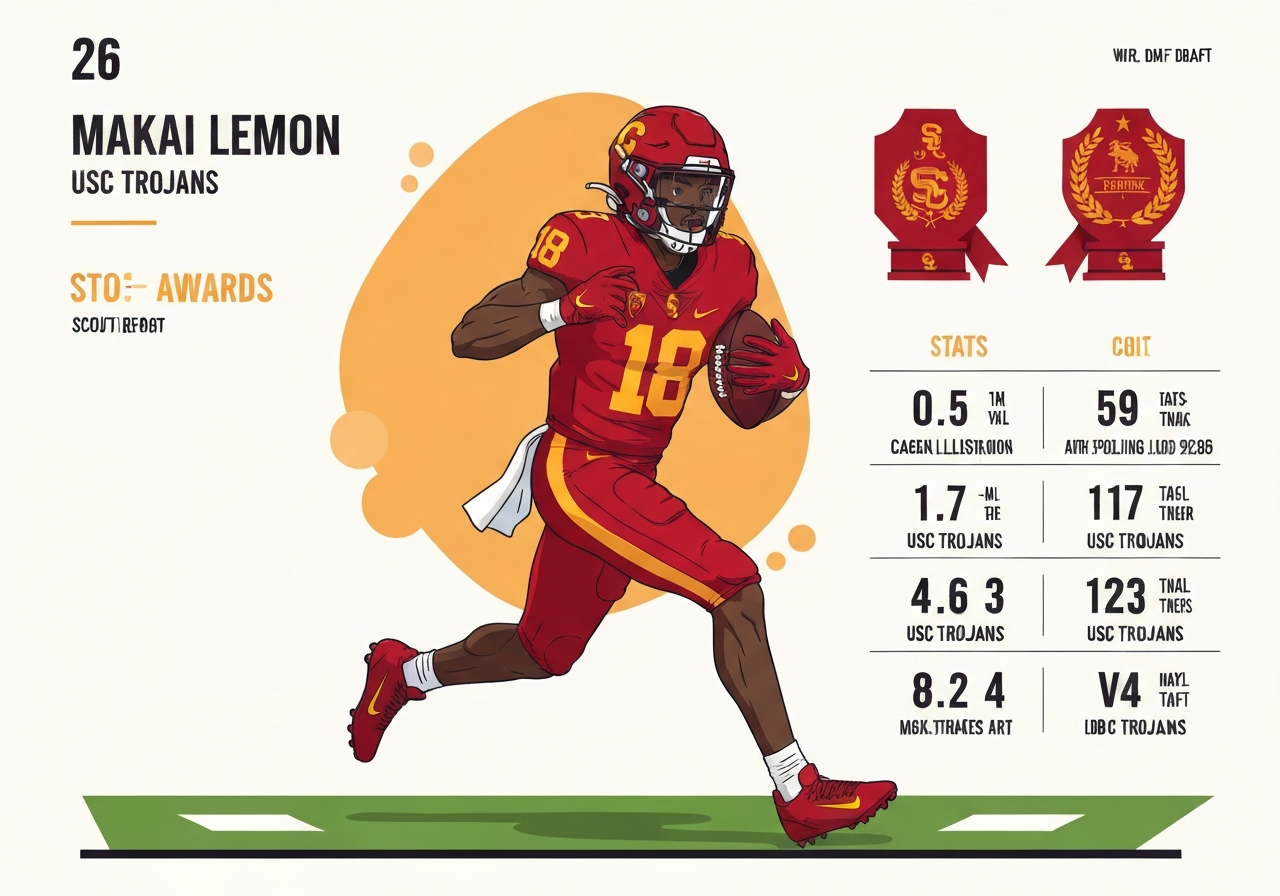
Lead: On April 24, 2026, the Philadelphia Eagles traded with the Dallas Cowboys to move back and select wide receiver Makai Lemon from USC with the No. 20 overall pick. Lemon arrives after a three-year collegiate arc that culminated in the 2025 Biletnikoff Award and a 1,156-yard, 11-touchdown season. The pick addresses Philadelphia’s need for a polished, contested-catch receiver who can contribute immediately in short-to-intermediate passing game concepts. Expect the Eagles to deploy Lemon early while they evaluate his deep-route consistency at the NFL level.
Key Takeaways
- Makai Lemon was taken No. 20 overall by the Philadelphia Eagles on April 24, 2026, after a trade with the Dallas Cowboys.
- College production: 2023 — 6 receptions for 88 yards (9 games); 2024 — 52 receptions, 764 yards, 3 TDs (12 games, 6 starts); 2025 — 79 receptions, 1,156 yards, 11 receiving TDs, plus 2 rushing TDs and a passing TD (12 games, 12 starts).
- Awards and honors include the 2025 Biletnikoff Award, First-Team All-American, First-Team All-Big Ten and Polynesian College Football Co-Player of the Year.
- Measured at 5’11”, 192 lbs with a reported 40-yard dash of 4.47 seconds; other combine/pro day numbers were not publicly listed in the source.
- Scouting summary: elite contested-catch ability and reliable hands; excels short-to-intermediate and on contested targets but shows questions on long speed and route-timing consistency.
- Projected role: immediate situational starter in the slot/wrap-around boundary zones with upside to expand routes once timing with the quarterback improves.
- Comparison frequently made during draft season: Amon-Ra St. Brown — similar competitive temperament and high-volume hand skills.
Background
The 2026 draft opened with teams prioritizing playmakers who can create separation within compressed windows; undersized, high-volume receivers have become premium assets because they consistently produce slot and chain-moving yardage. Lemon developed in that mold at USC, where coaching emphasized contested catching, route precision in short-to-intermediate concepts, and physicality after the catch. Across three seasons he moved from sporadic snaps in 2023 to a high-usage, award-winning role in 2025, reflecting both physical maturation and schematic trust from USC’s staff.
Philadelphia entered the draft seeking dependable targets for their quarterback amid a league-wide premium on quick-read passing attacks. The Eagles’ offense has historically valued receivers who can win contested throws and sustain separation in tight windows; that contextual fit elevated Lemon on their board despite concerns about deep speed. College accolades — notably the Biletnikoff Award and All-American recognition — boosted his profile for teams needing immediate, reliable hands at the catch point.
Main Event
Draft night unfolded with the Eagles agreeing to a swap with the Cowboys that allowed Philadelphia to select at No. 20 and take Makai Lemon. Team decision-makers prioritized his track record of contested catches and dependable production across high-leverage downs. Media reporting emphasized that the Eagles viewed Lemon as a receiver who can step into third-down and red-zone situations right away while their coaching staff integrates him into broader route trees.
On-field tape shows Lemon regularly winning contested situations and serving as a safety valve in timing-based concepts, often creating separation with sudden, violent breaks rather than pure top-end speed. His 2025 campaign — 79 catches for 1,156 yards and 11 receiving TDs — showcased his ability to sustain high-volume production over a full season while contributing on jet sweeps and trick-play passing when called upon.
Coaches and scouts at the college level praised Lemon’s hand strength and catch consistency; he rarely relinquished contested targets and routinely finished catches through contact. Those traits were central to Philadelphia’s decision-making, which favored a polished technician with immediate situational value over a longer-term, purely upside prospect with elite deep speed.
Analysis & Implications
Strategically, drafting Lemon signals the Eagles want a dependable chain-mover who reduces turnover risk on intermediate reads. NFL defenses often prioritize limiting explosive plays; a receiver like Lemon who consistently wins contested targets and stays productive after contact helps sustain drives and improve third-down conversion rates. In matchups where defensive backs push into short zones, Lemon’s contested-catch prowess should create mismatches against linebackers and nickel corners.
Economically, a first-round pick entails expectations of early snaps and a significant rookie contract commitment; the Eagles are betting that Lemon’s polished skill set shortens the rookie learning curve. If Lemon adapts quickly to NFL route timing and deep-concept acceleration, the pick could pay dividends in both offensive efficiency and scoring opportunities. Conversely, persistent long-speed limitations would cap his ceiling as a vertical separation threat, funneling him into a high-volume slot/possession role.
On the broader draft market, Lemon’s selection continues the recent NFL trend of valuing technical, contested-catch receivers even when they lack elite measurable explosiveness. Teams balancing immediate offensive needs against developmental upside increasingly select players who can influence red-zone outcomes early — a profile Lemon fits. Internationally and across scouting circles, his award-laden final season enhances perceived reliability, which carries weight for both coaching staffs and future contract negotiations.
Comparison & Data
| Season | Games | Receptions | Receiving Yards | Receiving TDs |
|---|---|---|---|---|
| 2023 | 9 | 6 | 88 | 0 |
| 2024 | 12 | 52 | 764 | 3 |
| 2025 | 12 | 79 | 1,156 | 11 |
Context: Lemon’s jump from 52 catches in 2024 to 79 in 2025 reflects both increased target share and improved efficiency. His 1,156 yards and 11 receiving TDs in 2025 positioned him among the nation’s top receivers by traditional volume metrics, supporting his selection at the top of the first round despite measurable limitations.
Reactions & Quotes
“A productive, contested-catch specialist who finished his collegiate career at the top of the national leaderboard for catches in critical situations,”
Bleeding Green Nation (media report)
This summary from the reporting media captured the draft narrative that Lemon’s hands and contested-catch success were decisive factors for Philadelphia.
“His 2025 Biletnikoff win and All-American status show he handled high volume and attention; the NFL question is whether his straight-line speed will stretch defenses as a consistent vertical threat,”
Draft analyst consensus (media coverage)
Analysts framed the pick as a balance between immediate reliability and longer-term ceiling; that tension will shape Lemon’s snap distribution early in his pro career.
“Fans noted strong tape on contested catches but raised speed questions in social coverage on draft night,”
Public/social reaction (aggregated)
Social media reaction reflected a mix of optimism about hands and competitiveness, paired with reminders to monitor his contested-to-explosive-play ratio at the next level.
Unconfirmed
- Exact trade compensation with the Dallas Cowboys (pick swaps, future picks or players) beyond the reported move-back to No. 20 has not been fully detailed in all public reports.
- Comprehensive combine/pro-day testing numbers for several drills (vertical, broad jump, 3-cone, short shuttle, bench press) were not published in the sourcing; official measurements may surface or vary by team reporting.
Bottom Line
The Eagles used a first-round selection on Makai Lemon to secure a polished, contested-catch receiver who posted 1,156 yards and 11 receiving touchdowns in 2025 and won the Biletnikoff Award. Philadelphia prioritized immediate reliability and red-zone production over top-end measured explosiveness, betting that his hand strength and contested-catch skills will translate quickly in third-down and goal-line packages.
Key items to monitor: how quickly Lemon builds timing with the Eagles’ quarterback on deeper routes, whether coaching can mitigate his long-speed concerns, and how the team deploys him—primarily as a slot/possession option or as a more diverse route-tree weapon. If he adapts efficiently, Lemon should impact drive-extension and scoring metrics early in his rookie season.