
Lead
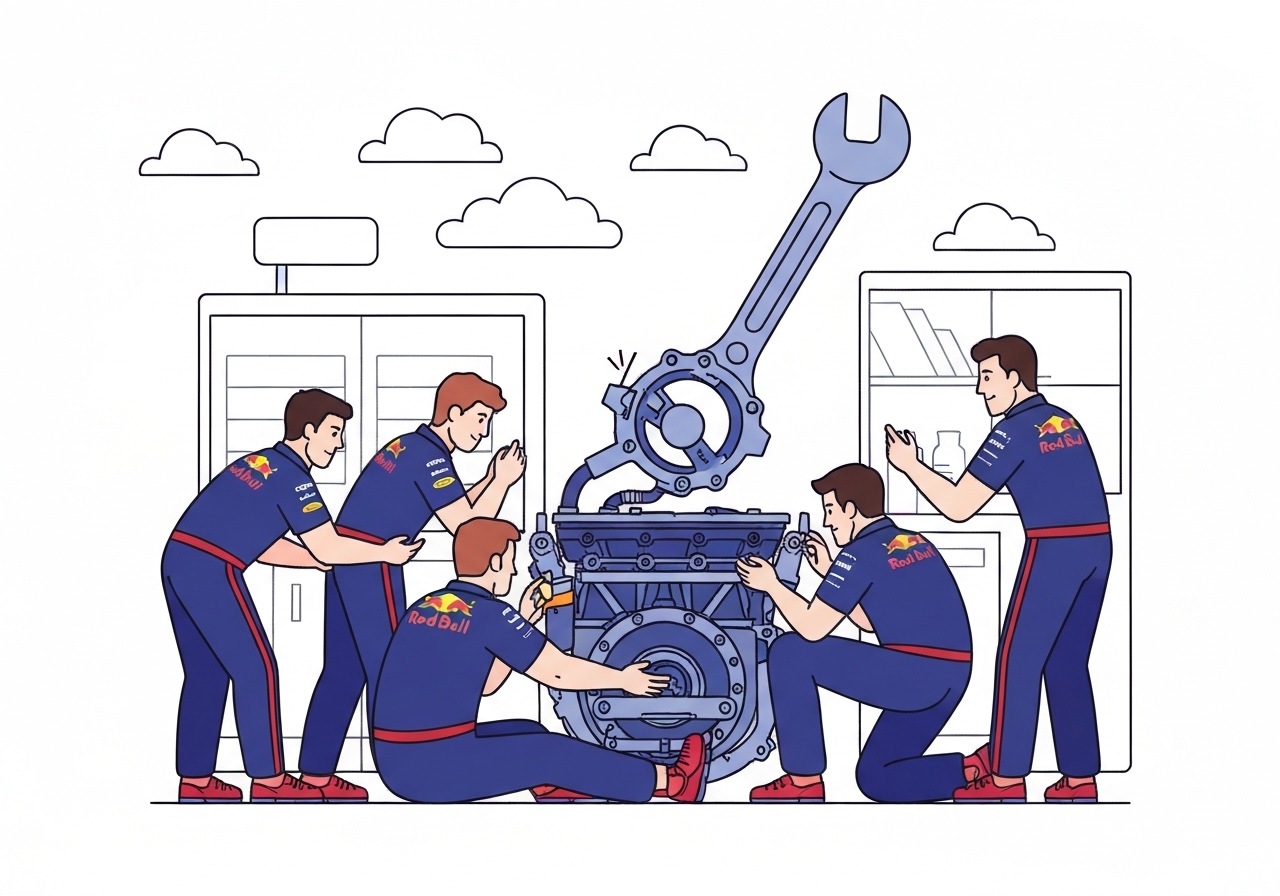
Red Bull Racing has warned that its debut season running in-house engines with Ford support could be bumpy during the opening rounds of the 2026 Formula 1 campaign. The warning came as Red Bull and sister team Racing Bulls unveiled their 2026 liveries at Ford Racing’s season launch in Detroit on Thursday night, where Ford confirmed a formal partnership with Red Bull Powertrains. Red Bull Powertrains has expanded rapidly — now employing more than 700 people across three factories — but the team’s leadership says immediate parity with established engine-makers is unlikely. Team principal Laurent Mekies framed early reliability and integration headaches as expected growing pains rather than a sign of long-term weakness.
Key Takeaways
- Red Bull and Racing Bulls showed their 2026 liveries at Ford Racing’s Detroit launch on Thursday night ahead of the new rules season.
- Ford has joined Red Bull Powertrains as a partner for 2026, pledging technical staff and equipment to the project.
- Red Bull Powertrains now exceeds 700 employees and operates three factories, all built since the project began.
- Laurent Mekies warned of “a few headaches, a few sleepless nights,” and asked fans to expect struggles in the first few months of 2026.
- Ford executive chairman Bill Ford used bold language — “together, we’re going to be unstoppable” — while CEO Jim Farley called the undertaking a mountain to climb and an underdog project.
- Technical director Ben Hodgkinson compared the effort to racing alone in a foreign stadium, underscoring limited benchmark visibility until pre-season testing.
- Pre-season testing will be the first real indicator of where the new Red Bull–Ford power unit sits against established rivals.
Background
Red Bull Powertrains was founded by Red Bull to design and manufacture its own Formula 1 power units under the 2026 regulations. The company has grown quickly, recruiting experienced engineers and building production capacity; public figures cited at the launch put staffing above 700 people with operations across three factories. Ford formally joined the effort as a partner and committed staff and equipment to accelerate development, turning a bespoke Red Bull operation into a manufacturer-backed programme.
The 2026 rule change marks a rare reset in F1 power-unit regulation, creating a window for entrants and reshuffling the competitive order. Historically, teams that arrived early and well-resourced have converted rule changes into advantage — Mercedes High Performance Powertrains is a cited example for its early mastery in the 2014 era. Red Bull’s decision to hire experienced personnel such as Ben Hodgkinson — who worked at Mercedes HPP during that period — reflects an explicit desire to import institutional knowledge.
Main Event
The Detroit launch focused attention on the engine partnership as much as the new liveries. Ford executives and Red Bull leaders shared the stage, balancing optimism about long-term potential with candid expectations for the near term. Mekies told attendees that assuming immediate parity with established manufacturers would be naive and asked stakeholders to allow time for the integration to mature.
Ford’s public messaging diverged between big-picture ambition and caution: Bill Ford offered a headline-grabbing assertion of future dominance, while CEO Jim Farley acknowledged the scale of the challenge and described the project as an underdog effort. On the technical side, Ben Hodgkinson used a vivid analogy — likening the programme to running a 400-metre race alone in a foreign stadium — to explain the practical limits on benchmarking ahead of on-track tests.
The team stressed that meaningful comparisons to rivals will only be possible after pre-season testing, when lap times, reliability and fuel-use data become available. Until then, the launch was positioned primarily as a declaration of intent and a demonstration of resource commitment rather than a performance claim. Red Bull said the initial months will be a learning phase and framed early problems as part of an expected progression toward competitiveness.
Analysis & Implications
The short-term implication is clear: early-season reliability and integration issues could cost Red Bull valuable points or race results, opening a window for rivals in the opening rounds. Given the tight championship margins in modern F1, even a modest dip in performance or a string of retirements could shift momentum. Teams with factory-backed, mature power-unit programmes will enter 2026 with institutional experience that often translates to fewer teething problems during the first races.
In the medium to long term, Ford’s involvement changes the calculus. Access to Ford’s engineering resources, test facilities and supplier relationships should accelerate development compared with a purely independent start-up. The presence of over 700 staff and multiple factories gives Red Bull Powertrains scale, but scale alone does not guarantee immediate peak performance; systems integration, reliability engineering and on-track calibration remain decisive.
Ben Hodgkinson’s recruitment signals Red Bull’s intent to replicate practices from successful engine manufacturers. His past role at Mercedes HPP — a squad that dominated early in the last major power-unit transition — provides relevant experience in avoiding the pitfalls of a new-build programme. However, past success is not a guarantee: the 2014 example involved years of accumulated know-how and a different competitive landscape.
Comparison & Data
| Attribute | Red Bull Powertrains (known) | Context / Benchmark |
|---|---|---|
| Staff | >700 employees | Rapidly built-up workforce since project launch |
| Facilities | 3 factories | New production and assembly infrastructure |
| Manufacturer status | New entrant (2026 debut) | Established makers have multi-year continuity |
The table summarizes verifiable program metrics disclosed at the launch: workforce size and factory count. Those figures indicate industrial scale but do not measure on-track competitiveness, which depends on design maturity, software, cooling packaging and integration with chassis aerodynamics. The decisive data points will arrive during pre-season testing and the first races, when lap times, reliability records and fuel consumption metrics can be compared directly to incumbents.
Reactions & Quotes
The public responses mixed bold long-term confidence with short-term realism, reflecting different communication priorities from Ford and Red Bull.
Together, we’re going to be unstoppable.
Bill Ford — Ford executive chairman (public statement)
I don’t think anyone truly understands what a mountain it is to climb.
Jim Farley — Ford CEO (launch remarks)
We will go through the struggle. We will eventually come out on top. Bear with us in the first few months.
Laurent Mekies — Red Bull Racing CEO and team principal (launch remarks)
Unconfirmed
- The exact on-track performance gap between Red Bull Ford Powertrains and incumbent manufacturers before pre-season testing is not yet known.
- The precise scale and timing of Ford personnel and equipment contributions to day-to-day development have not been fully disclosed.
- Any internal reliability targets or failure-rate expectations for the first races have not been published by the teams.
Bottom Line
Red Bull’s move to run its own engines with Ford support is a major strategic step that combines rapid in-house growth with a legacy car-maker partner. The programme now has industrial heft — more than 700 staff and three factories — and credible technical leadership, but the team itself and Ford caution that early-season struggles are likely and expected.
For observers, the clearest near-term signal will be pre-season testing and the opening races; those sessions will show whether the partnership can translate infrastructure and talent into immediate competitiveness or whether the team pays a short-term price on track. Over the course of 2026 the story will pivot on how quickly Red Bull Ford Powertrains closes the reliability and performance gaps and whether early setbacks reshape the championship landscape.