
Lead
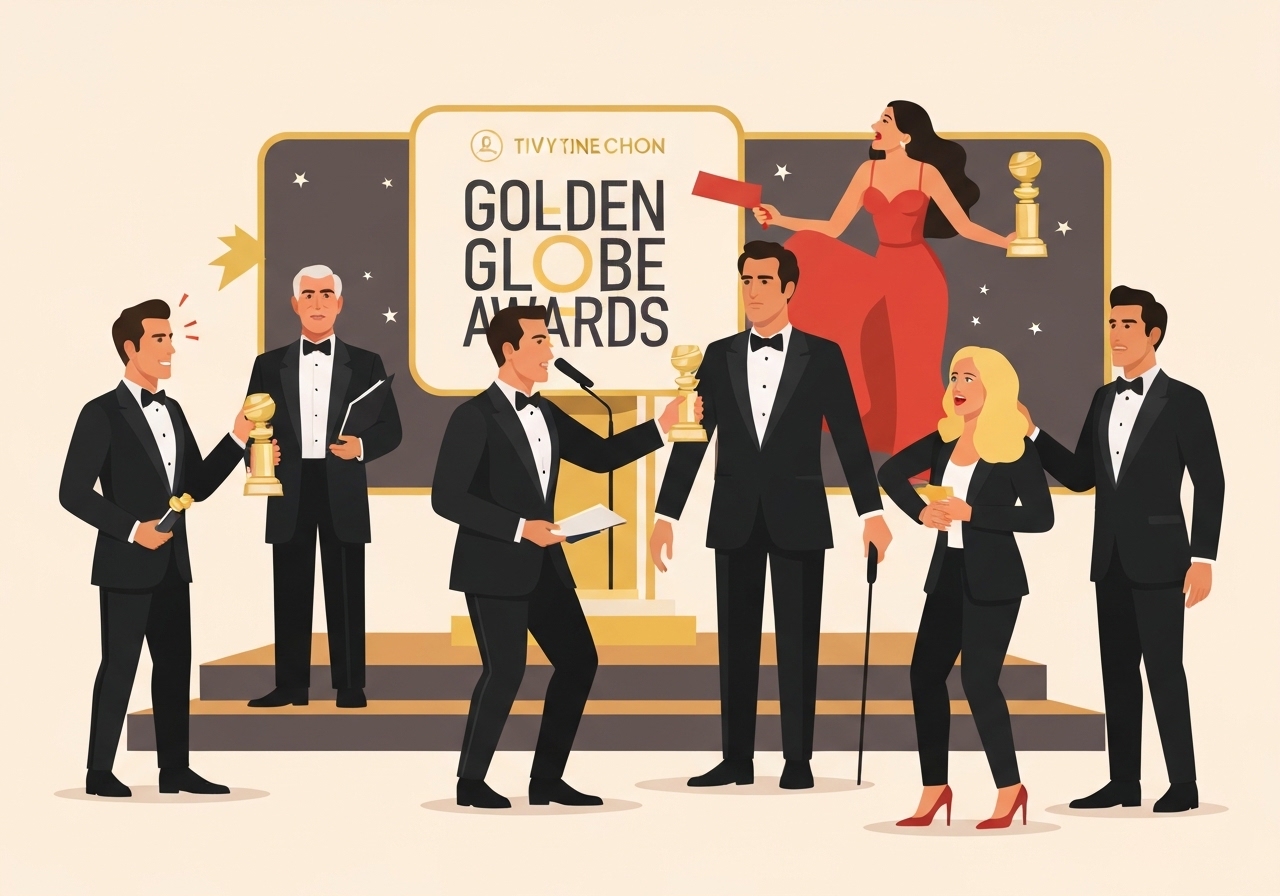
On Monday the Penske Media-managed Golden Globe ceremony proceeded in Los Angeles despite the Hollywood Foreign Press Association being formally dissolved in 2023; 95 former HFPA members kept voting rights and the show went ahead. The event included commercial tie‑ins such as a Polymarket partnership and introduced a new podcast award that went to Amy Poehler’s Good Hang. Television honours recognised Stephen Graham for Adolescence on Netflix and HBO’s The Pitt won best drama, while Michelle Williams took a prize for Dying for Sex on FX. Watching the assembled talent on the red carpet and in the audience, it was hard to imagine many of them skipping future ceremonies despite recurring controversies.
Key Takeaways
- The Golden Globes continued under Penske Media on Monday, with 95 ex‑HFPA members retaining ballot privileges after the HFPA’s 2023 disbandment.
- Penske’s second iteration of the awards featured a branded integration with Polymarket, a commercial betting‑tool partner tied to audience engagement.
- A new category for podcasts was added; Amy Poehler’s Good Hang won over finalists including Call Her Daddy and The Mel Robbins Podcast.
- TV prizes included recognition for Stephen Graham’s Adolescence (Netflix) and HBO’s The Pitt as best drama; Michelle Williams won for Dying for Sex (FX).
- A separate industry note: AARP reaches roughly 38 million U.S. members and its awards attracted established stars such as George Clooney this week.
- In theatre, Oh, Mary! transferred from New York to London’s Trafalgar Theatre and has drawn a mixed reaction from West End audiences despite sold‑out runs.
- Pop culture coverage of the week also revisited Alan Rickman on the 10th anniversary of his death, prompting renewed appreciation for his diaries and anecdotes.
Background
The Hollywood Foreign Press Association (HFPA) lost its institutional standing after a series of racism allegations and structural critiques that culminated in the organisation’s effective dissolution in 2023. Control of the Golden Globes ceremonies moved to Penske Media, which carried forward the awards while inheriting reputational challenges and the question of legitimacy in the industry. Despite institutional upheaval, a bloc of 95 former HFPA members retained voting privileges, allowing a recognisable ballot process to continue.
For decades the Golden Globes served as a high‑profile early awards moment in the entertainment calendar, valued for publicity and the chance to shape awards season narratives. Commercial partners and broadcasters have a financial incentive to keep the event prominent, and promoters have sought new formats and sponsor integrations to stabilise viewership. The week’s other cultural notes — from West End transfers to AARP’s own ceremonies — reflect a broader media landscape where brand reach and demographic targeting shape programming choices.
Main Event
The Monday ceremony highlighted how the mechanics of show business can outlast institutional scandal: attendees still arrive in formalwear, cameras still scan the room, and producers still introduce new categories to broaden appeal. One conspicuous innovation was an advertising and data partnership with Polymarket, billed as offering integrated branding and market insights to deepen audience engagement. The new podcast prize acknowledged the medium’s growing role in celebrity culture and promotional strategy; Amy Poehler’s Good Hang emerged as the winner amid established contenders.
Onstage moments and awards were a mix of the expected and the pointedly commercial. Nikki Glaser’s opening set sent cameras across a crowd that, despite repeated criticisms of the ceremony’s governance, showed few absentees. Television awards distributed this week included recognition for Stephen Graham’s Adolescence, which explores masculinity and social dynamics on Netflix, and HBO’s The Pitt was named best drama — a title noted for limited legal access in some territories. Michelle Williams’s win for the FX series Dying for Sex was singled out as under‑appreciated work that found overdue recognition.
The week also featured AARP’s Movies for Grownups awards, where established figures such as George Clooney appeared to accept honours; the ceremony underlines how different institutions cultivate prestige across overlapping audiences. Meanwhile, in London theatre the transfer of Oh, Mary! to the West End brought praise for the cast but mixed audience reactions, with some viewers unsettled by the show’s irreverent treatment of historical figures. Coverage of Alan Rickman’s diaries and tributes on the 10th anniversary of his death rounded out cultural conversation, reminding readers of long‑running engagement with performer legacies.
Analysis & Implications
The persistent turnout at award shows despite ethical or structural questions points to the complex incentives that sustain celebrity culture. For performers and studios, an awards appearance fuels publicity cycles, streaming‑platform algorithms and subsequent bookings; skipping a red carpet can carry professional and commercial costs. Even where governance failures erode institutional credibility, the immediate business logic for attendance — visibility, platforming, networking — often outweighs reputational concerns in the short term.
Penske Media’s stewardship of the Globes shows how private media companies can repurpose legacy ceremonies into monetisable properties. The addition of categories such as podcasts and partnerships with commercial prediction or betting platforms signal an effort to diversify revenue and audience metrics. Those moves may stabilise income but risk further commodifying what were once peer‑judged accolades, raising questions about cultural value versus commercial optimisation.
Broader industry patterns are visible in parallel: organisations with large, affluent audiences — such as AARP, with about 38 million members — can shape cultural agendas by staging awards and curated content for target demographics. Similarly, high‑circulation print titles like Costco’s magazine (circulation reported at 15.4 million) demonstrate that sizeable, monetisable readerships still exist outside digital‑native outlets. Together these examples show that audiences and advertisers remain the levers that determine which cultural events thrive.
Comparison & Data
| Organisation | Type | Reach / Note |
|---|---|---|
| Golden Globes (Penske era) | Awards ceremony | Succeeded HFPA ceremony after 2023 transition; 95 former HFPA voters retained |
| AARP | Membership non‑profit / media | ~38 million U.S. members and a major publishing arm |
| Costco magazine | Retail magazine | Circulation reported at 15.4 million |
The table above contrasts the institutions that surfaced in the week’s coverage: an awards brand undergoing institutional change, a membership organisation with wide demographic reach, and a high‑circulation retail magazine. These figures illustrate why certain events attract star power — the scale of audience or membership translates into promotional and financial incentives for participants and sponsors. For award organisers, reach matters as much as reputation when it comes to securing talent and advertisers.
Reactions & Quotes
Industry voices and cultural observers framed the week’s events in different ways. Before the ceremony, a quip from a veteran host resurfaced as shorthand for institutional critique; that remark has become shorthand for scepticism about the HFPA’s past behaviour.
The HFPA used to operate out of “the back booth of a French McDonald’s,” a line that captured widespread cynicism about the group’s credibility.
Tina Fey (host, 2019)
Later in the week, reflections on celebrity culture and insider parties prompted recall of a sharply observed anecdote about celebrities at social gatherings, used to argue that awkward or disorderly episodes at events are not new and do not necessarily alter industry routines.
“I had never seen a group of people more uncontrollably drunk and disorderly,” an actor remembered after attending a late‑1990s party, a line often cited in discussions of celebrity social life.
Alan Rickman (diaries)
Unconfirmed
- Any suggestion that Polymarket’s sponsorship influenced award outcomes remains unproven and is not supported by public evidence.
- Claims of widespread London audience rejection of Oh, Mary! are anecdotal; while some viewers expressed disapproval, box‑office reports show sold‑out performances.
Bottom Line
The week underscored a tension at the heart of contemporary culture: ceremonies and institutions can lose normative authority yet retain instrumental value for participants. Awards remain a currency for publicity and industry momentum even when governance is questioned, because the tangible benefits of visibility, contracts and streaming placement persist.
Looking ahead, the sustainability of ceremonies like the Golden Globes will depend on whether new stewards can combine credible adjudication with viable business models. For now, audiences, advertisers and nominees continue to treat the events as essential stops on the cultural calendar — which means the spectacle, and the scrutiny that follows, will likely continue.