
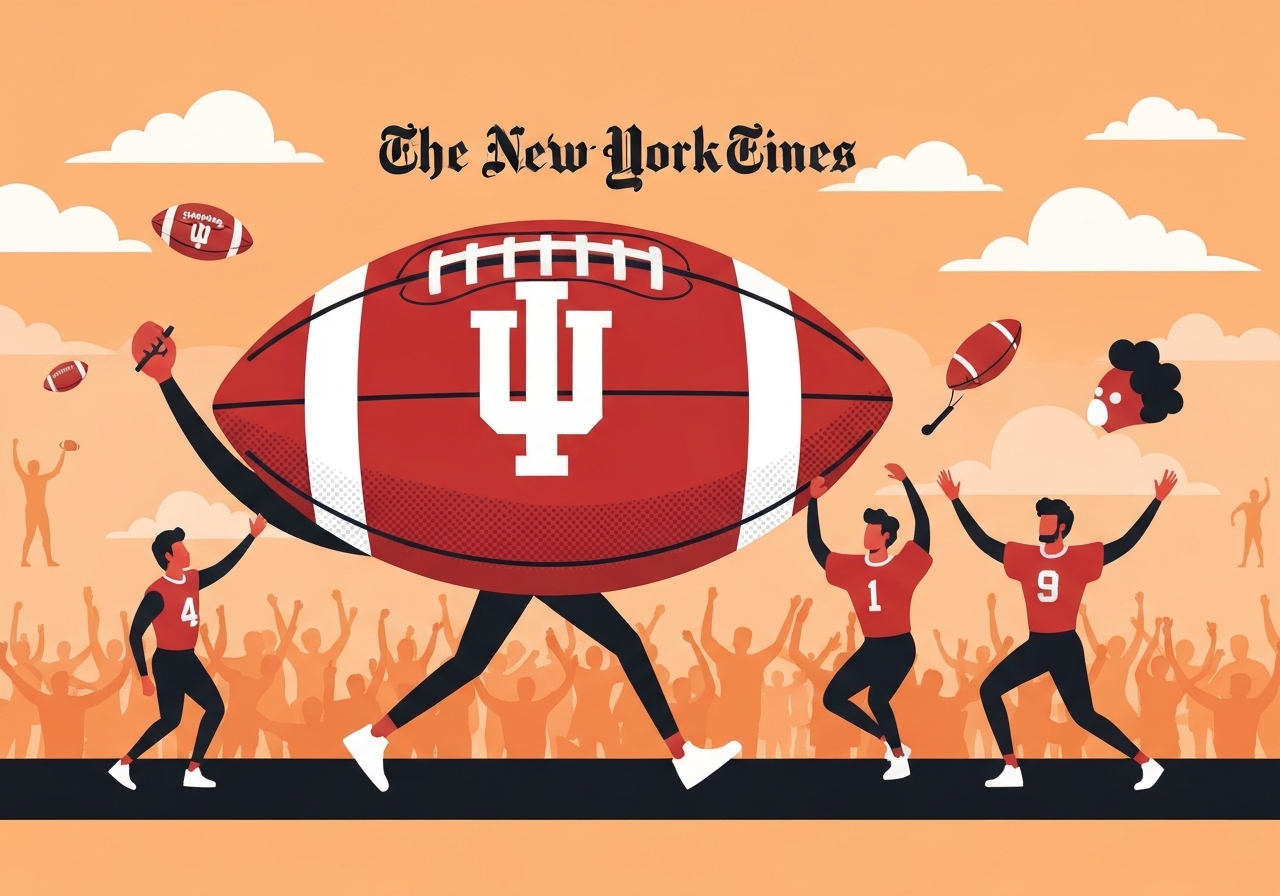
In two seasons, Indiana transformed from a Big Ten cellar dweller into a national championship contender, producing a 26-2 run that included College Football Playoff routs of Alabama and Oregon. Head coach Curt Cignetti inherited a program that went 3-24 in Big Ten play over the prior three years and has overseen a rapid rebuild that has reverberated across the sport. The Hoosiers’ climb — powered by transfers, bigger budgets and high-profile additions such as Heisman-winning quarterback Fernando Mendoza — has prompted programs and fans nationwide to reassess timelines and expectations. As administrators and coaches react, the sweeping change raises questions about money, roster mobility and what constitutes a viable job in modern college football.
Key Takeaways
- Indiana posted a 26-2 overall record under Curt Cignetti, including decisive College Football Playoff wins over Alabama and Oregon in 2025.
- The program had been 3-24 in Big Ten play in the three seasons before Cignetti’s arrival, and entered 2025 with the most losses in FBS history.
- Indiana’s athletic budget for football rose from under $24 million in 2021 to over $61 million in 2025, per the Knight-Newhouse database cited by reporting.
- The university paid a $15.5 million buyout to fire Tom Allen in 2023, signaling a growing financial commitment to football.
- Transfers such as D’Angelo Ponds, Elijah Sarratt, Mikail Kamara and QB Fernando Mendoza were key additions that shortened a traditional rebuild timeline.
- Industry observers estimate Indiana likely spent more than $20 million on roster-related costs in the recent cycle.
- Over the past three seasons, 11 different schools have filled 12 College Football Playoff semifinal slots, reflecting greater roster mobility across programs.
- Inside voices say Indiana’s rise is exceptional rather than a universal blueprint, but the program has nevertheless accelerated shifts in expectations and hiring behavior.
Background
For decades, program turnarounds typically required multiple recruiting classes and slow development of high school signees. Coaches who inherited weak rosters were largely stuck with their predecessors’ players for a year or two, limiting how quickly a program could change its on-field fortunes. That era began to shift as transfer rules loosened and the transfer portal matured into a major talent marketplace, permitting quicker roster overhauls.
Indiana’s case is notable because the program combined that new roster flexibility with a deliberate increase in financial resources. The school’s football budget more than doubled between 2021 and 2025, moving from well below the Big Ten median to well above it. Institutional spending, coaching hires and roster purchases have all influenced how candidates and fans evaluate job trajectories in a compressed time frame.
Simultaneously, fan patience has shortened. Athletic departments are under pressure to show progress quickly, and donor support or high-profile gifts — such as a recent donation from alumnus Mark Cuban to Indiana’s football effort — can reshape what a program is able to offer coaches and players. Those shifts interact with social-media-driven expectations that demand immediate results.
Main Event
Curt Cignetti arrived at Indiana and quickly reshaped the roster, bringing impact transfers from his previous stops and accelerating the team’s competitive window. Players who might once have been required to sit out a season were available immediately under current transfer rules, allowing Indiana to field a roster markedly different from the one that struggled in prior years. The team’s success culminated in lopsided CFP victories and a national championship appearance that few predicted when the decade began.
Administrators at other programs reacted with a mix of alarm and recalibration. Athletic directors and agents described an environment in which coaching jobs are judged first by available resources for players and recruiting rather than solely by facilities or tradition. Some programs that had been viewed as safer or more prestigious now find themselves competing for talent and staff in ways they had not anticipated.
Internally, Indiana moved to secure its coach. In October, when other programs showed interest, Cignetti signed a new contract that will place him among the top three highest-paid coaches in college football. That commitment, together with roster spending and the firing buyout paid in 2023, signaled to the broader market that Indiana intended to sustain its investment.
The Hoosiers’ roster strategy included targeted transfers: cornerback D’Angelo Ponds, receiver Elijah Sarratt and defensive lineman Mikail Kamara were among the additions from Cignetti’s previous stop, and the team also landed Heisman Trophy-winning quarterback Fernando Mendoza. Those moves, industry sources say, required significant roster spending and helped compress what used to be a multi-year rebuild into a two-year ascent.
Analysis & Implications
Indiana’s rapid ascent illustrates how the transfer portal and concentrated spending can upend conventional rebuilding timetables. When coaches can add ready-made starters immediately, patience measured in recruiting cycles gives way to expectations of near-instant results. That shift increases turnover risk for programs that cannot match the new pace of investment.
Financially, the case underscores the centrality of budget allocation in modern college football. Indiana’s football budget more than doubled from below $24 million in 2021 to above $61 million in 2025, a change that moved the school from underfunded relative to its conference to a top-tier spender. That reallocation — including an estimated $20 million-plus on roster-related costs — demonstrates that competitive parity increasingly depends on where institutions are willing to deploy resources.
For coaches, the landscape of what constitutes a “great job” has evolved. Candidates now ask first about committed roster dollars and second about traditional factors such as facilities and recruiting pipelines. The result is a labor market where programs that were once considered downtrodden can become coveted if institutional backing arrives, and historically successful programs risk reputational damage if they fail to invest at comparable levels.
At a macro level, the Indiana example may produce wider institutional responses: more upward pressure on budgets across conferences, rethinking of buyout policies, and renewed debate over the role of donor influence in competitive balance. If other schools match spending, parity might return; if not, a new hierarchy informed by financial commitment and transfer marketplace acumen could take shape.
Comparison & Data
| Year | Indiana Football Budget (approx.) |
|---|---|
| 2021 | Under $24 million |
| 2025 | Over $61 million |
The table above places Indiana’s budget increase in stark relief. That kind of growth explains both the ability to pay a $15.5 million buyout in 2023 and to pursue a high-profile transfer strategy. While exact roster and roster-adjacent spending figures remain partially undisclosed, industry estimates cited in reporting put roster-related costs above $20 million for the recent cycle.
Reactions & Quotes
Administrators and agents were quoted anonymously in reporting to illustrate internal industry sentiment. Their statements reflect concerns about rapidly rising expectations and the influence of money on program trajectories.
“In college football nowadays, you have to win every year. With social media the way it is, the pressure to be successful, you’ve got to put together a team that’s ready to compete for championships every single year.”
Curt Cignetti, Indiana head coach (public remarks)
This comment by Cignetti, made while discussing roster construction and expectations, captures the coach’s view that the current environment demands consistent contention. It also helps explain why the university moved quickly to extend his contract.
“He’s the exception, not the norm.”
Coaching agent (anonymous, industry comment)
An agent’s assessment emphasizes that while Indiana’s turnaround is impressive, it is not necessarily replicable for every program without similar resource commitments. Several other anonymous industry sources echoed the sentiment that Indiana’s combination of transfers and spending is unusual.
“People have to be cautious about what jobs they take, because Indiana was a non-starter a few years ago.”
Player agent (anonymous)
That quote reflects shifting market signals for coaching candidates and highlights how fast a program’s profile can rise when institutional priorities change.
Unconfirmed
- Exact roster-related spending for Indiana is not publicly disclosed; industry figures estimating more than $20 million have not been independently verified by university financial disclosures.
- Reports that Mark Cuban’s recent donation directly funded roster acquisition have not been specifically itemized by the university.
- Attribution of internal motives for other programs’ hiring decisions, as reported by anonymous sources, remains partially speculative without public statements from those institutions.
Bottom Line
Indiana’s rapid rise under Curt Cignetti is a clear demonstration of how transfer mobility and concentrated financial investment can compress rebuild timelines in major-college football. The program’s leap from 3-24 in Big Ten play over three years to a 26-2 record and CFP run was driven by strategic roster additions, increased budgetary commitment and decisive administrative choices.
The broader effect is a recalibration of expectations for coaches, athletic directors and fans: patience has shortened, and the first question for many candidates is now about committed roster dollars. Whether other programs will replicate Indiana’s model depends on institutional willingness to match spending and adjust recruitment strategies; absent that, competitive balance risks shifting toward programs that do.
For observers and stakeholders, the key takeaway is that structural changes in transfer policy and funding — more than a single coach’s skill — are remaking the sport’s job market and timeline for success. How conferences and governments respond to these trends will shape college football’s next era.