
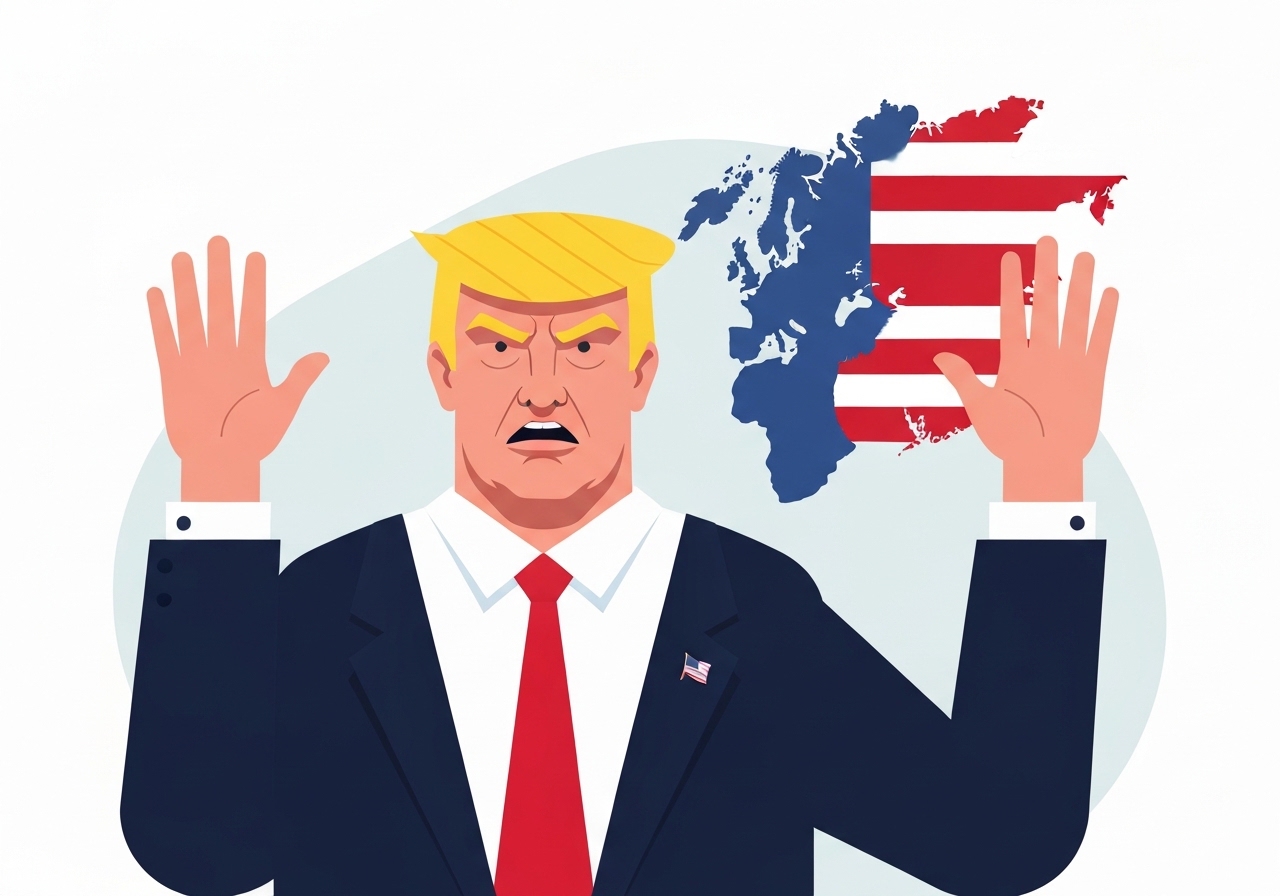
Lead: On 16 January 2026, President Donald Trump renewed public pressure for U.S. control of Greenland, saying he might impose tariffs on countries that do not support Washington’s claim. The remarks came as an 11-member bipartisan U.S. congressional delegation visited Copenhagen to defuse tensions with Denmark and Greenland. Trump framed Greenland as essential to U.S. national security because of its strategic location and mineral resources, and he reiterated that anything less than U.S. control would be “unacceptable.” Lawmakers and allied governments sought to reassure Danish and Greenlandic leaders while a diplomatic working group was being established.
Key takeaways
- President Trump said on 16 Jan 2026 he may levy tariffs on countries that do not back U.S. control of Greenland, citing national security and mineral resources.
- An 11-member bipartisan U.S. congressional delegation, led by Sen. Chris Coons, met Danish PM Mette Frederiksen and Greenlandic PM Jens-Frederik Nielsen in Copenhagen to lower tensions.
- Trump returned to the White House in January 2026 and has repeatedly insisted the U.S. should control the semiautonomous island, calling any other outcome “unacceptable.”
- U.S. Vice President JD Vance and Secretary of State Marco Rubio met Denmark and Greenland foreign ministers in Washington earlier that week; they agreed to form a working group, though public accounts of its purpose diverged.
- Denmark said it would increase its military presence in Greenland in cooperation with allies; several European nations sent small numbers of personnel at Denmark’s request.
- Jeff Landry, Trump’s special envoy to Greenland, said he plans to visit the island in March 2026 and expressed confidence a deal can be reached.
Background
The dispute centers on Greenland, a semiautonomous territory within the Kingdom of Denmark that occupies a strategic position in the Arctic. Greenland hosts critical air and naval approaches across the North Atlantic and Arctic, and it has significant deposits of rare minerals and other resources that have drawn increased geopolitical interest. Relations between Washington, Copenhagen, and Nuuk have been stable for decades as NATO partners, but renewed U.S. strategic attention has elevated the issue to a diplomatic flashpoint.
Trump’s public insistence on U.S. control follows earlier episodes of American interest in Greenland and reflects a broader competition for influence in the Arctic among NATO members and other powers. Denmark maintains constitutional authority over Greenland’s external affairs, though Greenlandic leaders exercise growing self-government. That division of responsibility complicates any unilateral move by the United States and places Danish-Greenlandic consent at the center of the dispute.
Main event
On 16 January 2026, at an unrelated White House event on rural health care, President Trump described Greenland as vital to national security and said he might use tariffs to pressure countries that do not support U.S. control. He told attendees, in reference to European allies, that he would consider tariffs on pharmaceuticals and added, “I may do that for Greenland too.”
Earlier that week, U.S. Vice President JD Vance and Secretary of State Marco Rubio met in Washington with the foreign ministers of Denmark and Greenland. The meeting produced an agreement to establish a working group, but Copenhagen and the White House publicly characterized that group differently, signaling continuing gaps on objectives and sequencing. Danish officials stressed that decisions about Greenland must be made by Denmark and Greenland together.
In Copenhagen, an 11-member bipartisan congressional delegation led by Senator Chris Coons held talks with Danish Prime Minister Mette Frederiksen and Greenlandic Prime Minister Jens-Frederik Nielsen. The delegation emphasized congressional willingness to support U.S.-Danish cooperation and sought to “lower the temperature,” as Coons put it, after the president’s public threats. Separately, European nations sent small contingents of military personnel to Greenland at Denmark’s request, and Copenhagen announced plans to augment its military presence on the island with allied cooperation.
Jeff Landry, designated by the White House as special envoy to Greenland, told Fox News he plans a March 2026 visit and expressed optimism that a deal could be struck once Washington’s demands are clarified and bilateral negotiations proceed. Lawmakers and officials, however, described differences over how to translate those diplomatic contacts into durable arrangements that respect Danish sovereignty and Greenlandic self-rule.
Analysis & implications
Trump’s tariff threat marks an escalation in the rhetorical toolkit the administration is willing to deploy to press strategic aims in the Arctic. Tariffs applied to allied countries would be an atypical use of trade policy to resolve a territorial or geopolitical disagreement and could provoke a broader economic and diplomatic backlash. Allies facing potential levies would likely view such measures as coercive, complicating NATO cohesion on Arctic and broader security matters.
For Greenland, increased U.S. pressure raises questions about self-determination and resource governance. Greenlandic authorities have been pursuing greater control over their economy and foreign partnerships, particularly around mining and energy projects. Any external attempt to assert control or shape outcomes through third-party pressure could strengthen political resistance in Nuuk and feed domestic opposition to outside influence.
Denmark is positioned between alliance commitments to the United States and its constitutional responsibility for Greenland. Copenhagen’s decision to bolster its military presence signals readiness to affirm sovereignty while reassuring allies that it will manage security arrangements in coordination with partners. The creation of a working group could produce technical and procedural measures to manage basing, economic cooperation, and resource access, but its divergent public descriptions reflect an unfinished political negotiation.
Economically, the use of tariffs as leverage risks collateral damage to supply chains and pharmaceutical trade that NATO partners rely on. If implemented, tariffs could trigger reciprocal measures or legal challenges at the World Trade Organization, increasing the cost of coercive diplomacy. Strategically, the episode highlights how Arctic governance is becoming a contested arena where resource competition, military posture, and alliance politics intersect.
Comparison & data
| Item | 2019 (precedent) | Jan 2026 |
|---|---|---|
| U.S. public interest | Purchase talk and diplomatic fallout | Repeated public claims for control; tariffs threatened |
| Diplomatic activity | High-level contacts, mixed signals | VP and Secretary of State met Denmark/Greenland; working group formed |
| Military posture | Routine NATO cooperation | Denmark increasing presence; small allied deployments |
The table summarizes key contrasts with prior U.S. episodes of heightened Greenland interest and the current 2026 escalation. The working group agreed in January 2026 may formalize discussions, but public disagreement about its mandate suggests outcomes remain uncertain. Any concrete basing or transfer-of-authority proposals would require protracted negotiations involving Copenhagen and Nuuk.
Reactions & quotes
U.S. lawmakers in Copenhagen sought to calm partners after the president’s statements by stressing diplomatic channels and congressional support for allied cooperation.
“There’s a lot of rhetoric, but there’s not a lot of reality in the current discussion in Washington,”
Sen. Chris Coons, Democratic congressional delegation leader
At the White House, the president framed tariffs as one means to secure American interests in the Arctic.
“I may put a tariff on countries if they don’t go along with Greenland,”
President Donald Trump
Jeff Landry, the administration’s special envoy to Greenland, signaled plans for in-person diplomacy and optimism that a deal could be reached.
“I do believe that there’s a deal that should and will be made once this plays out,”
Jeff Landry, U.S. special envoy to Greenland
Unconfirmed
- No independent confirmation that tariffs will be formally proposed or enacted; the president framed them as a potential measure rather than a decided policy.
- Claims that the working group will resolve sovereignty questions are premature; Denmark and the White House have publicly described its purpose differently.
Bottom line
The episode underscores an acute diplomatic tension: Washington is asserting strategic priorities for Greenland while Copenhagen and Nuuk emphasize legal authority and self-determination. Tariffs as a lever against allied countries would be a novel and potentially disruptive instrument for resolving a territorial or influence dispute among NATO partners.
Near-term prospects hinge on the working group’s mandate, the March 2026 planned envoy visit, and whether bilateral diplomacy can translate U.S. strategic interests into arrangements that respect Danish sovereignty and Greenlandic autonomy. Policymakers and businesses should watch for concrete proposals on basing, resource access, and legal frameworks rather than rely on public rhetoric alone.