
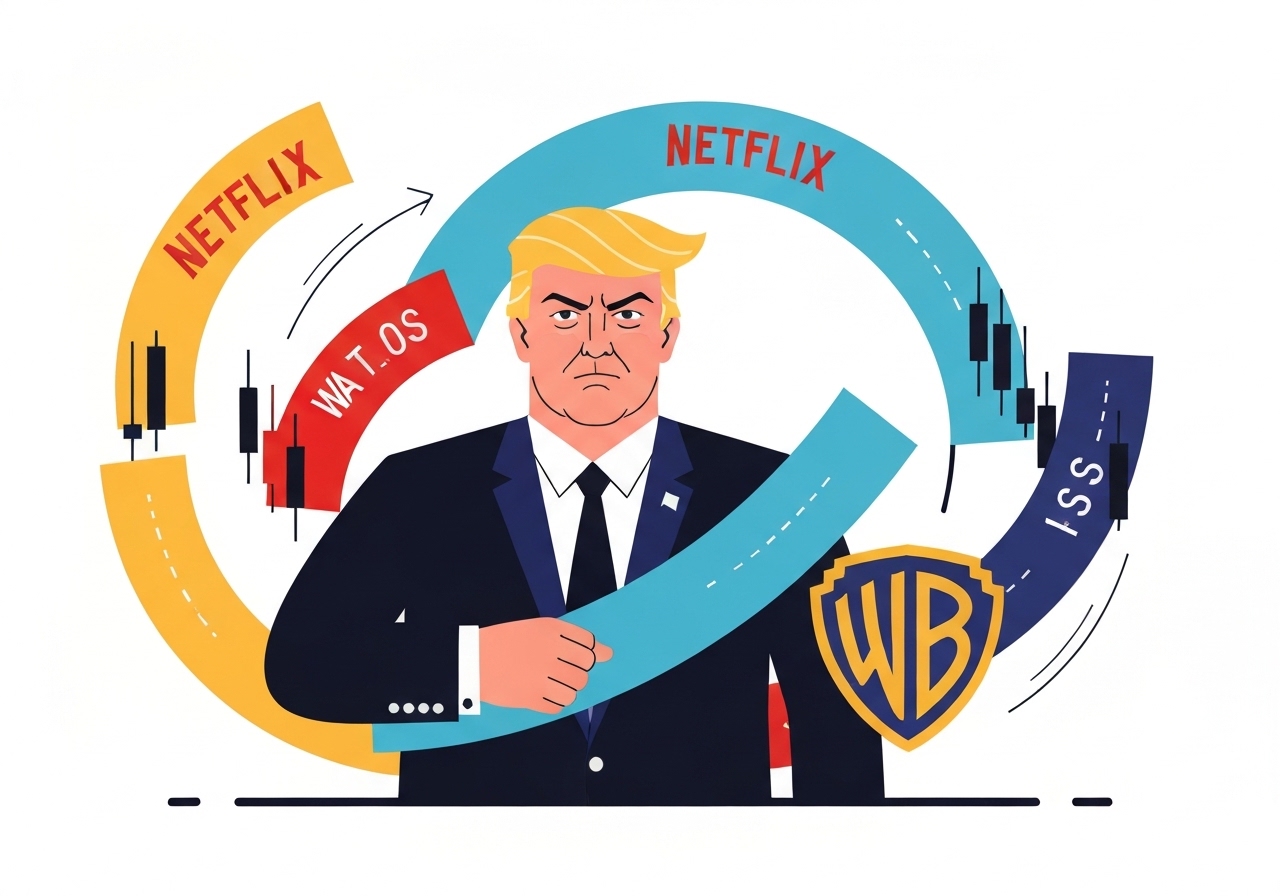
President Donald Trump purchased bond holdings tied to Netflix and Warner Bros Discovery in mid-December, days after he said he would “be involved” in regulatory decisions around the companies’ proposed merger. A White House financial disclosure filed Friday lists two purchases from Netflix and two from Warner Bros Discovery, each entry shown at $502,000 or more, putting the minimum combined total at roughly $1.0m. The transactions — recorded on 12 and 16 December — came a little over a week after Netflix agreed to buy Warner Bros Discovery in an $82.7bn deal that remains subject to regulatory approval. The timing and Mr. Trump’s public remarks about the merger have prompted questions about potential conflicts and market perception.
Key Takeaways
- The White House disclosure lists four bond purchases made on 12 and 16 December, each entry reported at $502,000 or greater, for a minimum combined amount of about $1.0m.
- Netflix announced its $82.7bn agreement to buy Warner Bros Discovery in early December; the deal requires regulatory clearance in the US.
- Trump told reporters at the Kennedy Center on 7 December he expected to “be involved” in decisions related to the consolidation, five days before the bond purchases began.
- The next day, Paramount Skydance launched a $108.4bn hostile bid backed by David Ellison and Larry Ellison, both of whom have ties to the administration.
- Labor groups and some lawmakers criticized the Netflix–WBD deal; the Writers Guild warned of job and wage impacts and Senator Elizabeth Warren called it an ‘‘anti-monopoly nightmare’’.
- The filing also shows Trump bought about $100m in municipal and corporate bonds from mid-November to late December and had previously purchased more than $100m in bonds earlier in his term.
- The White House did not immediately respond; an unnamed official told the Washington Post the president’s portfolio is managed by third-party firms and the president/family cannot direct trades.
Background
The Netflix–Warner Bros Discovery transaction, valued at $82.7bn, was announced in early December and would combine two of the largest content owners in US streaming and entertainment. That consolidation would transfer prominent library shows, including major franchise content, into Netflix’s distribution ecosystem and expand its market share significantly. Antitrust scrutiny is expected because the merger concentrates a large volume of popular content under one platform, prompting regulators to examine consumer prices, competitive dynamics and content diversity.
President Trump’s public remarks in early December — made two days after the deal was announced — signaled he anticipated playing a role in any regulatory considerations. In the weeks that followed, competing bidders moved, including a $108.4bn hostile bid from Paramount Skydance backed financially by CEO David Ellison and his father Larry Ellison. Critics including labor unions and some politicians quickly voiced concerns about market power and worker impacts, while industry players and investors weighed the commercial logic of combining studios and streaming services.
Main Event
On Friday the White House released a financial disclosure showing four bond purchases tied to Netflix and Warner Bros Discovery. The document lists two transactions from Netflix and two from WBD, each entry shown at $502,000 or more; the lines are dated 12 and 16 December. Taken together, the entries create a public minimum of roughly $1.0m in holdings related to the two companies. The purchases occurred after public comments by the president indicating he would be ‘‘involved’’ in how regulators address the merger.
The disclosure arrives amid heightened attention to the deal’s wider competitive implications and to the question of whether public officials’ financial moves could overlap with official duties. The White House did not answer immediate questions about the bond purchases. Separately, an anonymous administration official told the Washington Post that the president’s stock and bond portfolio is handled by independent third-party managers and that the president and his family have no ability to direct specific trades.
Industry observers noted that bond holdings differ from equity stakes but still expose an investor to company credit risk and market movements tied to corporate events. The timing — purchases recorded within days of comments and weeks after the merger announcement — prompted scrutiny from lawmakers and ethics observers who point to the optics and the potential for perceived conflicts of interest during an active regulatory review.
Analysis & Implications
Legally, bond ownership does not necessarily create the same level of conflict as equity stakes, because bondholders are creditors rather than owners. Regulators and ethics rules focus on whether an official’s private financial interests could improperly influence public duties or whether trades reflect material nonpublic information. The White House’s assertion that outside managers control the portfolio, if accurate, aligns with a common mitigation used by officials to reduce direct influence over trades; however, independent management does not remove all ethical or political concerns about appearance.
From an antitrust standpoint, regulators at the Department of Justice and Federal Trade Commission will assess competitive effects regardless of investor composition. Still, the perception that a sitting president has financial exposure to companies involved in a merger could increase political pressure on agencies and lawmakers to scrutinize the transaction more intensely. That could lengthen review timelines or invite conditions intended to protect competition and content diversity.
The deal’s broader market implications include potential shifts in bargaining power with content creators, distribution partners and advertisers if Netflix gains Warner Bros Discovery’s library. Labor groups warn of job losses and wage suppression; for investors, the combination could deliver scale and cost synergies but also integration risks. Separately, the appearance of friendly ties between some bidders and administration figures may deepen partisan debate around merger assessments.
Comparison & Data
| Date | Transaction | Reported amount | Note |
|---|---|---|---|
| 12 Dec | Bond purchase — Netflix | $502,000+ | Listed on White House disclosure |
| 16 Dec | Bond purchase — Netflix | $502,000+ | Listed on White House disclosure |
| 12 Dec | Bond purchase — Warner Bros Discovery | $502,000+ | Listed on White House disclosure |
| 16 Dec | Bond purchase — Warner Bros Discovery | $502,000+ | Listed on White House disclosure |
| Mid Nov–Late Dec | Various municipal & corporate bonds | ≈$100m | Reported in same disclosure |
The table shows the line-item amounts the disclosure lists; each of the four Netflix/WBD entries is recorded at $502,000 or more, making the combined minimum roughly $1.0m. The filing also notes larger bond purchases over the November–December period and earlier in the administration, underlining that these transactions are part of a broader bond portfolio rather than isolated trades tied solely to the merger announcement.
Reactions & Quotes
Trump’s public comment in early December that he would ‘‘be involved’’ in the merger review drew attention when paired with the later bond purchases.
“When they have Warner Bros, that share goes up a lot… I’ll be involved in that decision too.”
Donald Trump, Kennedy Center remarks, 7 Dec
Lawmakers and labor groups quickly criticized the deal itself and raised concerns about concentration in the streaming market. Senator Elizabeth Warren labeled the combination a major antitrust concern, while the Writers Guild warned of negative effects on jobs and wages.
“This merger is an anti‑monopoly nightmare.”
Sen. Elizabeth Warren (statement)
Industry unions emphasized potential labor impacts and the possible reduction in diverse content available to viewers.
“It would eliminate jobs, push down wages and reduce the volume and diversity of content for all viewers.”
Writers Guild of America (public statement)
On the administrative side, an unnamed official told the Washington Post the president’s investments are handled externally and that neither Trump nor his family can direct when assets are bought or sold; that claim remains the administration’s sole public explanation in this matter.
“The portfolio is independently managed by third‑party financial institutions… neither President Trump nor any member of his family has any ability to direct… how the portfolio is invested.”
Unnamed administration official (reported to The Washington Post)
Unconfirmed
- Whether the president or any family member directly instructed the timing of these specific bond purchases remains unverified; the administration’s claim of independent management is the only public assertion.
- No public evidence has been presented that the purchases were based on nonpublic regulatory information or coordination with bidders; that possibility has not been substantiated.
- It is not confirmed whether the bond holdings will have any material effect on the president’s official actions or on the regulatory timetable for the Netflix–WBD review.
Bottom Line
The White House disclosure showing roughly $1.0m in bond entries tied to Netflix and Warner Bros Discovery, recorded shortly after Mr. Trump said he would be ‘‘involved’’ in the merger process, raises questions about optics and potential conflicts even if legal exposure is limited. Independent management of investments, if verifiable, reduces the prospect of direct influence but does not erase the political and reputational concerns that accompany such timing.
Regulators will continue to evaluate the Netflix–WBD transaction on competition grounds; political scrutiny stemming from these disclosures may increase pressure for rigorous review and transparency. Observers should watch for further disclosures, clarification from the White House about asset management arrangements, and any regulatory filings or remedies proposed by antitrust authorities.
Sources
- The Guardian — news report summarizing the White House disclosure and reactions (journalism)
- The Washington Post — report citing an unnamed administration official on portfolio management (journalism)
- The White House — official site for the financial disclosure release and related filings (official)
- Writers Guild of America — public statement on the merger’s labor and content effects (industry labor group)
- Office of Senator Elizabeth Warren — public statements on antitrust concerns (official congressional office)