
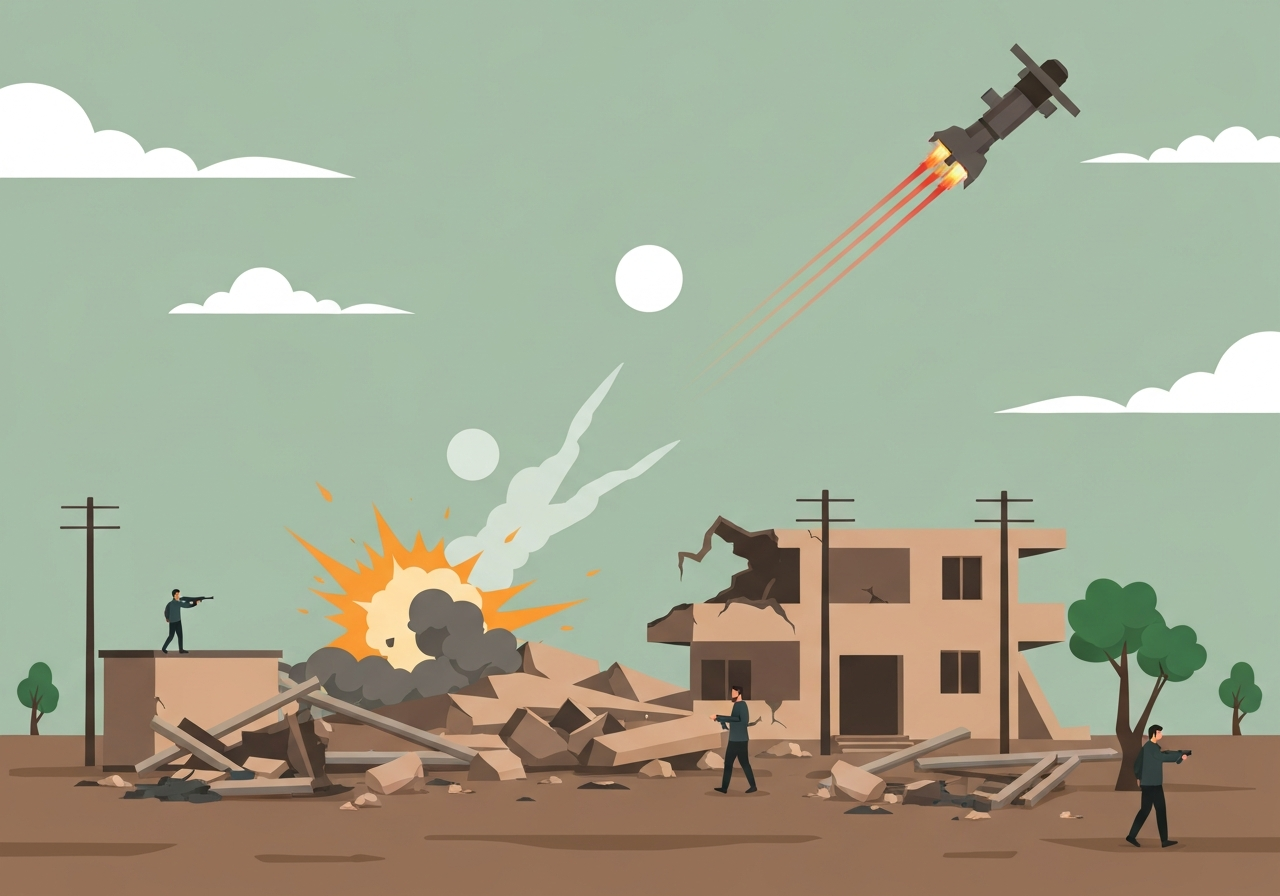
On June 3, 2026, Iran launched missiles and drones that struck targets in the Gulf, including an attack on Kuwait International Airport that killed one person and wounded at least 63. The strikes followed U.S. retaliatory strikes on Iranian facilities, and U.S. Central Command reported downing multiple drones while Bahrain said it intercepted missiles and drones overnight. President Trump told media that indirect talks with Iran remain active even as Tehran’s state-linked outlets reported a pause in mediated exchanges. Gulf leaders and security officials responded with condemnations and calls for regional unity.
Key Takeaways
- Kuwait: one confirmed dead and at least 63 injured after missiles and drones struck Kuwait International Airport; hospitals carried out seven major emergency surgeries.
- Bahrain reported its air defenses intercepted and destroyed three missiles and several drones aimed at its territory overnight.
- The U.S. military said it downed multiple drones targeting American forces and conducted “self-defense” strikes against Iranian targets, including a ground control station on Qeshm Island.
- Iran’s Islamic Revolutionary Guard Corps (IRGC) claimed it struck U.S. bases in Kuwait and warned of stronger retaliation to any further attacks.
- Commercial flights at Kuwait International Airport were temporarily suspended after damage to the passenger terminal; the airport had reopened on June 1 following an earlier closure.
- Oil prices rose more than 1% amid renewed doubts about a ceasefire extension; U.S. average gasoline was reported at $4.29 per gallon.
- UAE presidential adviser Anwar Gargash urged all Gulf states to adopt a unified stance against what he called repeated Iranian aggression.
- President Trump said negotiations with Iran were ongoing but has not decided whether to extend the fragile ceasefire, warning an alternative response would be harsher.
Background
The exchanges are part of a wider regional confrontation that began after the U.S. and Israel struck Iranian positions in late February, triggering cycles of retaliation between Tehran and U.S.-aligned forces. Negotiations to extend a fragile ceasefire have proceeded indirectly via mediators; Iranian semi-official outlets reported a halt in message exchanges while U.S. officials, including the president, have said dialogue continues. The Strait of Hormuz and nearby sea lanes have been a flashpoint, and attacks on shipping and oil infrastructure have periodically raised global energy-market anxiety.
The IRGC has increasingly framed its operations as proportionate retaliation for recent U.S. strikes, while the U.S. Central Command has emphasized defensive measures to protect personnel and regional partners. Gulf monarchies — notably Kuwait and Bahrain — have been drawn directly into the exchange of fire, complicating longstanding security arrangements and prompting public calls for collective regional responses. International actors, including the U.N., have proposed measures to stabilize adjacent conflicts that intersect with this standoff, such as the Israel–Hezbollah front in Lebanon.
Main Event
Early on June 3, Iranian missiles and unmanned aerial vehicles targeted locations across the Gulf. Kuwaiti officials said several hostile drones struck the passenger terminal at Kuwait International Airport, inflicting structural damage and human casualties; emergency medical teams treated and transferred dozens of wounded to hospitals in Kuwait City. The Kuwaiti foreign ministry condemned the attack and reserved the right to respond consistent with international law.
Bahrain’s military command reported that its defenses intercepted three missiles and multiple drones aimed at Bahraini territory and reiterated readiness to repel further strikes. U.S. Central Command said U.S. and partner forces downed multiple drones that were directed at American personnel and assets in the region, and later carried out strikes on Iranian military infrastructure, including a ground control facility on Qeshm Island.
The IRGC asserted it had struck U.S. military bases in Kuwait, describing fires and the destruction of targets; CENTCOM disputed claims of damage to U.S. personnel and framed its actions as self-defense. Kuwait’s health ministry reported 63 injured, several with severe trauma including fractures, head injuries and blast wounds, and said seven urgent major surgical operations were performed following the airport strike.
Analysis & Implications
The immediate humanitarian toll — a confirmed death and scores wounded — underscores how escalation between state militaries and proxy forces is spilling into civilian spaces. Strikes on airports and attempts to target bases near population centers raise the risk of larger miscalculations, particularly where command-and-control assessments rely on rapid, imperfect information. The contested public narrative from Tehran and U.S. officials about whether negotiations are active adds opacity that can harden positions on both sides.
Regionally, calls from Gulf leaders for unified security responses reflect anxiety about being singled out for attack. A coordinated Gulf posture could increase deterrence against further strikes but also complicate avenues for localized de-escalation, given differing threat perceptions among member states. Economically, even short-lived escalations push oil markets higher and feed through to global energy costs; traders reacted to the renewed uncertainty with price gains and increased volatility.
Politically, the episode places U.S. domestic policymakers in a bind: the White House must balance the use of force to protect regional partners with diplomatic options that could end hostilities. President Trump’s public emphasis on ongoing conversations with Iran while warning of harsher alternatives signals simultaneous pursuit of diplomacy and deterrence, a dual-track posture that may prolong uncertainty unless one course is clearly adopted.
Comparison & Data
| Event | Date | Casualties / Damage | Notes |
|---|---|---|---|
| Kuwait airport strike | June 3, 2026 | 1 dead, 63 injured; terminal damage | Commercial flights suspended; 7 major surgeries reported |
| Bahrain intercepts | June 3, 2026 | No reported casualties | 3 missiles and several drones destroyed by air defenses |
| U.S. strikes (Qeshm Island) | Late June 2–3, 2026 | No U.S. casualties reported | Described by CENTCOM as self-defense against attempted attacks |
| Market move | June 3, 2026 | Oil +~1%, gas avg. $4.29/gal (U.S.) | Investors cite stalled talks and shipping risk |
The table places the human cost alongside defensive operations and economic indicators to show how rapidly military events translate into market responses and humanitarian needs. While immediate physical damage is concentrated, the political reverberations affect regional alignments and global energy supply expectations.
Reactions & Quotes
Gulf and U.S. officials responded quickly with public statements demanding accountability and warning of defensive measures.
“No Gulf state should be left to face targeting alone,”
Anwar Gargash, UAE presidential adviser (former foreign minister)
Gargash’s remark was posted on social media and framed the strikes as attacks on collective Gulf security, calling for a cohesive regional stance against what he called Iranian aggression. His comments echo wider diplomatic pressure among Gulf monarchies seeking stronger deterrence.
“We’re working on a deal and if that happens, fine; if it doesn’t happen, that’s okay too,”
President Donald Trump
Mr. Trump told the New York Post he had not yet decided whether to formalize a ceasefire extension with Iran and suggested he might meet Iran’s future supreme leader if a deal materializes. He also warned of a harsher alternative should negotiations fail, stressing both diplomatic and coercive options remain on the table.
“A full-scale health emergency was declared”
Kuwait Ministry of Health
Kuwait’s health ministry described the medical response to the airport strike, detailing triage operations, transportation of the wounded, and the range of serious injuries treated in city hospitals.
Unconfirmed
- The extent of physical damage to U.S. bases in Kuwait remains disputed between IRGC claims and U.S. statements; independent verification is pending.
- Reports that mediated talks were definitively suspended are inconsistent across Iranian semi-official outlets and U.S. statements; the status of indirect negotiations is unclear.
- Precise attribution for every intercepted aerial object (missiles vs. drones) in the chaos of overnight exchanges has not been independently corroborated.
Bottom Line
The June 3 strikes mark a dangerous expansion of the Iran–U.S. confrontation into civilian infrastructure and Gulf national territory, with tangible human cost and immediate market consequences. While both sides publicly keep a diplomatic channel visible, competing claims and military responses create fertile ground for miscalculation that could broaden the conflict.
For the region, the incident intensifies calls for collective Gulf security arrangements and will likely push energy markets and defense planners to factor in a longer period of instability. Diplomacy remains possible but will require clearer signaling, third-party verification mechanisms, and rapid humanitarian and forensic assessments to reduce the risk of escalation.
Sources
- CBS News — live updates (news outlet)
- U.S. Central Command — official military statements (U.S. government)