
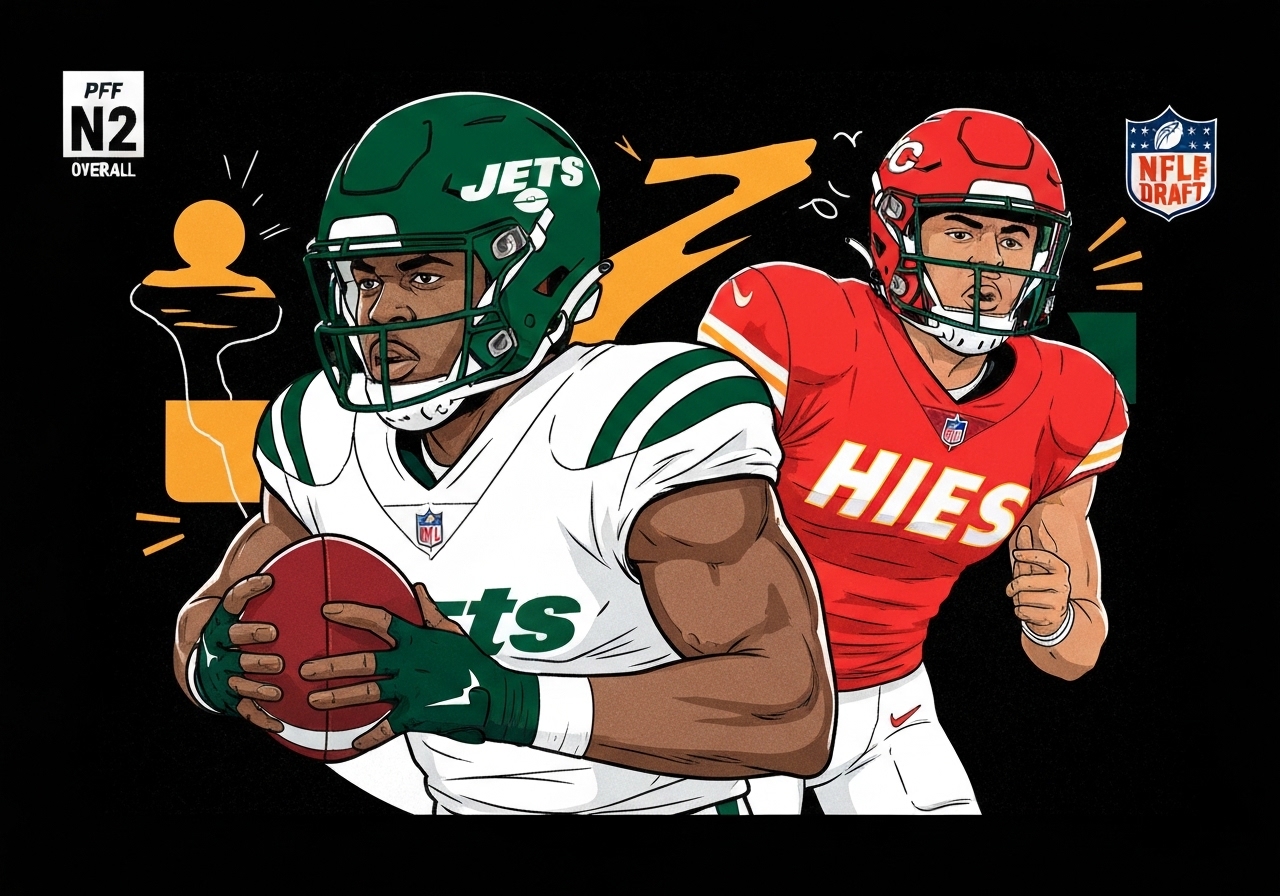
The 2026 NFL mock draft landscape tightened after the College Football playoff ended and several top prospects’ decisions landed: with Oregon quarterback Dante Moore returning to school, the New York Jets pivot to defense at No. 2 overall, selecting Texas Tech edge rusher David Bailey, while the Kansas City Chiefs add Notre Dame running back Jeremiyah Love at No. 9 to beef up Patrick Mahomes’ offense. The mock preserves a familiar top spot — Indiana QB Fernando Mendoza at No. 1 — and stacks the first round with premium defensive talent and a handful of game-changing skill players. These early selections reflect teams prioritizing immediate NFL readiness, medical and measurables permitting, as April’s draft approaches. Expect trades, medical rechecks and pre-draft testing to reshape pockets of the board but not the broad contours laid out here.
Key Takeaways
- 1 — Las Vegas projects to pick Indiana QB Fernando Mendoza at No. 1; Mendoza posted a 6.1% big-time throw rate and 2.5% turnover-worthy play rate in his final college season.
- 2 — With Dante Moore returning to Oregon, the New York Jets select EDGE David Bailey at No. 2; Bailey led FBS with 81 quarterback pressures in 2025.
- 3 — The New York Giants add Ohio State WR Carnell Tate at No. 5, pairing him with Malik Nabers; Tate caught 85.7% of contested targets and averaged 3.03 yards per route run in 2025.
- 4 — Kansas City takes RB Jeremiyah Love at No. 9; Love recorded 91.1 and 93.9 PFF overall grades over the past two seasons and averaged 4.5 yards after contact in 2025.
- 5 — Several interior and edge defenders populate the mid-to-late first round, including Caleb Downs (No. 3), Rueben Bain Jr. (No. 4) and Peters Woods (No. 10), underscoring a run on defensive front seven talent.
- 6 — Ohio State is well represented early, supplying top prospects at wide receiver, linebacker and defensive interior for multiple teams.
- 7 — The mock keeps an eye on practical fits: teams like the Cowboys and Dolphins take versatile players (Arvell Reese, Mansoor Delane) tailored to scheme needs rather than best-player-available alone.
Background
The 2026 draft order solidified as playoff eliminations wrapped up and four teams continue toward Super Bowl 60; everyone else has shifted focus to roster construction. That calendar compression and the early declarations/returns of top prospects have magnified the importance of pre-draft medicals, visits and measurable testing. Dante Moore’s publicly reported decision to return to Oregon removed a potential high-tier quarterback option from the top of the board, altering trade calculus for teams with early picks who might have hoped to flip for a QB target.
Teams with established quarterbacks — notably Kansas City with Patrick Mahomes — can target impact offensive weapons without needing to address the QB spot. Conversely, teams in transition (the Jets, Giants, Cardinals) face a balancing act between taking an immediate-impact cornerstone or further investing in surrounding personnel. PFF’s grading framework (coverage, run defense, pass-rush win rate, etc.) has become a common reference point for projecting college production to NFL outcomes; many of the prospects listed here are characterized by elite PFF metrics that correlate with early playing time at the next level.
Main Event
1. Las Vegas Raiders — Fernando Mendoza, QB, Indiana. The Raiders appear set to use No. 1 on Mendoza, who finished the college season with a 6.1% big-time throw rate and a 2.5% turnover-worthy play rate. Those figures are comparable to recent first-overall picks and provide a statistical foundation for Las Vegas to begin a franchise quarterback era.
2. New York Jets — David Bailey, EDGE, Texas Tech. With Dante Moore returning to Oregon, the Jets shift to defense at No. 2. Bailey led the FBS with 81 quarterback pressures in 2025 and profiles as a high-upside pass rusher who can produce immediate pressures on NFL offensive tackles. While scouts note raw elements in his technique, his production and disruption rate justify a top-five selection.
3. Arizona Cardinals — Caleb Downs, S, Ohio State. The Cardinals prioritize a premium defensive athlete at No. 3 as they weigh Kyler Murray’s long-term status. Downs posted PFF run-defense and coverage grades above 80.0 in 2025, combining range and tackling that projects to a mid-early starter in the NFL.
9. Kansas City Chiefs — Jeremiyah Love, RB, Notre Dame. The Chiefs add a physically dominant, contact-producing back who compiled elite PFF overall grades of 91.1 (2024) and 93.9 (2025) and averaged 4.5 yards after contact last season. Love’s burst and contact balance suit a high-volume complementary role behind Patrick Mahomes’ passing game and could tilt the Chiefs toward a more balanced offense in short and mid-yardage situations.
Other notable top-10 inclusions: the Giants at No. 5 take Carnell Tate of Ohio State to spice up Jaxson Dart’s receiving corps, while the Titans, Browns and Commanders all invest early first-round capital in premium edge and receiving talent. The mock emphasizes roster fit — players with high contested-catch rates, elite pass-rush win rates or top-tier coverage grades are prioritized for teams with matching schematic needs.
Analysis & Implications
Jets: By selecting Bailey at No. 2, the Jets signal a willingness to let quarterback questions be solved through free agency or a later trade rather than drafting a rookie QB immediately. Bailey’s 81 pressures and consistent disruption translate to an edge player who can change blocking plans and relieve coverage stress for the secondary. Strategically, a pass-rush cornerstone can accelerate a rebuild by forcing opponents into shorter down-and-distance scenarios and creating turnover opportunities.
Chiefs: Adding Jeremiyah Love represents a calculated upgrade to a receiving-first offense. Love’s Elite PFF grades and 4.5 yards-after-contact rate suggest he can create chunk plays after initial contact, improving third-down efficiency and red-zone options. The presence of a dependable, downhill runner would diversify play-call balance and potentially extend Mahomes’ prime by reducing negative plays and third-and-long situations.
Giants: Pairing Carnell Tate with Malik Nabers gives Jaxson Dart an athletic tandem capable of stretching defenses vertically and winning contested targets. Tate’s exceptional contested-target efficiency (85.7%) and 3.03 yards per route run indicate immediate compatibility in outside and contested-slot roles. The pick prioritizes complementary weapons over offensive line or quarterback upgrades, implying faith in short-term QB development.
League-wide: The early run on defensive linemen and edge rushers reflects an ongoing valuation of pass-rush impact in modern NFL schematics. Teams are willing to invest premium picks in players who can generate pressure and change offensive conversion rates, a trend likely to continue as analytics emphasize the outsized influence of sacks and pressures on win probability.
| Pick | Player | School | Key college metric |
|---|---|---|---|
| No. 1 | Fernando Mendoza | Indiana | 6.1% big-time throw rate; 2.5% turnover-worthy play rate |
| No. 2 | David Bailey | Texas Tech | 81 quarterback pressures (2025) |
| No. 9 | Jeremiyah Love | Notre Dame | PFF overall grades 91.1 & 93.9; 4.5 YAC (2025) |
The table highlights the measurable production that underpins these selections. College performance and PFF grades are useful predictors for early NFL playing time, but teams will still weigh workout metrics, interviews and medical reports heavily before finalizing draft boards.
Reactions & Quotes
League analysts and team spokespeople framed the picks through the lens of fit and immediate impact.
“Bailey’s pressure numbers are elite; he changes the pocket and gives a defense an immediate playmaker on day one.”
PFF draft analyst (media/analysis)
This reaction emphasizes the Jets’ choice to prioritize disruption up front given their quarterback uncertainty. The analyst note comes from broader PFF scouting commentary on edge rushers’ translation to the NFL.
“Love adds a physical dimension that can shorten games and improve third-down conversion rates for Kansas City.”
League offensive strategist (independent analyst)
That viewpoint captures why a pass-heavy offense might still invest a top-10 pick in a running back — to create multi-level stress for opposing defenses and increase play-call versatility.
Unconfirmed
- Potential trades involving the top two picks remain fluid; teams could still swap selections before the draft, changing where Bailey or Mendoza land.
- Prospect medicals and combine testing outcomes for top prospects (bench, speed, agility measurements) are pending and could alter draft valuation.
- Free-agent decisions referenced in team fits (for example, anticipated departures) are subject to contract negotiations and may shift draft priorities.
Bottom Line
The mock draft paints a picture of teams prioritizing immediate impact over long-term developmental quarterbacks in several early slots: New York’s choice of David Bailey at No. 2 is a defensive-first response to Dante Moore’s return to Oregon, and Kansas City’s selection of Jeremiyah Love at No. 9 shows an appetite for physical playmakers to complement an elite passing offense. These picks reflect both production-based scouting (pressure and PFF grades) and schematic fits—teams drafting to schemes they expect to run in 2026.
As the pre-draft process continues, expect trade chatter, medical rechecks and combine/testing results to tweak this board. Fans and front offices should watch for how teams prioritize measurable upside versus polished play: both paths are represented in this mock, and April will reveal which approach gained the most conviction.