
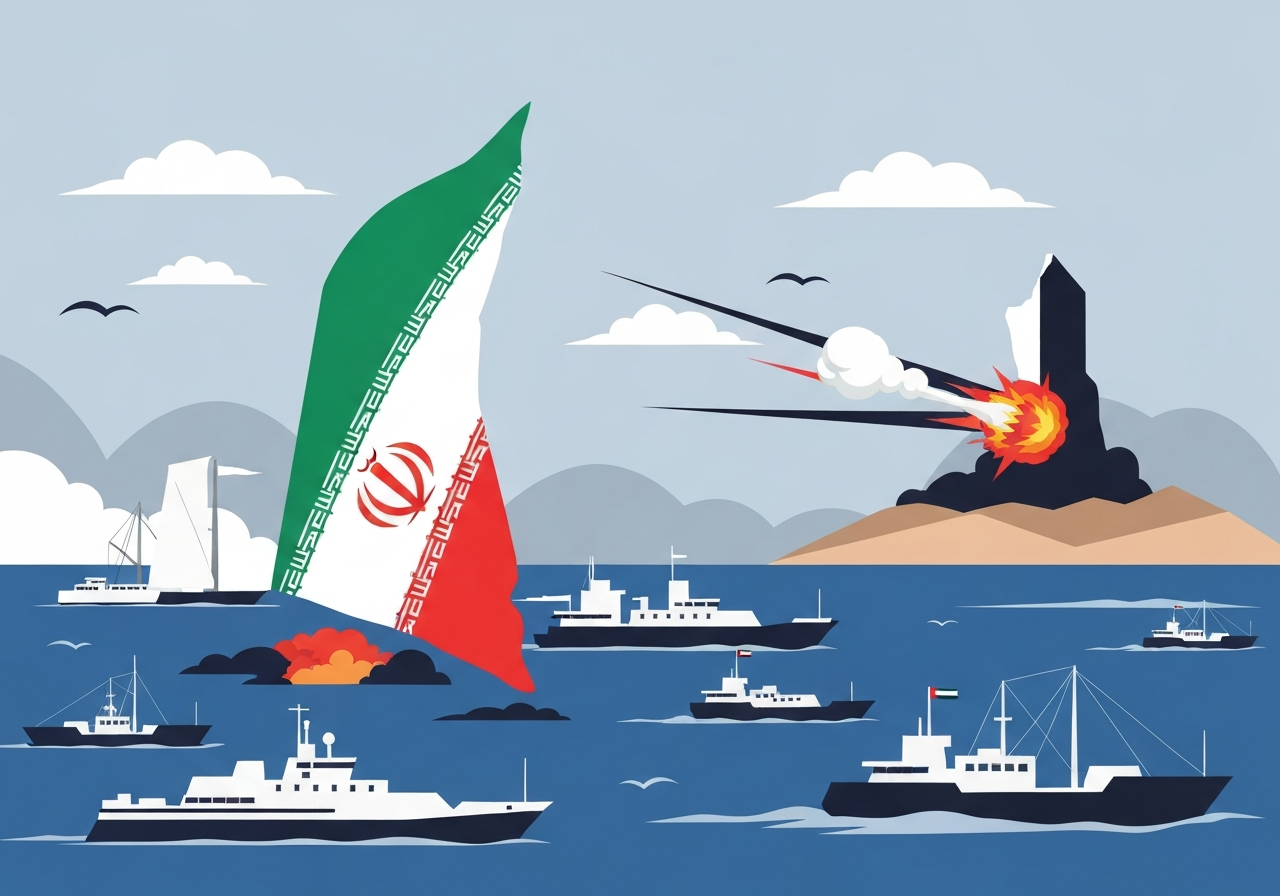
U.S. and allied officials say the ceasefire with Iran remains in effect even as Tehran renewed missile and drone strikes on the United Arab Emirates and attacked commercial vessels in the Strait of Hormuz on Tuesday. Washington launched “Project Freedom” to escort trapped merchant ships out of the Persian Gulf, while Iran has warned vessels to use only corridors it approves. U.S. commanders report defensive engagements at sea and say the situation remains below the threshold for resuming full-scale combat operations, but they warn forces are prepared to escalate if attacks continue.
Key Takeaways
- U.S. officials say the ceasefire is still holding as of Tuesday, despite fresh Iranian strikes on the UAE and maritime attacks in the Strait of Hormuz.
- Project Freedom, launched by CENTCOM on May 4, escorted the first commercial vessels through the strait; Gen. Dan Caine said more than 1,500 vessels and roughly 22,500 mariners remain trapped inside the Persian Gulf.
- CENTCOM reported 51 vessels were directed to reverse course or return to port under the U.S. maritime blockade as of Tuesday.
- Since April 8, U.S. commanders say Iran has attacked commercial vessels nine times, seized two container ships and struck U.S. forces more than 10 times—actions characterized as below the threshold to restart major combat operations.
- U.S. and Gulf partners circulated a U.N. Security Council draft resolution threatening sanctions if Iran does not stop attacks, disclose mine locations and allow safe navigation.
- President Trump announced Project Freedom would be paused briefly amid reported progress in negotiations with Iran, but the U.S. blockade will remain in place.
- Defense Secretary Pete Hegseth and Joint Chiefs Chair Gen. Dan Caine emphasized U.S. forces are defensive, prepared to protect shipping, and remain ready to resume major operations if ordered.
Background
The conflict escalated after joint U.S.-Israeli strikes on Iran on Feb. 28, touching off months of tit-for-tat maritime and aerial attacks that have endangered commercial traffic through the Strait of Hormuz, a choke point for global energy shipments. On April 8 the two sides announced a ceasefire, but intermittent clashes and attacks on merchant vessels have continued, complicating efforts to restore normal trade flows. Iran has asserted control over transit in the strait and at times demanded payments or permissions for passage; the United States and partners view those actions as unlawful interference with international navigation.
International concern has grown because the strait handles a significant share of world oil shipments; disruptions raise insurance costs, reroute vessels and strain global supply chains. Regional partners—including Gulf monarchies, NATO members and Asian importers—have debated multinational responses. France and the U.K. have led coalition talks on ensuring safe passage, while countries such as Germany have repositioned a minesweeper to be ready for a possible clearance mission.
Main Event
On Monday U.S. warships and aircraft escorted two commercial vessels through the Strait of Hormuz as part of Project Freedom; Iran responded with missiles, drones and small-boat harassment, according to U.S. officials. Defense forces reported destroying Iranian fast-attack craft in the encounter, while President Trump later said a pause in Project Freedom would begin because of reported progress in parallel negotiations. The U.S. blockade of Iranian ports and associated vessels remains in place, and CENTCOM said it had directed dozens of vessels to turn back under that posture.
Tuesday brought renewed violence. UAE authorities reported incoming missile and drone strikes originating from Iran for a second consecutive day; earlier attacks on Monday had caused a fire at an industrial complex in Fujairah and wounded at least three workers. U.S. officials also told reporters a cargo ship near Dubai was struck by a likely land-attack cruise missile, injuring several Filipino crew members. Separate reporting indicated a South Korean vessel damaged in the strait was awaiting towing into Dubai.
At a briefing, Defense Secretary Hegseth described Project Freedom as defensive and temporary, focused on ensuring safe passage for commercial shipping without entering Iranian territorial waters. Joint Chiefs Chair Gen. Caine said more than 15,000 U.S. service members and over 100 aircraft are involved in the broader posture supporting the operation and that U.S. forces have detected and defeated multiple Iranian threats while keeping engagements below a threshold that would trigger larger combat operations.
Analysis & Implications
Short-term, Project Freedom aims to relieve immediate commercial congestion in the Persian Gulf and reassure insurers and shippers that escorted transits are possible. That tactical success—an escorted transit completed without incident, per Maersk—does not remove the strategic risk: Iran can continue asymmetric attacks, lay mines, or threaten corridors, prolonging insecurity and raising shipping costs worldwide. The U.S. blockade and naval escorts increase the risk of further confrontations that could draw regional actors into broader hostilities.
Diplomatically, the move to circulate a U.N. resolution marks an attempt to internationalize the response and put legal pressure on Iran by threatening sanctions if it does not cease targeting vessels or reveal mine locations. Success at the Security Council will depend on China and Russia, both of which have previously blocked stronger U.N. measures. A failed resolution could push Washington toward harder unilateral measures or further coalition-building outside the U.N. framework.
Economically, continued disruption of the strait risks higher fuel prices and supply-chain delays. U.S. officials highlight the potential long-term strategic cost of a nuclear-armed Iran controlling the waterway; critics argue military containment and escort operations are costly and may not eliminate Iran’s ability to inflict damage. For regional states, the crisis forces a balance between seeking protection from the U.S. and avoiding escalation with Tehran; some governments are urging mediation and de-escalation even as they condemn Iranian strikes.
Comparison & Data
| Metric | Reported Figure |
|---|---|
| Merchant vessels trapped inside Persian Gulf | ~1,500 |
| Mariners affected | ~22,500 |
| Vessels directed to turn back (CENTCOM) | 51 |
| U.S. forces posture supporting operations | ~15,000 troops; 100+ aircraft |
| Commercial vessel attacks since April 8 | 9 attacks; 2 container ships seized |
These figures, cited by U.S. military leaders and public statements, give a snapshot of operational scale: thousands of mariners affected, dozens of vessels turned away, and significant U.S. force presence in the theater. The numbers underscore that even limited naval escorts require substantial resources and sustained diplomatic engagement to prevent escalation.
Reactions & Quotes
U.S. defense and political leaders framed the operation as defensive and conditional on Iran’s behavior, while Iranian officials renewed threats and framed their actions as protective of national sovereignty. Gulf states urged restraint and diplomacy.
“Right now, the ceasefire certainly holds.”
Pete Hegseth, U.S. Secretary of Defense (press briefing)
Hegseth emphasized that Project Freedom is distinct from broader offensive operations and described it as temporary and defensive. He warned Tehran to avoid actions that would cross the administration’s thresholds for renewed major combat operations.
“Commercial vessels that transit… will see, hear and frankly feel U.S. combat around them.”
Gen. Dan Caine, Chairman, Joint Chiefs of Staff (briefing)
Gen. Caine highlighted the visible U.S. presence intended to deter and, when necessary, defeat incoming threats to shipping and American forces in the region.
“Project Freedom is Project Deadlock.”
Abbas Araghchi, Iran Foreign Minister (social media)
Iranian officials criticized the U.S. maritime initiative as incapable of resolving the political crisis and reiterated their view that diplomatic negotiations—led in part by Pakistan—should proceed.
Unconfirmed
- Claims by Iran’s Fars news agency that U.S.-flagged vessels became stranded in shallow, rocky waters off Oman remain unverified by independent maritime tracking and Western officials.
- President Trump’s statement that seven or eight Iranian small boats were destroyed reflects U.S. assessments and public remarks but has not been independently corroborated by outside sources.
- Intelligence reports alleging that China or Russia are supplying advanced radar or weapons to Iran were reported in mid-April but details and full corroboration have not been publicly released.
Bottom Line
The ceasefire between the U.S. and Iran is holding for now, but repeated strikes on the UAE and commercial shipping show how fragile the arrangement is. Project Freedom has enabled at least one escorted transit and provided temporary relief for some vessels, yet it also increases the chances of naval clashes that could widen the conflict.
Diplomatic avenues— including the U.N. Security Council and Pakistan-facilitated talks—remain central to preventing renewed large-scale hostilities. For shippers, insurers and regional governments, the immediate focus will be on securing transits, demining routes if necessary, and monitoring whether international pressure through the U.N. or bilateral negotiations can produce a more durable solution.