
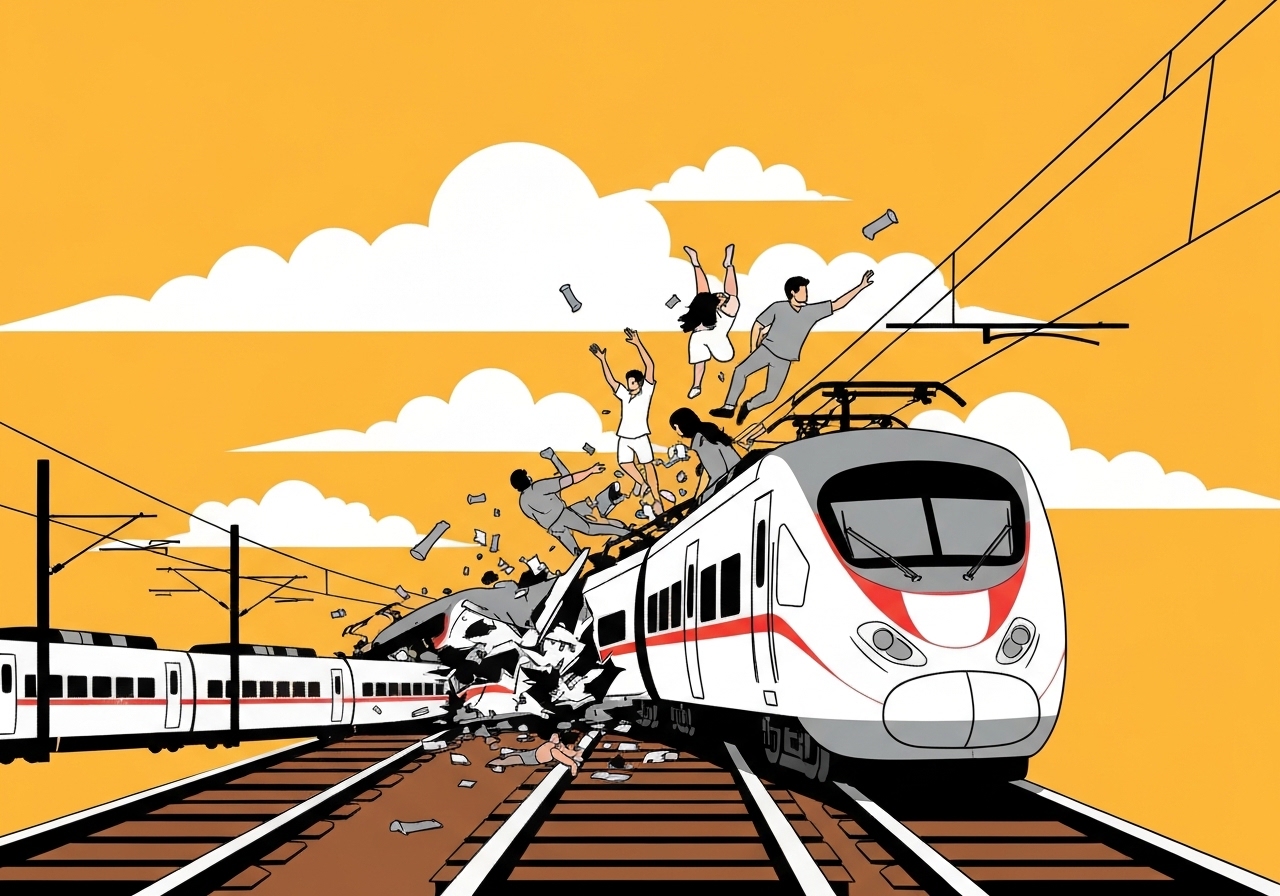
On Jan. 18, 2026, at about 7:45 p.m. local time, two high-speed passenger trains collided near Adamuz, a small town outside Córdoba in Andalusia, killing at least 39 people and injuring dozens more. Local authorities say the crash involved a privately operated Iryo service traveling from Málaga to Madrid and a Renfe train bound for Huelva. Preliminary reports indicate cars from the first train derailed onto the opposite track and struck the oncoming train; investigators are treating the incident as a major rail accident. Emergency teams and regional officials responded through the night and into Jan. 19 as recovery and searches continued.
Key Takeaways
- Fatalities: At least 39 people were confirmed dead by local authorities following the collision on Jan. 18, 2026.
- Timing and place: The collision occurred at approximately 7:45 p.m. local time near Adamuz, Córdoba, in Andalusia.
- Trains involved: The derailed train was operated by Iryo (Málaga–Madrid); the striking train was operated by Renfe (toward Huelva).
- Passenger counts: Iryo reported about 300 passengers on board; Renfe has not released a passenger count.
- Damage pattern: Investigators say two rear cars of the Iryo train fell onto the opposite track; the first two cars of the Renfe train then fell down an estimated 12-foot embankment.
- Historical context: This is the deadliest rail accident in Spain since the 2013 derailment that killed 80 people in the country’s northwest.
- Network context: Spain operates the world’s second-longest high-speed rail network, making safety and systemic oversight central to the ongoing probe.
Background
Spain developed one of the largest high-speed rail systems globally over the past two decades, linking major cities such as Madrid, Málaga and Seville with frequent AVE and private services. The expansion has included a mix of state-run operator Renfe and newer private entrants like Iryo, which increased service frequency on southern routes. While high-speed travel has reduced journey times and boosted regional connectivity, it has also heightened regulatory attention to track maintenance, signaling, and train integration across operators.
Spain’s most fatal recent rail disaster occurred in 2013, when a high-speed train derailed near Santiago de Compostela, killing 80 people; that accident prompted legal and regulatory reviews and infrastructure investments. Since then, authorities have pursued a mix of technical upgrades and procedural reforms, but the coexistence of multiple operators and complex signaling environments remains a management challenge. Local communities along high-use corridors have periodically raised concerns about speed limits, crossing protections and emergency preparedness.
Main Event
According to provisional investigative findings released by local officials, two rear cars of the Iryo service derailed as it was approaching Adamuz station and fell into the adjacent, opposing track. Moments later, a Renfe train traveling toward Huelva struck the derailed cars; the impact caused the first two cars of the Renfe train to tumble down a roughly 12-foot embankment. Emergency services arrived quickly, establishing triage and evacuation points and transferring injured passengers to regional hospitals.
Iryo stated it had around 300 passengers on board at the time and confirmed it was cooperating with investigators and providing assistance to victims. Renfe had not published a passenger manifest immediately after the crash; company spokespeople focused on rescue support and information coordination with authorities. Local civil protection units and ambulance services described chaotic scenes at the site late on Jan. 18, with search-and-rescue work continuing overnight.
Investigators from Spain’s accident inquiry bodies and civil protection agencies began securing the scene to preserve evidence, inspect track conditions and review on-board recording systems and signaling logs. Early reports did not assign a definitive cause; investigators said they would examine train speed, track geometry, equipment condition and any potential human or technical errors. Officials also emphasized victim identification and family notifications as immediate priorities in the hours after the collision.
Analysis & Implications
The scale of casualties makes this crash a national crisis for Spanish rail safety, reopening debates about system integration as private operators expand service on lines historically dominated by Renfe. With Iryo reporting roughly 300 people aboard, questions will focus on passenger manifest completeness, emergency egress procedures in multi-operator corridors and the interplay of signaling systems when trains share adjacent tracks. Policymakers will likely face pressure to accelerate inspections and to clarify responsibility for track-side safety across operator boundaries.
Economically and politically, the accident may trigger temporary service curbs and reviews of southern Andalusian routes, with potential wider impacts on tourism and freight scheduling if sections of line are closed for extended investigation. Spain’s reputation for high-speed rail — often cited as a national asset and export model — will be tested; regulators may propose stricter oversight, additional automatic braking systems, or renewed investment in track geometry monitoring. The incident is also likely to prompt legal actions by victims’ families, which could catalyze regulatory change.
Internationally, neighboring countries and EU rail safety bodies will watch the investigation for lessons relevant to mixed-operator corridors elsewhere. If the root cause involves signaling compatibility or track maintenance, recommendations could affect procurement and interoperability standards across European high-speed networks. Conversely, if human factors or localized infrastructure issues are to blame, Spain’s response will center on training, staffing and targeted upgrades at identified risk points.
Comparison & Data
| Year | Location | Confirmed deaths | Context |
|---|---|---|---|
| 2026 | Adamuz, Córdoba | 39 | Collision between Iryo (Málaga–Madrid) and Renfe (to Huelva) |
| 2013 | Near Santiago de Compostela (NW Spain) | 80 | Derailment on a curved section of track |
The table places the Jan. 18, 2026 collision in recent perspective: while smaller in death toll than the 2013 disaster, it represents the deadliest rail accident in Spain in more than a decade. Spain’s high-speed network remains one of the largest by route kilometers worldwide, which concentrates risk exposure across dense traffic corridors. Officials will compare onboard data recorders, track logs and maintenance records from both events as part of broader efforts to identify system vulnerabilities.
Reactions & Quotes
“We are cooperating fully with authorities and supporting passengers and families at this tragic time,”
Iryo (operator)
Iryo issued an immediate statement confirming cooperation with investigators and offering passenger assistance; the operator also noted the approximate number of people on board. The company emphasized search-and-rescue support and a commitment to provide information to families.
“Emergency services remain on site to assist the injured; our priority is rescue, identification and informing next of kin,”
Regional civil protection authority (Andalusia)
Regional officials described the multi-agency response and outlined steps to stabilize the scene, transport the wounded and begin evidence preservation. Authorities urged the public to rely on official channels for updates and to avoid speculating on causes while the investigation proceeds.
“This accident will require a full technical and operational review of how mixed services operate on shared corridors,”
Independent rail safety analyst (industry expert)
Industry experts signaled that investigators should examine signaling interoperability, track condition and operational protocols when private and national carriers operate adjacent services. Analysts also flagged the importance of black-box data and speed records to establish the sequence of events.
Unconfirmed
- Exact cause: No definitive cause has been announced; investigators have not yet released final findings on speed, signaling or mechanical failure.
- Renfe passenger count: Renfe had not confirmed how many passengers were aboard its train at the time of the collision.
- Specific equipment faults: Allegations of track or signal faults remain under review and have not been substantiated publicly.
Bottom Line
The Jan. 18, 2026 collision near Adamuz is a major rail disaster that will prompt intensive technical, regulatory and legal scrutiny in Spain. With at least 39 dead and many more injured, authorities face immediate tasks of victim support, scene preservation and transparent communication while a complex investigation unfolds. The presence of both private and national operators on the affected corridor raises questions about interoperability, oversight and whether existing safeguards were sufficient.
In the coming weeks, investigators’ findings on speed records, signaling logs and maintenance histories will determine both the proximate cause and the policy remedies. Policymakers, operators and safety agencies should expect pressure to accelerate any pending safety upgrades and to clarify responsibilities for shared infrastructure to reduce the risk of a similar tragedy in the future.