
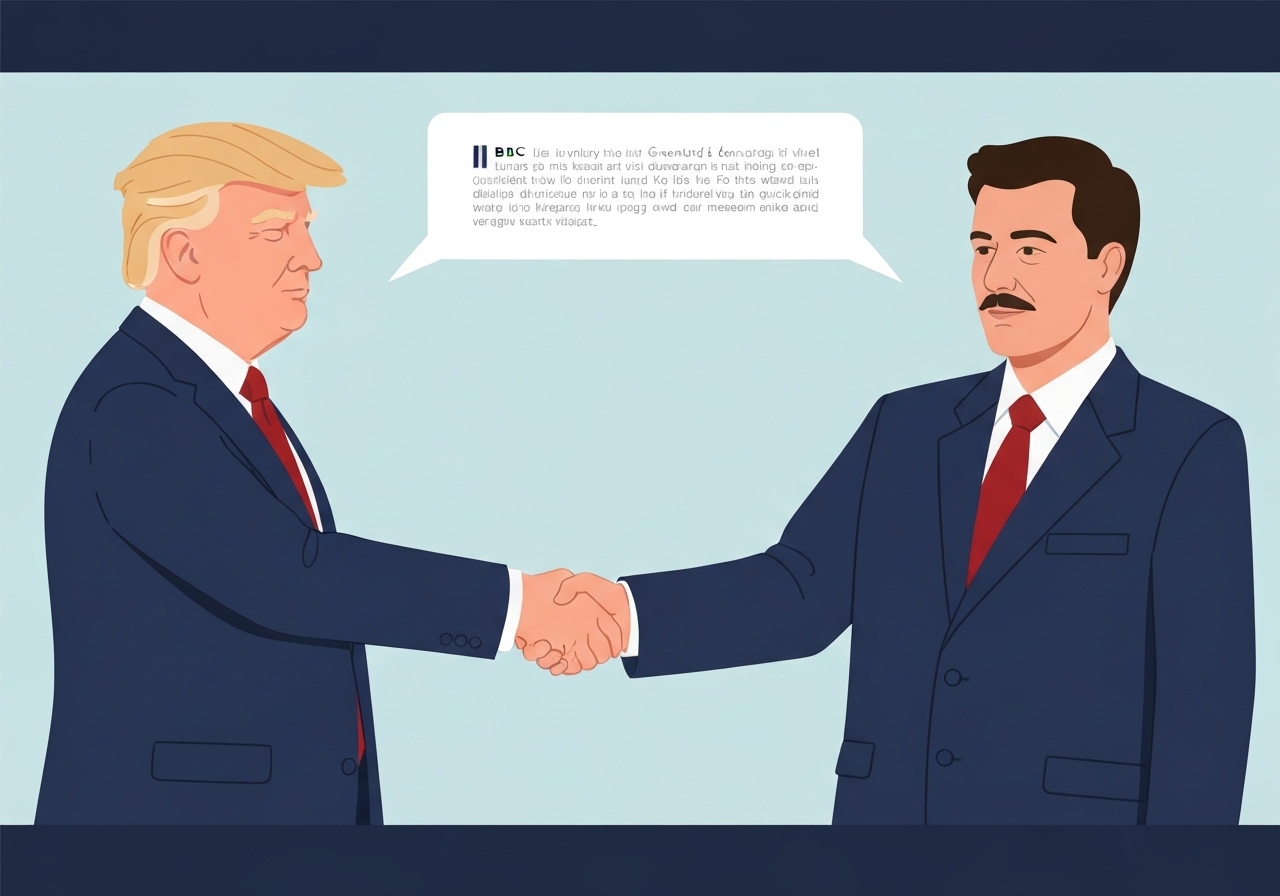
US President Donald Trump told Norway’s prime minister he felt freed from an obligation to focus solely on peace after not receiving the Nobel Peace Prize last October, and in the same exchange renewed a call for “Complete and Total Control of Greenland.” The message, exchanged with Prime Minister Jonas Gahr Støre and referenced alongside a joint appeal from Finland’s Alexander Stubb, linked Trump’s disappointment over the 2024 prize — awarded to Venezuelan opposition leader María Corina Machado — to a more forceful US posture on Arctic strategy. Støre replied by stressing that the Nobel Peace Prize is awarded by an independent committee, not the Norwegian government; Trump continued to question Denmark’s claim to Greenland and warned of economic measures against NATO allies that oppose his proposal.
- Trump says he no longer feels “obliged to think only of peace” after not receiving the Nobel Peace Prize, which went to María Corina Machado last October.
- In messages to Norway’s Jonas Gahr Støre, Trump insisted the US needs “Complete and Total Control of Greenland.”
- He threatened tariffs on goods from eight NATO allies: 10% from 1 February, rising to 25% by June if they oppose the Greenland plan.
- Denmark warned that any US military action in Greenland would jeopardize NATO; several European states sent small reconnaissance contingents to Greenland last week.
- The White House has listed eight conflicts it says Trump helped end; independent checks by BBC Verify found several claims overstated or lacking clear evidence.
- UK Prime Minister Keir Starmer said Greenland’s status must be decided by the people of Greenland and the Kingdom of Denmark and called proposed tariffs “wrong.”
- Trump declined to say whether force would be used to secure Greenland, replying “no comment” when asked.
Background
Greenland is a large, sparsely populated Arctic island that is a semi-autonomous territory within the Kingdom of Denmark. Its geographic position gives it strategic value for early warning systems and monitoring of polar maritime approaches; military and intelligence planners have long regarded Arctic basing and sensing as high priority for missile and naval surveillance. NATO was founded in 1949 on a collective-defense principle; no member has attacked another since then, and alliance cohesion has been central to European security architecture.
US interest in Greenland is not new: Washington has previously explored expanded basing and even purchase offers in the past. Greenlandic authorities and Denmark maintain that decisions over sovereignty and status rest with the people of Greenland and the Danish Realm. Recent months have seen a rise in Arctic activity by Russia and China, prompting NATO and European states to increase exercises and deployments in the North Atlantic and Arctic regions.
Main Event
The public thread began when Norway’s prime minister, Jonas Gahr Støre, sent a message urging de-escalation after a period of high diplomatic tension over Greenland. Støre’s note — sent on behalf of himself and Finland’s Alexander Stubb — urged allied restraint and solidarity. In reply, President Trump tied his diplomatic stance to his failing to secure the Nobel Peace Prize, saying the committee’s decision relieved him of an obligation to “think purely of Peace” and allowing him to pursue what he deemed “good and proper” for the United States.
Trump challenged Denmark’s capacity to defend Greenland from Russian or Chinese activity and questioned the legal basis of Danish sovereignty, arguing that historical landing claims were weak. He reiterated that the US has done more for NATO than any other person since its founding and said the alliance should reciprocate. The president also declared a policy preference for US control of Greenland, framing it as a security imperative for missile warning and regional monitoring.
Denmark responded that any US military action would be incompatible with continued NATO membership and warned of severe alliance consequences. European NATO members signaled support for Denmark: a number deployed small reconnaissance teams to Greenland last week in a largely symbolic show of solidarity. After those deployments, Trump announced he would impose a 10% tariff on goods from eight allied countries beginning 1 February if they opposed his Greenland plan and threatened to raise the rate to 25% by June.
Analysis & Implications
Diplomatically, tying a territorial bid to personal grievances over the Nobel Prize deepens mistrust between the US and key European partners. NATO relies on political and military reciprocity; public threats of tariffs and unilateral territorial claims risk eroding the alliance’s unity at a time when coordination on Russia and the Arctic is increasing. Allies have limited appetite for coercive bargaining that conflates trade and collective defense commitments.
Legally and politically, Greenland’s status is governed by Danish constitutional arrangements and Greenlandic self-rule institutions. Any shift in sovereignty would require consent from Greenland’s population and Denmark, and likely involve protracted negotiations and legal processes. A unilateral attempt to seize territory would face severe international legal, diplomatic, and potentially military pushback.
Economically, tariffs of the scale proposed could disrupt transatlantic trade and supply chains. A 10% tariff applied to multiple NATO allies would create reciprocal pressures and might harm US exporters and consumers as well as allies’ economies. The threat to escalate to 25% compounds uncertainty and could lead to rapid retaliatory measures, complicating cooperation on defense and other shared priorities.
Comparison & Data
| Item | Detail |
|---|---|
| Nobel Peace Prize (last awarded) | María Corina Machado — awarded last October |
| Tariff threat | 10% from 1 February; threatened 25% by June (on 8 NATO allies) |
| NATO founding | 1949; collective defense principle (Article 5) |
| Recent allied deployments to Greenland | Small reconnaissance contingents sent by several European states (last week) |
The table summarizes the immediate factual touchpoints in the dispute. While tariffs are concrete proposals announced by the US president, their legal implementation, duration and economic impact would depend on formal administration action and potential retaliation by trading partners.
Reactions & Quotes
European and Greenlandic officials have been quick to push back, emphasizing legal and democratic processes. UK Prime Minister Keir Starmer framed the issue primarily as a matter for Greenland and Denmark.
“Any decision about the future status of Greenland belongs to the people of Greenland and the Kingdom of Denmark alone.”
Keir Starmer, UK Prime Minister
Norway’s prime minister sought to defuse tensions and reminded correspondents of the Nobel committee’s institutional independence.
“The Nobel Peace Prize is decided by an independent committee, not by the Norwegian government.”
Jonas Gahr Støre, Prime Minister of Norway
Denmark warned of severe consequences for alliance cohesion if military action were taken against Greenland.
“US military action in Greenland would spell the end of NATO.”
Danish government statement
Unconfirmed
- Claims that US forces have seized and removed Venezuela’s president Nicolás Maduro lack confirmation in independent, verifiable reporting and should be treated as unverified here.
- President Trump’s assertion that “Norway totally controls” the Nobel Prize contradicts the Nobel Foundation’s and legal descriptions of an independent committee; the degree of governmental influence is a disputed claim.
- Statements that there are “no written documents” establishing Danish ownership of Greenland require legal-historical verification; sovereignty claims rest on a complex record of treaties and administrative arrangements.
Bottom Line
The exchange linking a Nobel Prize outcome to a push for US control of Greenland has intensified transatlantic tensions and strained NATO political cohesion. While the United States can lawfully pursue enhanced basing or bilateral agreements, any attempt to change Greenland’s status without the consent of Greenlanders and Denmark would provoke a major diplomatic and legal crisis. Allies have already signalled resistance through symbolic deployments and public admonitions, and threats of tariffs risk turning a security dispute into an economic confrontation.
In practical terms, the dispute highlights competing priorities: US desire to secure Arctic strategic advantages, allied insistence on legal process and sovereignty rights, and the broader challenge of keeping NATO focused on shared threats. Watch for formal steps by the US administration (executive orders, formal tariff actions) and for coordinated allied responses in diplomacy, trade policy, and defence planning over the coming weeks.