
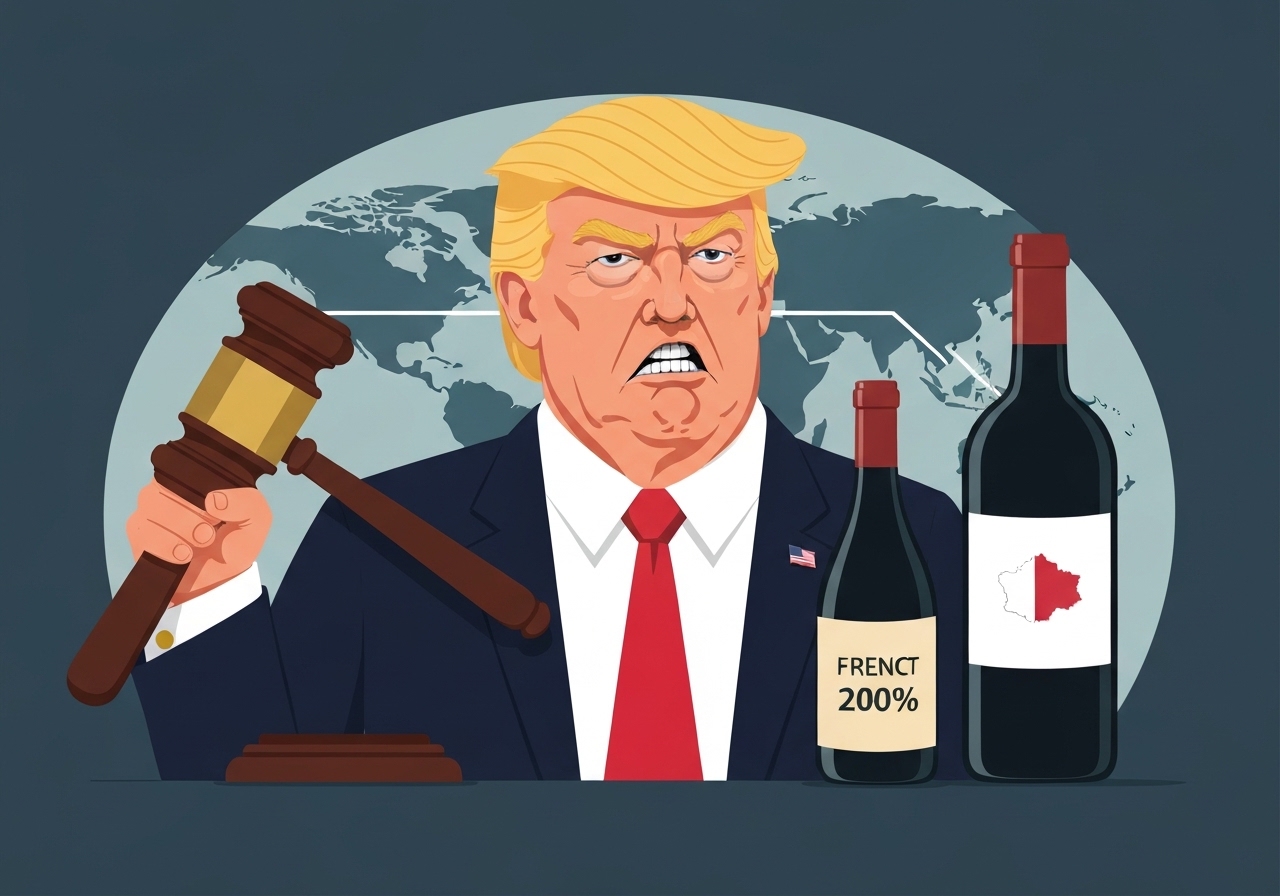
Lead: U.S. President Donald Trump on Jan. 20, 2026 threatened to impose a 200% tariff on French wines and champagne after reports that French President Emmanuel Macron declined a seat on a newly created “Board of Peace.” The comment came during a public exchange following a New York appearance related to the United Nations General Assembly, and was reiterated later in Miami. Trump framed tariffs as leverage to pressure Macron, while simultaneously renewing controversial remarks about Greenland and potential U.S. control. European governments are weighing economic countermeasures in response to the threats.
Key Takeaways
- Trump threatened a 200% tariff on French wines and champagnes on Jan. 20, 2026 as leverage after reports Macron would not join the Board of Peace.
- Macron’s presidential term runs through May 2027 and French law bars a third consecutive term, a fact Trump cited when downplaying Macron’s influence.
- The Board of Peace was endorsed by the U.N. Security Council in November 2025 to oversee the Israel–Hamas ceasefire and has issued invites to multiple world leaders.
- Separately, Trump renewed remarks about Greenland, saying the U.S. needed to control it for “world security,” and suggested Europe would not strongly resist.
- On Jan. 17–18 (weekend), Trump warned of tariffs up to 25% on eight European countries, including the U.K., tied to U.S. control over Greenland.
- Secretary of State Marco Rubio was reported on Jan. 6 to have said Trump preferred buying Greenland to military action; the claim remains reported rather than independently confirmed.
- European capitals are reported to be considering retaliatory tariffs and broader punitive economic measures against the U.S. in response.
Background
The Board of Peace is a U.N. Security Council–endorsed initiative unveiled in November 2025 to monitor and support a ceasefire between Israel and Hamas. It was conceived as a multilateral supervisory body with invitations extended to a range of global leaders to lend political weight and oversight. Supporters argue such a board could provide impartial monitoring and diplomatic channels; critics have questioned its composition and enforceability.
Emmanuel Macron, elected to a five-year term in 2022, is legally prohibited from seeking a consecutive third term under French law, with his current mandate ending in May 2027. That constitutional constraint has become a frequent talking point in international exchanges about France’s medium-term political leverage. France is a leading European actor on security and diplomacy, and Macron’s decisions on multilateral initiatives routinely reverberate across allied capitals.
Greenland’s constitutional and historical status is also central to the unfolding dispute. Denmark established colonial ties with Greenland from 1721, and Greenland became a full part of the Kingdom of Denmark in 1953. In 2009 Denmark granted Greenland self-government, delegating domestic affairs while retaining responsibility for foreign policy and defense. Greenland’s strategic location and natural resources have long made it a subject of geopolitical interest.
Main Event
On Jan. 20, 2026, following press exchanges after appearances tied to the 80th U.N. General Assembly, President Trump publicly threatened to levy a 200% tariff on French wines and champagnes if France acted “hostile” by declining a seat on the Board of Peace. Asked about Macron’s reported refusal, Trump dismissed the French leader’s sway and presented tariff threats as a tool to compel cooperation. He explicitly linked economic penalties to diplomatic compliance, framing tariffs as a preferred lever.
Trump framed Macron’s political future as limited, saying the French president would be “out of office very soon,” a reference to the May 2027 end of Macron’s term and France’s ban on a third consecutive term. The president suggested that punitive trade measures would be applicable if France remained “hostile,” presenting the 200% figure as an escalatory possibility rather than an enacted policy. Administration officials had not announced formal tariff actions by publication.
In parallel remarks, Trump revived assertions about securing Greenland, asserting the U.S. needed control of the island for strategic reasons. He downplayed potential European resistance and referenced a centuries-old maritime claim with the opaque phrase about a “boat” visiting 500 years ago. Historical records show Denmark’s governance dates to 1721 and Greenland’s integration into Denmark occurred in 1953; self-rule arrived in 2009.
Earlier in the same week, Trump warned of broader tariffs—up to 25%—on eight European countries, including the U.K., conditioned on U.S. control of Greenland. Media reports on Jan. 6 attributed a comment to Secretary of State Marco Rubio that the administration would prefer to purchase Greenland rather than seize it. European governments have publicly and privately discussed potential retaliatory tariffs and other economic countermeasures.
Analysis & Implications
Practically, a unilateral 200% tariff on French wines would be extraordinary in scale and would likely prompt immediate legal challenges under World Trade Organization rules. Such a tariff would drastically raise import prices, likely collapsing market demand in the U.S. and provoking reciprocal measures from France and the European Union. Enforcement would require a formal proclamation and customs implementation, steps that demand administrative and often legal groundwork.
Politically, the threat fuses domestic political theater with foreign policy: using high-profile economic threats to influence diplomatic behavior. For Trump, linking trade penalties to bilateral disputes amplifies pressure in the short term, but risks longer-term damage to allied relations and transatlantic cooperation on security issues. Macron’s constrained term through May 2027 makes immediate political retaliation in Paris more brittle, but institutions and markets in France and the EU can respond independently of any single leader’s tenure.
On Greenland, the logistical, legal and diplomatic obstacles to U.S. control are substantial. Greenland’s constitutional relationship with Denmark and the island’s self-governance complicate any unilateral move; acquisition—whether purchase or other means—would require negotiations with Denmark and oversight from multiple international actors. Any credible attempt to alter Greenland’s status without a negotiated settlement would be likely to prompt severe diplomatic backlash and possible economic countermeasures from European partners.
Economically, French wine and champagne producers could face an immediate market shock if punitive tariffs were imposed; exports to the U.S. are a significant revenue stream for some producers. Conversely, broad EU counter-tariffs could target U.S. agricultural, industrial or consumer sectors, creating wider trade disruptions. Businesses and markets typically price in policy risk quickly, so even mere threats can move futures, stock prices and exchange rates.
Comparison & Data
| Measure | Target | Rate | Status |
|---|---|---|---|
| Threat: wine & champagne tariff | France | 200% | Threatened (Jan. 20, 2026) |
| Threat: tariffs on European countries | 8 countries incl. U.K. | up to 25% | Threatened (weekend prior) |
The figures above reflect public, threatened measures rather than implemented policy. A 200% tariff would be punitive far beyond commonly used ad valorem rates and would likely be characterized as retaliatory, inviting countermeasures. By contrast, a 25% tariff—while still significant—is inside the range of tariffs historically levied during trade disputes and is more administratively familiar to customs authorities.
Reactions & Quotes
“Well, nobody wants him because he’s going to be out of office very soon…If they feel like [being] hostile, I’ll put a 200% tariff on his wines and champagnes, and he’ll join.”
Donald J. Trump (public remarks, Jan. 20, 2026)
Context: Trump linked Macron’s reported refusal to serve on the Board of Peace to his broader negotiating posture, offering steep tariffs as a coercive tool.
“I don’t think they’re going to push back too much…We have to have it …They can’t protect it.”
Donald J. Trump (comments on Greenland)
Context: These comments followed earlier weekend threats and were presented as strategic rationale for U.S. interest in Greenland, though the administration has not published formal acquisition plans.
“He would prefer to buy Greenland,”
Marco Rubio (reported Jan. 6, 2026)
Context: Media reports attributed this account to Secretary of State Rubio; it frames purchase as a preferred, less confrontational option compared with military action. Independent confirmation of the exact phrasing is limited in public reporting.
Unconfirmed
- No formal U.S. tariff on French wines had been enacted as of publication—public statements remain threats rather than implemented measures.
- Claims that U.S. forces would be used to seize Greenland are not substantiated by official, verifiable plans and remain unconfirmed.
- The exact meaning of Trump’s reference to a “boat” from 500 years ago is unclear and was not explained publicly.
Bottom Line
President Trump’s public threat of a 200% tariff on French wine ties economic coercion directly to diplomatic behavior and risks triggering a rapid escalation in transatlantic trade tensions. The immediate chance of actual imposition appears limited by legal, administrative and diplomatic constraints, but the rhetoric raises policy uncertainty for exporters, importers and allied governments.
Longer term, repeated use of extreme trade threats could weaken institutional cooperation between the U.S. and European partners at a moment when coordination on security and the Middle East ceasefire oversight is important. Watch for formal U.S. trade filings, EU legal and retaliatory planning, and any clarified administration position on Greenland—these will determine whether threats remain rhetorical or evolve into enforceable policy.