
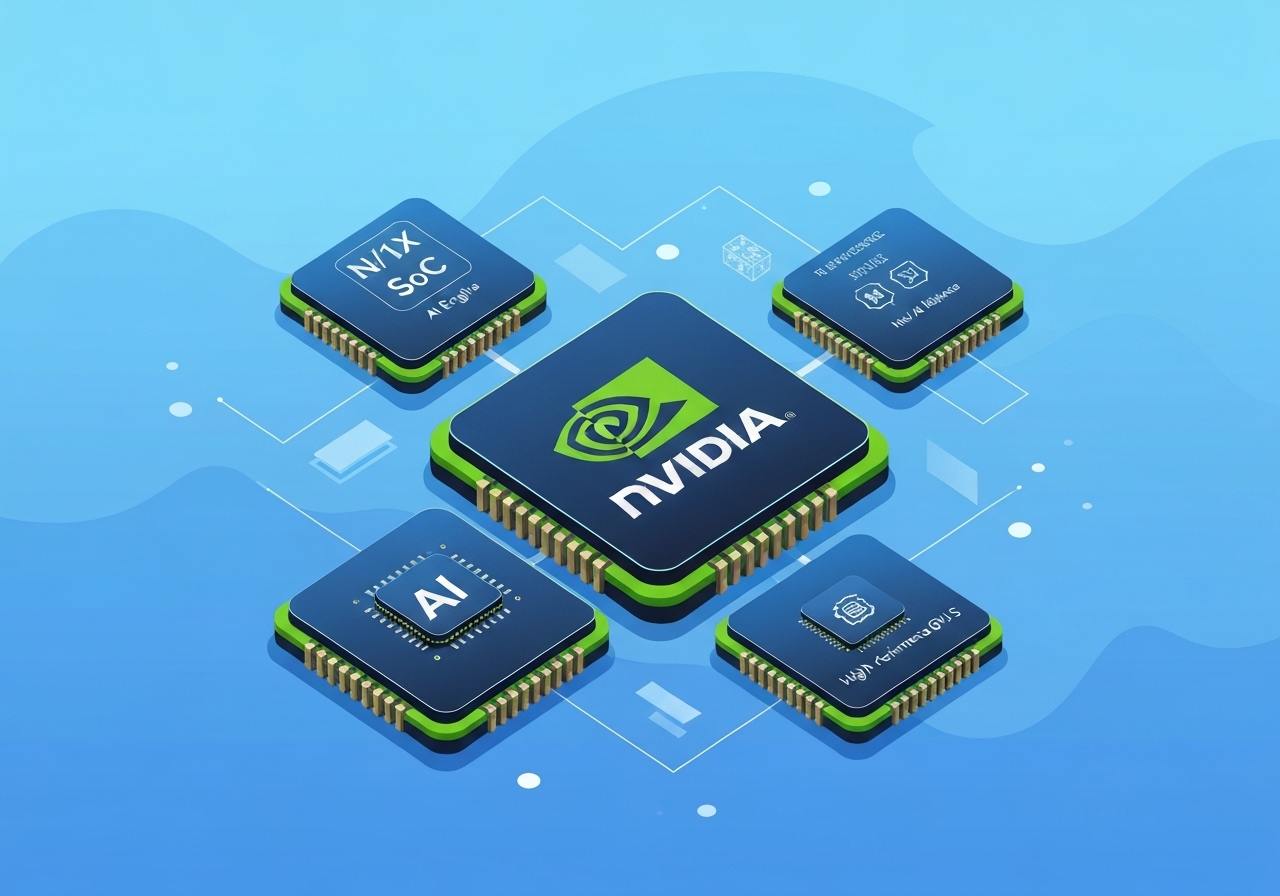
NVIDIA plans to ship ARM-based laptop SoCs to the consumer market this year, with N1/N1X variants reportedly appearing in notebooks in Q1 and reaching retail by Q2. The chips are built on TSMC’s 3nm process and are described as sharing design DNA with the GB10 used in DGX Spark systems. Reports also say NVIDIA is preparing a next-generation N2/N2X family for consumer devices targeted for Q3 2027. If delivery and ecosystem support line up, the move would mark a major push by NVIDIA into Windows-on-ARM laptops and a direct challenge to x86 incumbents.
Key Takeaways
- NVIDIA’s N1/N1X laptop SoCs are reported to debut in notebooks in Q1, with retail availability by Q2 of the same year, according to industry reporting.
- The N1/N1X chips are expected to use TSMC’s 3nm process and mirror architectural elements of the GB10 SoC found in DGX Spark systems.
- NVIDIA reportedly plans follow-up consumer ARM parts, labeled N2/N2X, with potential consumer launches as early as Q3 2027.
- Retail rollout will rely on OEM adoption via NVIDIA reference designs and an approved/recommended vendor list (AVL/RVL), allowing partner-specific tuning.
- Industry timing points to product reveals at GTC 2026 (March) and retail showcases at Computex 2026.
- The launch targets Windows on ARM (WoA) laptops and aims to position NVIDIA as a high-end edge AI computing platform for consumer notebooks.
Background
Discussion of a consumer NVIDIA laptop SoC has circulated since at least last year, driven by speculation that the company would leverage ARM architecture to extend its AI and graphics expertise into portable PCs. NVIDIA’s product strategy has increasingly emphasized an end-to-end AI stack—hardware, software frameworks and cloud services—which makes an ARM-based laptop SoC a logical extension to capture on-device AI workloads.
Last year’s public releases prioritized data-center and specialized systems: DGX Spark, which ships with a GB10 chip, was presented as a high-performance AI appliance and served as an early indicator of NVIDIA’s mobile-SoC design direction. Multiple outlets later reported that consumer SoC efforts were postponed because the Windows-on-ARM ecosystem and certain design elements needed more maturation before a broader consumer rollout.
Main Event
Industry sources now say the N1X will appear in notebooks in Q1, with retail availability by Q2. The chips are described as 3nm TSMC designs that echo the GB10’s configuration, suggesting NVIDIA is adapting its data-center SoC learnings for consumer form factors. The reports attribute the delayed consumer rollout to both software ecosystem readiness and design challenges that NVIDIA needed to resolve.
NVIDIA’s go-to-market approach reportedly centers on supplying reference designs to OEMs and maintaining two vendor tiers: an Approved Vendor List (AVL) for fully certified partners and a Recommended Vendor List (RVL) for partners allowed variation or tuning. Industry commentary indicates partners on the RVL could tune parameters such as clock speeds and power profiles within limits defined by NVIDIA and OEMs.
Alongside the N1/N1X timeline, sources claim NVIDIA intends to scale the family with N2/N2X parts aimed at consumer notebooks as early as Q3 2027, implying a multi-year roadmap rather than a one-off product. Public events could align with this cadence—GTC 2026 in March is a likely stage for initial demos, followed by broader OEM unveilings at Computex 2026.
Analysis & Implications
If the N1/N1X products meet performance and battery-efficiency targets, NVIDIA would directly contest the x86 duopoly of Intel and AMD in the laptop segment. ARM-based SoCs offer a path to tighter integration of AI accelerators, lower power consumption for certain workloads, and opportunities to optimize hardware-software co-design for on-device inference.
However, the success of such chips will hinge on software compatibility and the maturity of Windows on ARM. WoA must provide broad driver support, legacy application compatibility (through emulation or native ports), and optimized AI frameworks to surface the architectural advantages of NVIDIA’s silicon to everyday users.
Partner execution also matters: OEM adoption depends on reference design flexibility, thermal and power engineering, and supply-chain alignment. The AVL/RVL model could speed adoption by allowing different vendor approaches, but it also risks fragmentation if certification and tuning rules are unclear or inconsistent.
Finally, market reception will depend on comparative value versus Intel’s Panther Lake and AMD’s Gorgon Point platforms. Even with strong AI credentials, NVIDIA must demonstrate competitive CPU performance, battery life, and price-to-performance balance for mainstream laptop buyers to shift away from established x86 options.
Comparison & Data
| SoC | Process node | Target market | Expected debut |
|---|---|---|---|
| N1 / N1X | TSMC 3nm | Consumer laptops (WoA) | Reported Q1 (notebooks), retail by Q2 |
| GB10 (DGX Spark) | — | AI appliance / data center | Released with DGX Spark (reference design) |
| N2 / N2X | — | Consumer laptops (next-gen) | Targeted Q3 2027 |
The table summarizes reported process and timing data; performance, power and pricing metrics were not disclosed in the public reporting. Comparisons to Intel and AMD in the laptop space depend on later benchmark disclosures and OEM configurations.
Reactions & Quotes
“N1X chip will debut in notebooks by Q1, with retail availability by Q2,”
DigiTimes (trade press report)
The DigiTimes report is an industry source that first linked NVIDIA’s silicon schedule to notebook and retail timelines. Trade outlets often cite supply-chain and OEM channels for such timelines; independent confirmation from NVIDIA or partners is required for final dates.
“A consumer ARM platform aligns with NVIDIA’s goal to capture the entire ‘AI ecosystem’,”
Wccftech (analysis)
That phrasing captures analysts’ and reporters’ summaries of NVIDIA’s broader strategy: combining silicon, software and partner programs to deliver on-device AI experiences across consumer and enterprise form factors.
Unconfirmed
- Exact performance, battery life and thermals for N1/N1X in retail laptop configurations are not publicly confirmed.
- Details of the AVL/RVL verification mechanism and the scope of partner tunability remain unconfirmed by NVIDIA.
- Final launch dates and OEM model availability are subject to change and await official announcements from NVIDIA and device partners.
Bottom Line
NVIDIA’s reported N1/N1X laptop SoCs represent a concerted effort to extend the company’s AI-first strategy into consumer notebooks, leveraging 3nm process technology and lessons from data-center SoC designs. The proposed Q1 notebook debut and Q2 retail availability position NVIDIA to make a visible consumer push in 2026, with N2/N2X mapped as follow-on generations into 2027.
Yet the move’s impact will be determined as much by software and partner execution as by silicon. Windows on ARM compatibility, OEM thermal and power engineering, and clear certification rules for partners will determine whether NVIDIA’s chips can dislodge incumbent x86 suppliers or remain a niche, AI-focused option for certain workloads.