
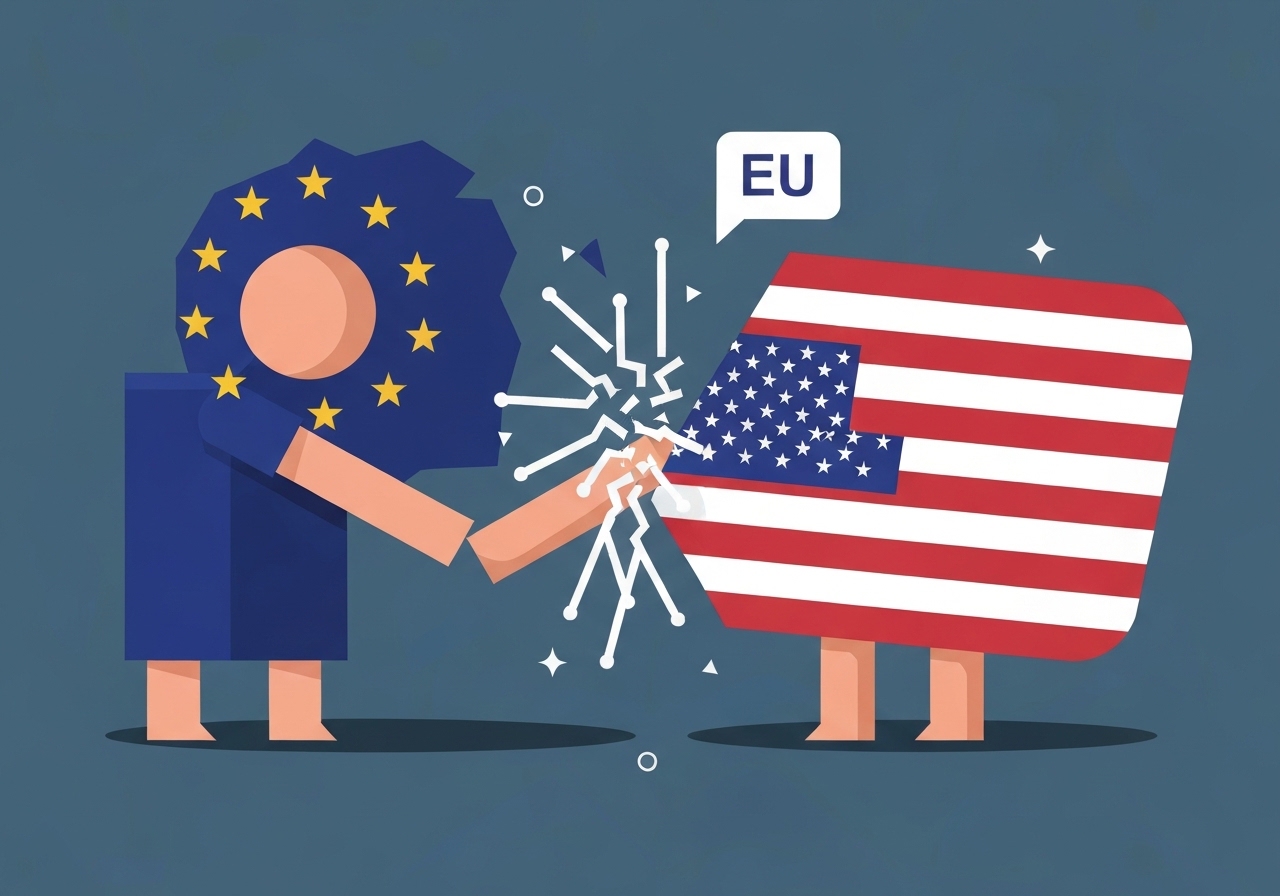
Lead: The European Parliament’s international trade committee plans to suspend work on the US–EU trade package agreed in July, sources say, with the announcement due in Strasbourg on Wednesday. The suspension follows US threats connected to a separate dispute over Greenland and has sent shock waves through global markets, pushing major US indexes down more than 1.7–2.4% and lifting gold above $4,800 an ounce. The decision pauses the Turnberry-derived legislative proposals and raises the prospect of renewed tit-for-tat tariffs unless negotiations resume.
Key Takeaways
- The European Parliament’s trade committee will suspend approval of the July US–EU trade deal; the move is set to be announced in Strasbourg on Wednesday.
- US equity markets fell sharply on Tuesday: the Dow dropped over 1.7%, the S&P 500 fell more than 2%, and the Nasdaq closed about 2.4% lower.
- Precious metals surged: gold rose above $4,800 an ounce and silver eased from a record above $94 an ounce, reflecting flight-to-safety flows.
- The EU retains a contingency list of roughly €93bn ($109bn, £81bn) of US goods that could be hit with retaliatory levies; that reprieve expires 6 February, with levies due on 7 February unless extended.
- Key EU figures including Manfred Weber and Bernd Lange signalled approval is impossible while US threats over Greenland stand, linking territorial rhetoric to trade policy.
- US officials in Davos urged restraint; Washington warned it would respond if the EU enacted retaliatory measures, raising risks of escalation.
Background
The July agreement negotiated at the Turnberry summit reduced proposed US levies on most European goods to 15%, down from the 30% initially threatened by the US earlier in the year. In return, Europe agreed to investment and regulatory adjustments intended to increase US exporters’ access to European markets. That framework was contingent on formal approval by the European Parliament and implementing legislation inside the EU.
Tensions flared again after the US signalled interest in acquiring Greenland and followed with trade threats over the island, prompting prominent MEPs to say parliamentary approval is no longer possible. The EU had already drafted a list of about €93bn of US products that could face retaliatory tariffs in response to Washington’s earlier measures; that list was held in abeyance while the Turnberry deal was discussed. Unless the EU decides to extend its temporary hold, those countermeasures would be scheduled to take effect on 7 February.
Main Event
The international trade committee of the European Parliament is reported to be suspending its work on the two Turnberry legislative proposals, a procedural step that halts the path to a final parliamentary vote. Bernd Lange, who chairs the committee, framed the suspension as a response to what he described as coercive US tactics linking tariff threats to questions of territorial sovereignty. Manfred Weber, a senior German MEP, said approval was not possible while such threats persist.
Financial markets reacted quickly: US equities logged multi-percent declines on Tuesday, European bourses extended losses for a second session, and Asia-Pacific markets traded mixed on Wednesday. Investors pushed into perceived safe havens; gold climbed past $4,800 an ounce and silver eased slightly after reaching record highs above $94 an ounce. Currency moves were smaller: the US dollar was broadly steady against major peers after a recent 0.5% drop overnight.
Political leaders across the EU signalled openness to defensive measures. French President Emmanuel Macron publicly urged consideration of tools including the so-called anti-coercion instrument, nicknamed the “trade bazooka,” as part of a broader push to deter what he called an unacceptable pattern of tariff accumulation. At the same time, EU institutions must weigh the economic costs of triggering retaliatory levies against the political need to signal firmness.
US officials in Davos sought to temper immediate escalation, urging European partners not to retaliate prematurely while also warning that Washington would respond if punitive measures were implemented. The US administration has expressed frustration with the pace of European legislative steps to ratify the Turnberry package, and the current pause underscores the fragility of the negotiated compromise.
Analysis & Implications
The suspension transforms a technical parliamentary pause into a geopolitical flashpoint. By tying approval to rhetoric about Greenland and to tariff tools, EU leaders signalled that trade arrangements cannot be isolated from broader diplomatic conduct. Markets treated the news as a near-term shock, repricing risk across equities, commodities and currencies; the rapid jump in gold reflects demand for safe assets rather than a durable structural shift in commodity fundamentals.
For businesses, the uncertainty is immediate and costly. Companies that had begun to price the Turnberry terms into supply-chain planning now face the prospect of reverting to higher US levies or awaiting renewed negotiation. The looming deadline for the EU’s suspension of retaliatory measures — 7 February — creates a narrow window for diplomacy or for the EU to decide whether to extend its moratorium while seeking concessions.
Politically, the episode highlights the limits of bilateral deals in an era of heightened strategic rivalry. Middle powers such as Canada warned against negotiating from weakness, and EU leaders will weigh domestic political optics: appearing to capitulate could be politically damaging, while triggering tariffs could harm consumers and exporters in key EU industries. The US Supreme Court case on the legality of many of last year’s tariffs adds a legal layer of uncertainty to any long-term solution.
Comparison & Data
| Market / Item | Recent Move |
|---|---|
| Dow Jones | Down >1.7% |
| S&P 500 | Down >2% |
| Nasdaq | Down ~2.4% |
| Gold | Above $4,800/oz |
| Silver | Lightly below record >$94/oz |
| EU contingency list | ~€93bn ($109bn, £81bn) |
These figures illustrate how financial markets and policy levers are moving in parallel: equity indices reacted negatively to the political development, while commodity prices rose on safe-haven demand. The EU’s €93bn list provides a measurable scale for potential countermeasures; if enacted, it would affect a broad swathe of US exports. Policymakers face a trade-off between signaling deterrence and avoiding self-harm through reciprocal tariffs.
Reactions & Quotes
European lawmakers and leaders framed the suspension as a necessary response to threats that touch on sovereignty and predictability in trade relations.
“Approval is not possible at this stage.”
Manfred Weber, MEP (reported)
Weber’s remark followed public pressure inside the European Parliament after US statements about Greenland. It was cited by committee members as a key reason for halting the approval process.
“By threatening the territorial integrity and sovereignty of an EU member state and by using tariffs as a coercive instrument, the US undermines the stability and predictability of EU–US trade relations.”
Bernd Lange, Chair, EP International Trade Committee
Lange framed the committee’s suspension as a proportional institutional response, noting that the committee must sign off before the deal reaches a full plenary vote.
“Sit back. Take a deep breath. Do not retaliate. The president will be here tomorrow, and he will get his message across.”
Scott Bessent, US Treasury (Davos remarks)
US officials urged caution in public remarks at Davos while privately warning of consequences if the EU enacted counter-tariffs. Their comments underline the diplomatic balancing act between deterring escalation and preserving trade ties.
Unconfirmed
- Whether the EU will trigger the €93bn list of retaliatory levies immediately if the suspension holds is unresolved and depends on fast-moving political decisions.
- It is not yet confirmed whether the US administration will follow through on additional tariff steps tied to Greenland beyond public statements reported in Davos.
- The timing and outcome of the pending Supreme Court review of last year’s tariffs and how it will affect future US tariff policy remain uncertain.
Bottom Line
The European Parliament’s move to suspend approval converts a bilateral trade compromise into a broader geopolitical dispute, with markets interpreting the development as a substantive escalation. Investors shifted into safe-haven assets and equities repriced risk, while policymakers on both sides of the Atlantic signalled readiness to resist perceived coercion.
Watch the next week closely: the EU’s moratorium on countermeasures formally ends on 6 February, with levies scheduled for 7 February unless an extension or new agreement is reached. Diplomatic engagement between Brussels and Washington — and the pace of statements from leaders and markets — will determine whether this episode resolves into renewed talks or a sustained trade standoff.