
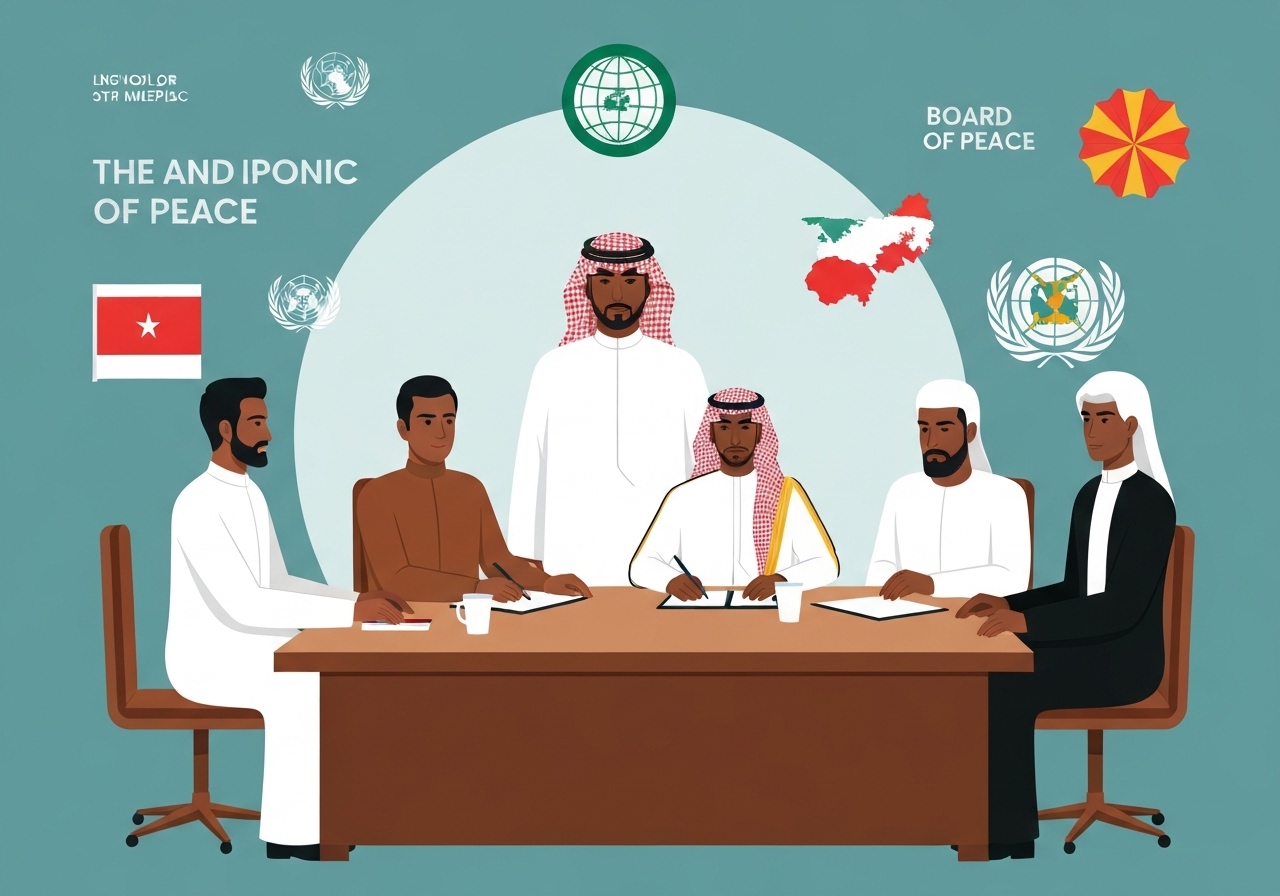
Lead: Seven countries — Saudi Arabia, Turkey, Egypt, Jordan, Indonesia, Pakistan and Qatar — announced they will join US President Donald Trump’s newly proposed Board of Peace in a joint statement on Wednesday, adding to Israel which had already confirmed participation. The announcement followed President Trump saying Russian President Vladimir Putin had accepted an invitation, a claim Putin later described as still under consideration. The Board is presented as a vehicle to consolidate a durable Gaza ceasefire, coordinate reconstruction and advance a lasting settlement, though its draft charter does not explicitly reference the Palestinian territories and raises questions about overlap with UN roles.
Key Takeaways
- Seven Muslim-majority countries (Saudi Arabia, Turkey, Egypt, Jordan, Indonesia, Pakistan and Qatar) publicly endorsed joining the Board of Peace to support a permanent Gaza ceasefire and reconstruction.
- Israel had earlier confirmed participation; the board’s Gaza Executive Board composition drew criticism from Netanyahu’s office for lack of coordination.
- President Trump said Vladimir Putin had accepted an invitation, but the Russian president said the offer was still being reviewed; Russia also offered $1bn from frozen assets for the effort.
- A leaked charter says the Board would become effective after three states ratify it, offers renewable three‑year terms, and gives permanent seats to states contributing $1bn.
- The White House named seven founding Executive Board members including Secretary of State Marco Rubio, envoy Steve Witkoff, Jared Kushner, and former UK prime minister Tony Blair; Nickolay Mladenov was named the Gaza representative for a second phase running until the end of 2027 under an authorized UN resolution.
- Several states — including the UAE, Bahrain, Albania, Armenia, Azerbaijan, Belarus, Hungary, Kazakhstan, Morocco and Vietnam — have already signed up; invitations to Canada and the UK are reported but responses are pending.
- Slovenia’s prime minister declined participation, saying the body risks interfering with the broader international order.
- Humanitarian indicators remain dire: more than 71,550 people reported killed in Gaza since the October 7, 2023 offensive; the Hamas-run Gaza health ministry reports over 460 Palestinians killed since the ceasefire, while Israeli military reports three soldiers killed during the same period.
Background
The Board of Peace proposal emerges against the backdrop of the Israel–Hamas war that began with the Hamas-led attack on 7 October 2023, which Israeli authorities say killed about 1,200 people and saw 251 taken hostage. Israel’s military response in Gaza has, according to Gaza’s health authorities, resulted in more than 71,550 deaths in the territory. Humanitarian collapse and large-scale displacement have been central drivers for international involvement.
Regional actors — notably Turkey, Qatar and Egypt — have played key mediating roles during ceasefire negotiations and hostage exchanges, and they are among the countries now agreeing to join the Board. The United Nations has also been central to relief and reconstruction planning; some diplomats and legal experts worry a new organization with powers overlapping UN functions could fragment international governance for peacebuilding and relief coordination.
Main Event
The joint statement by the seven countries said they endorsed aims to consolidate a permanent Gaza ceasefire, support reconstruction and advance a “just and lasting peace.” The announcement arrived shortly after President Trump told reporters at the World Economic Forum that Vladimir Putin had accepted an invitation to join; Kremlin spokespeople subsequently said the invitation was still under review. Russia additionally signalled readiness to contribute $1bn from frozen assets to related efforts.
A leaked draft of the Board’s charter — circulated in diplomatic and media outlets — describes a body that would be constituted once three states formally agree to be bound by it, with member terms renewable every three years and options for permanent seats for large financial contributors. The charter also gives the Board authority to appoint executive members and create or dissolve subsidiary bodies, with Trump named as chairman and the US representative in separate capacities.
The White House on Friday named seven founding executive members, combining political figures, business envoys and former officials. A Gaza Executive Board was described as a mechanism for a second phase of the plan — involving reconstruction and demilitarisation — and was said to be authorised by a UN Security Council resolution running until the end of 2027. Israel’s government later said the Gaza Executive Board’s composition had not been coordinated with Jerusalem and contradicts its policy.
Analysis & Implications
The rapid enlistment of several regional states gives the Board initial political heft, particularly because it includes countries that helped broker the October ceasefire. Their participation could improve coordination on reconstruction logistics and donor commitments — a pressing need given Gaza’s devastated infrastructure. However, absence of explicit reference to Palestinian territorial sovereignty in the charter may exacerbate Palestinian political concerns and could weaken perceived legitimacy among local stakeholders.
Institutionally, the charter’s suggested powers and financing thresholds risk creating a parallel structure to the UN for peacebuilding in Gaza, raising legal and diplomatic questions about mandate, accountability and the interplay with existing UN agencies. States that view multilateral institutions as central to post‑conflict reconstruction are likely to press for clear safeguards, transparent financing rules and mechanisms for Palestinian representation.
Geopolitically, Russia’s potential participation and pledge of funds would mark a rare avenue for Moscow to re-engage diplomatically in a Middle East reconstruction programme alongside the United States, complicating a traditional US‑Russia dynamic. European reactions and the positions of Canada, the UK and other Western partners will be crucial in determining whether the Board acquires broad international legitimacy or remains a more limited coalition led by Washington and select regional partners.
Comparison & Data
| Metric | Reported figure | Source |
|---|---|---|
| Deaths in Gaza since Oct 7, 2023 | 71,550+ | Gaza health ministry |
| Palestinians reported killed since ceasefire | 460+ | Gaza health ministry |
| Israeli casualties since ceasefire | 3 soldiers | Israeli military |
| Hostages taken on 7 Oct 2023 | ~251 | Israeli authorities |
| Permanent seat contribution threshold (leaked charter) | $1bn (≈£740m) | Leaked charter |
The table juxtaposes core human‑cost figures reported by local authorities with provisions in the leaked charter that set financial thresholds for governance roles. Those monetary thresholds, if enacted, could concentrate influence among wealthier states and shape reconstruction priorities. Humanitarian figures come from local health authorities and military tallies; independent verification is limited in some cases due to access restrictions.
Reactions & Quotes
“He was invited; he accepted — many people have accepted,”
Donald Trump, US President (reported at World Economic Forum)
Trump framed the initiative as gaining rapid international backing. His public remarks intended to signal momentum, though some invitees later clarified they were still reviewing the proposal.
“The invitation is under consideration,”
Vladimir Putin / Kremlin statement (reported)
The Kremlin response tempered Washington’s claim, while offering a tangible Russian financial pledge of $1bn drawn from frozen assets — a move that could complicate Western coordination if confirmed.
“The Pope will need time to consider participation,”
Cardinal Pietro Parolin, Vatican Secretary of State (reported)
The Vatican confirmed the Holy See received an invitation; the Holy See emphasised deliberation will be required before accepting a political role in a reconstruction body.
Unconfirmed
- Whether Vladimir Putin has formally accepted membership remains unconfirmed; Kremlin language described the invitation as still under consideration.
- The full list of invited states and the total number that have accepted has not been publicly confirmed; reports vary on which capitals were approached.
- Details and legal standing of the leaked charter — including the $1bn permanent‑seat rule and automatic powers for the chairman — have not been officially published or vetted by independent legal authorities.
- Precise financial pledges beyond Russia’s reported $1bn offer are not publicly verified, and timelines for reconstruction funding remain unclear.
Bottom Line
The Board of Peace has secured headline support from seven additional states, boosting its regional legitimacy and signaling potential for a new multilateral vehicle to manage ceasefire consolidation and reconstruction in Gaza. Yet significant questions remain about legal mandate, transparency, Palestinian representation and interaction with UN systems — issues that will determine whether the initiative reinforces or undermines established international mechanisms.
Watch for clarifications over the next days on which states formally ratify the charter, whether Russia finalises participation and how Israel and Palestinian representatives respond to executive appointments and reconstruction plans. The initiative’s long‑term impact will depend less on initial endorsements and more on whether it can secure broad, verifiable commitments to funding, accountability and an inclusive political process.
Sources
- BBC News (international media report)
- Reuters (news agency — reporting cited)
- The White House (official statements and announcements)
- United Nations (UN documentation and Security Council records)
- Israel Defense Forces / Israeli military statements (official)
- Gaza Health Ministry (local health authority reporting)