
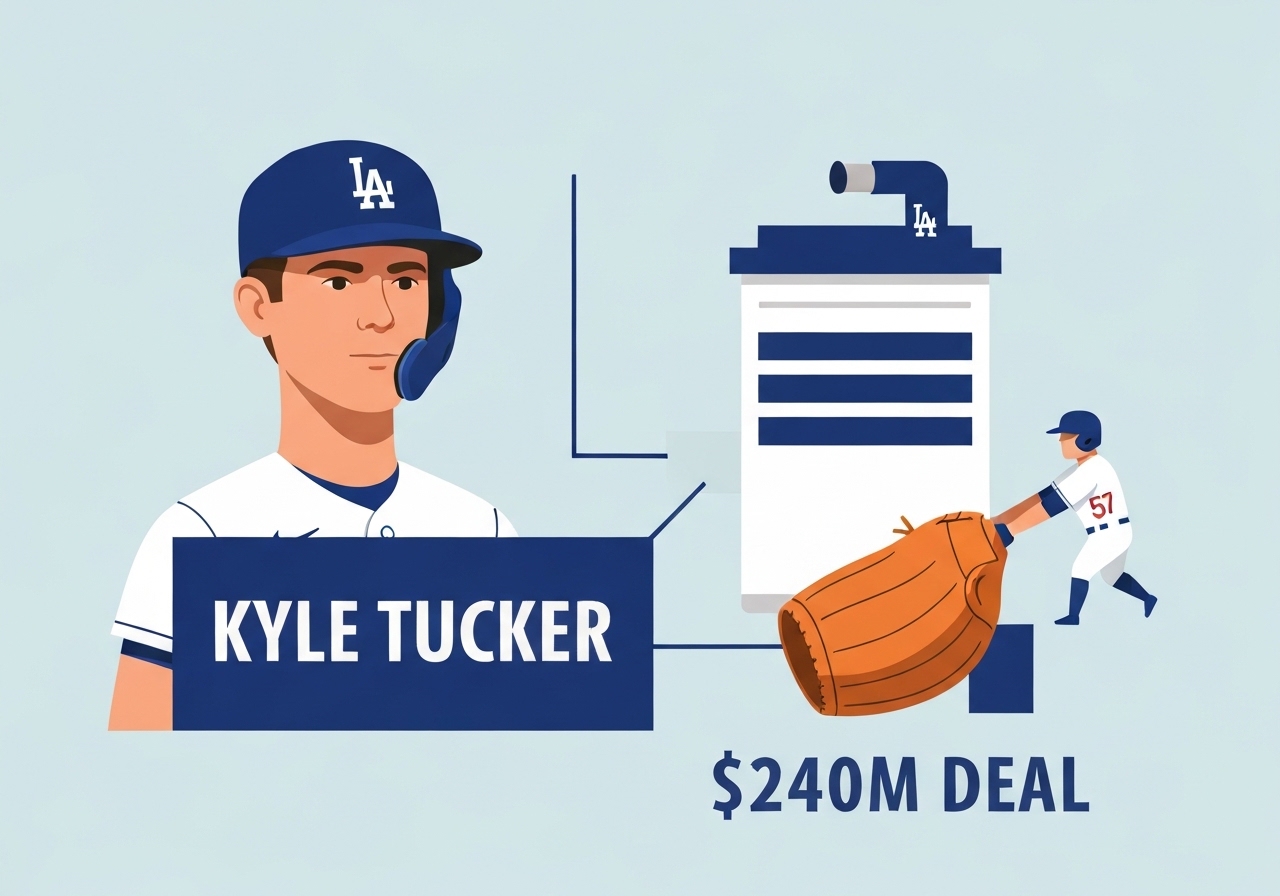
LOS ANGELES — On Jan. 21, 2026, outfielder Kyle Tucker agreed to a four-year, $240 million contract with the Los Angeles Dodgers, saying the club’s pursuit of a third straight World Series made his decision easier. Tucker, who weighed offers from the New York Mets and the Toronto Blue Jays, can opt out after years two and three and joins a roster already led by Shohei Ohtani and other high-profile signings. The deal includes a large signing bonus, structured deferred payments and unique perquisites, and positions Tucker to play right field and slot near the top of the Dodgers’ batting order.
Key Takeaways
- Kyle Tucker signed a four-year, $240 million contract with the Los Angeles Dodgers on Jan. 21, 2026; he may opt out after seasons two and three.
- The contract includes a $64 million signing bonus (with $54 million due Feb. 15, 2026, and $10 million due Feb. 1, 2027) and a $1 million salary in 2026 followed by $55 million in 2027.
- Player options of $60 million exist for 2028 and 2029; each 2027–29 season carries $10 million in deferred pay, payable in 10 equal installments from Dec. 1, 2036–45.
- Tucker’s $60 million average annual value ranks second in baseball history behind Shohei Ohtani’s $70 million AAV with the Dodgers (without counting deferred sums).
- With Tucker’s addition and deferred money included, Los Angeles will owe $1.0945 billion in deferred compensation to 10 players between 2028 and 2047.
- Club officials said Tucker materially improved the Dodgers’ 2026 World Series outlook; management also expects him to play right field and bat second or third.
- The Dodgers conducted thorough vetting of Tucker’s competitiveness and work ethic, addressing past criticism about his on-field demeanor.
Background
Kyle Tucker, an established five-tool outfielder and a 2025 National League All-Star starter, entered free agency with multiple suitors after a season that reinforced his run-producing and defensive profile. The Dodgers, two-time defending World Series champions entering 2026, have focused recent offseasons on assembling a roster capable of extending their championship streak. Los Angeles’ payroll strategy has included large up-front guarantees and deferred structures, which have repeatedly sparked wider discussion of competitive-balance measures in collective bargaining.
Historically, the Dodgers have used big contracts to build sustained contention, pairing top-tier hitters and pitchers with depth across the roster. Tucker’s decision followed overtures from both the Mets and the Blue Jays, teams that also offered competitive packages. The ability to opt out after short intervals gives Tucker flexibility, while deferred elements allow the Dodgers to smooth short-term payroll impact even as long-term obligations accumulate.
Main Event
The formal announcement came at a press event inside Dodger Stadium, where Tucker donned No. 23 — a tribute, he said, to former Astros teammate Michael Brantley — and outlined why Los Angeles appealed to him beyond money. Tucker said the city, the organization’s championship habit and the fanbase made the choice easier; he emphasized a desire to help the club pursue another title. Manager Dave Roberts and president of baseball operations Andrew Friedman were present and framed the signing as both a roster upgrade and a cultural fit.
Contract structure: Tucker receives a $64 million signing bonus with $54 million immediately payable in mid-February and $10 million the following February, a $1 million 2026 salary, $55 million in 2027, and $60 million player options for 2028 and 2029. Each of the 2027–29 seasons defers $10 million, with the deferred pool payable in ten equal installments from 2036 through 2045. The Dodgers also granted Tucker a hotel suite for road trips as part of the agreement.
On the field, the Dodgers intend to place Tucker in right field and likely bat him second or third, behind leadoff hitter Shohei Ohtani, who was present and working out before Tucker’s introduction. Teoscar Hernandez is expected to move from right to left field to accommodate Tucker’s arrival. Front-office leaders said they vetted Tucker’s competitiveness extensively — speaking with clubhouse staff, trainers, coaches and previous managers — to address public questions about his effort and demeanor.
Analysis & Implications
Short term, the Dodgers add a potent middle-of-order bat and above-average outfield defense, which management believes increases their probability of repeating as champions in 2026. General manager Brandon Gomes asserted that Tucker moved Los Angeles’ World Series prospects more than any other single addition this winter, signaling that the club expects immediate on-field return on the investment.
From a payroll and roster-management perspective, the deal continues Los Angeles’ pattern of heavy spending combined with deferred obligations. The AAV headline of $60 million places Tucker second only to Ohtani in yearly average pay, and the deferred schedule contributes to a substantial long-range liability — $1.0945 billion owed to 10 players from 2028–47. That cumulative deferred burden complicates future spending flexibility and will factor into any labor talks about limits or luxury tax reforms.
For Tucker personally, the opt-out provisions offer levers: strong performance could prompt an early departure for a longer-term, higher-value contract elsewhere; conversely, remaining through the options would keep him in a prime contention window with the Dodgers. The club emphasized development pathways they believe can sharpen Tucker’s performance in defense, baserunning and hitting mechanics, suggesting both sides view the contract as a near-term championship play with room for individual growth.
Comparison & Data
| Year | Cash (Salary/Bonus) | Deferred | Notes |
|---|---|---|---|
| 2026 | $1,000,000 + $54,000,000 (part of signing bonus) | $0 | Signing bonus split: $54M due Feb. 15, 2026 |
| 2027 | $55,000,000 + $10,000,000 (bonus installment) | $10,000,000 | Opt-out available after year 2 |
| 2028 | $60,000,000 (player option) | $10,000,000 | Player option; deferred payable 2036–45 |
| 2029 | $60,000,000 (player option) | $10,000,000 | Player option; deferred payable 2036–45 |
The table above summarizes headline cash flows and deferred elements. Compared with Shohei Ohtani’s $70 million AAV that runs through 2033, Tucker’s $60 million AAV (excluding deferred amounts) marks the second-highest yearly average in the sport. The club’s total deferred liabilities grow materially when multiple player contracts are stacked with similar structures.
Reactions & Quotes
Front-office leaders framed the signing as a strategic move to sustain a championship window and praised Tucker’s competitive traits after due diligence.
“Obviously, we started lower,”
Andrew Friedman, Dodgers president of baseball operations
Friedman used the comment lightheartedly to acknowledge negotiation dynamics while stressing the organization’s ability to build a destination team that attracts elite players. He also highlighted the club’s process for assessing character and how Tucker’s work habits fit the Dodgers’ model.
“There was really nobody that moved our World Series odds for 2026 more than Kyle Tucker,”
Brandon Gomes, Dodgers general manager
Gomes attributed measurable championship upside to Tucker’s addition, framing it as a roster-altering move rather than a marginal upgrade. The front office stopped short of providing quantified odds during the announcement.
“This organization from top down is first class,”
Kyle Tucker
Tucker echoed the organization’s cultural pitch and said competing for another title and joining the Los Angeles fanbase were decisive factors in his choice. He also acknowledged past public criticism about his demeanor and emphasized a growth mindset toward improving finer points of his game.
Unconfirmed
- Whether Tucker will exercise either opt-out after the 2027 or 2028 seasons is unknown and will depend on performance and market conditions.
- The precise numeric shift in Los Angeles’ 2026 World Series probability tied to Tucker was described qualitatively by the front office but not quantified publicly.
- Any formal labor negotiations or management proposals for a league-wide salary cap prompted by this signing remain speculative until clubs or the union announce specific plans.
Bottom Line
Kyle Tucker’s four-year, $240 million agreement with the Dodgers is both a clear push to extend Los Angeles’ championship window and an example of how modern contracts mix upfront guarantees with deferred payments and player flexibility. In the near term, the move strengthens the Dodgers’ lineup and outfield alignment and is expected to improve their 2026 title chances according to team leadership.
Longer term, the financial architecture of the deal — especially the deferred components and high AAV — contributes to a growing aggregate liability for the franchise that will factor into future roster choices and labor conversations. For Tucker, the opt-outs offer strategic freedom; for the Dodgers, the signing is a calculated bet that immediate contention outweighs added long-range obligations.