
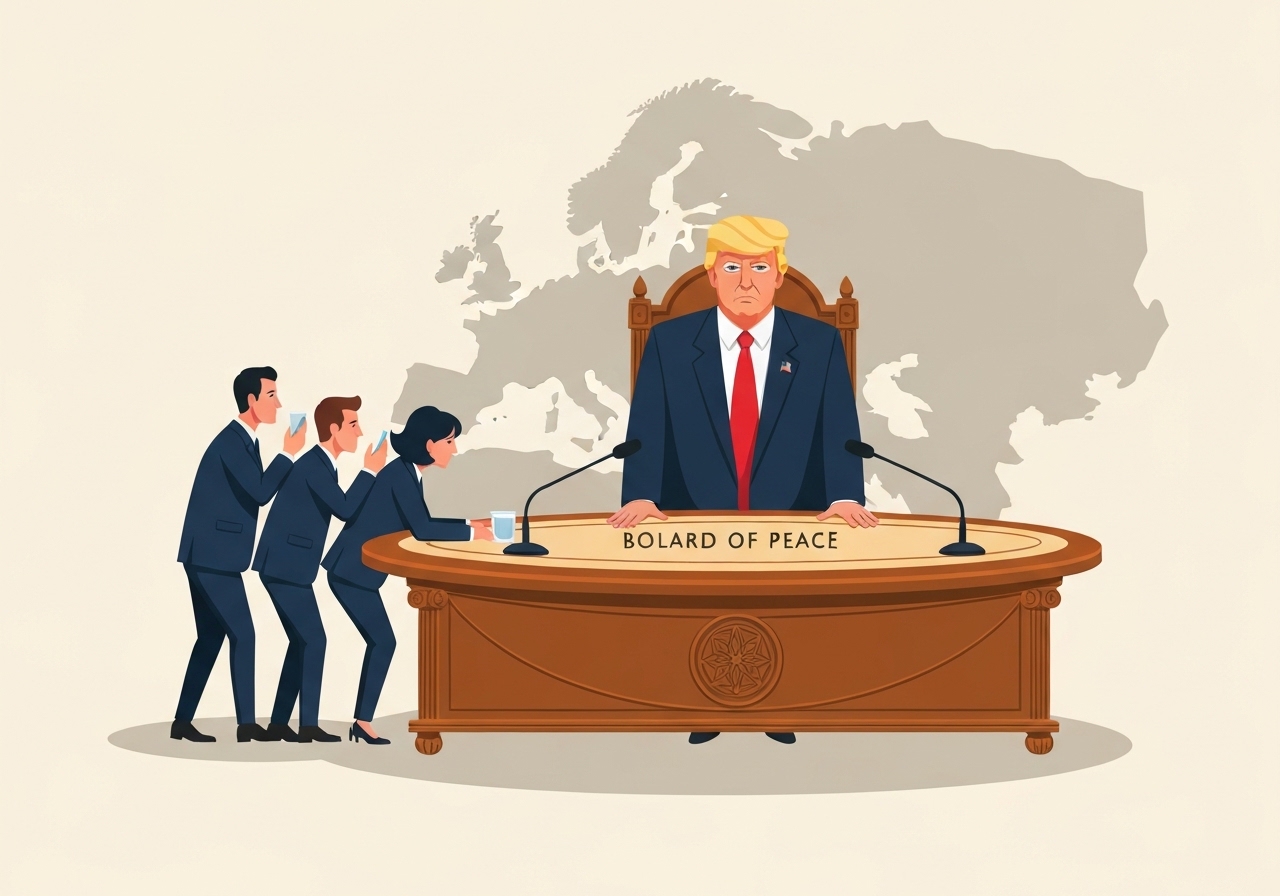
On Jan. 20, European governments signalled reluctance to join former U.S. President Donald Trump’s proposed “board of peace” for Gaza, and the move has coincided with a separate White House intervention over the Chagos Islands that British opposition leader Keir Starmer has said risks domestic political fallout. Reporting by Politico indicates the proposal failed to win quick support in key capitals, deepening strains at a moment when transatlantic ties are already fragile. The combined developments have prompted public unease in Europe and stoked questions about U.S. influence on allied policy and domestic politics in the U.K.
Key Takeaways
- On Jan. 20, Politico reported that multiple European capitals declined to endorse Trump’s proposed “board of peace” to oversee Gaza, citing concerns about mandate and process.
- The White House’s intervention on the Chagos sovereignty issue was interpreted by some U.K. figures as an unexpected intrusion into British domestic politics, with potential consequences for Labour leader Keir Starmer.
- European diplomats emphasised the need for careful coordination and multilateral frameworks rather than ad hoc fora, reflecting reluctance to be seen as endorsing a U.S.-led initiative without broader buy-in.
- The episode comes amid already strained transatlantic relations, complicating cooperation on Gaza, NATO burden-sharing, and regional security in Europe and the Middle East.
- Political actors in London and Brussels signalled that any partnership would require clarity on membership, legal mandate, and links to existing international institutions.
Background
Proposals for ad hoc panels or “boards” to manage ceasefires and reconstruction in Gaza have periodically surfaced during the conflict, often met with mixed reactions from regional and European governments. European states typically prefer established multilateral channels — including the United Nations and the Quartet — to bilateral or U.S.-led bodies, citing legitimacy, legal frameworks, and long-term accountability. That institutional preference helps explain the cautious reaction to a U.S.-originated board pitched as a quick path to managing complex humanitarian and security responsibilities.
The Chagos Islands dispute has been a long-running diplomatic matter between the U.K. and Mauritius, involving sovereignty claims and the status of the Diego Garcia military base. Any external commentary touching on Chagos carries political sensitivities in London, where both government and opposition have to weigh defense, diplomatic, and electoral considerations. According to reporting, recent U.S. comments were read by some British observers as an intervention with possible domestic political implications for Labour leader Keir Starmer.
Main Event
Politico’s reporting on Jan. 20 describes how White House outreach about the creation of a “board of peace” failed to translate into immediate European endorsement. Senior officials in several EU capitals reportedly pressed for more detail on membership, legal authority, and how such a board would relate to the U.N. and existing humanitarian mechanisms. Without those assurances, ministers stopped short of giving public backing.
At the same time, U.S. statements on the Chagos question were publicised in London and quickly became a talking point among British politicians. Opposition figures said the intervention risked being interpreted as partisan interference in U.K. domestic politics, while government spokespeople urged calm and private diplomatic engagement. The juxtaposition of the two moves — a foreign-policy initiative and a separate comment on a colonial-era territorial dispute — amplified sensitivity in European capitals.
European capitals conveyed practical objections: a desire for mandates rooted in international law, concerns about bypassing existing institutions, and wariness of any forum that might be perceived as legitimising unilateral decision-making. Officials emphasised that effective Gaza diplomacy requires broad diplomatic participation, financing commitments, and enforceable mechanisms — none of which were yet spelled out for Trump’s proposal, as reported.
Analysis & Implications
The European retreat underscores a recurrent pattern in transatlantic relations: when U.S. initiatives appear ad hoc or insufficiently coordinated with partners, capitals outside Washington often resist quick alignment. That dynamic reflects both principled institutionalism — a preference for U.N.-backed frameworks — and pragmatic concern about domestic political optics. For Europe, joining a United States-authored board without clear rules risked political backlash at home and could complicate efforts to maintain credibility in longer-term reconstruction and accountability efforts.
For the U.K., the Chagos intervention carries dual risks. Diplomatic friction with Washington is politically costly but often manageable; domestic political effects, however, can be more immediate and unpredictable. If opposition figures portray external commentary as favouring one domestic actor over another, it could intensify scrutiny of the government’s response and of relations with the United States.
Strategically, the episode may nudge European governments to double down on multilateralism: investing more diplomatic capital in U.N. channels, the International Court of Justice where relevant, and coordinated EU-level responses. That would preserve legitimacy but could slow the timetable for on-the-ground relief or enforcement actions — a trade-off that policymakers must weigh amid urgent humanitarian needs in Gaza.
Reactions & Quotes
European officials said they needed explicit terms of reference and legal clarity before committing to any new body.
Politico Europe (media)
Some British politicians urged calm, warning against public escalation while diplomatic channels remained open.
Politico Europe (media)
Observers noted the episode reinforced wider concerns about coordination between Washington and its European partners on Middle East policy.
Politico Europe (media)
Unconfirmed
- Whether the White House’s Chagos comments were intended to influence the U.K. domestic election calculus remains officially unproven and is reported as interpretation rather than fact.
- Details of private conversations between U.S. officials and specific European capitals about the board’s structure were not publicly confirmed in the reporting.
Bottom Line
The immediate outcome is clear: European governments did not rush to join the U.S.-proposed “board of peace,” favouring established multilateral tracks and demanding legal and operational clarity. That hesitation reflects both institutional preferences and practical concerns about legitimacy, oversight, and domestic political costs.
Looking ahead, the incident is likely to prompt renewed efforts at quiet diplomacy: detailed consultations over mandates, closer coordination with U.N. mechanisms, and an effort by Washington to win buy-in through clearer frameworks and guarantees. For policymakers, the lesson is straightforward — transatlantic cooperation on highly sensitive issues requires early, transparent coordination and respect for existing international institutions to secure durable support.
Sources
- Politico Europe — Media/press reporting (Jan. 20)