
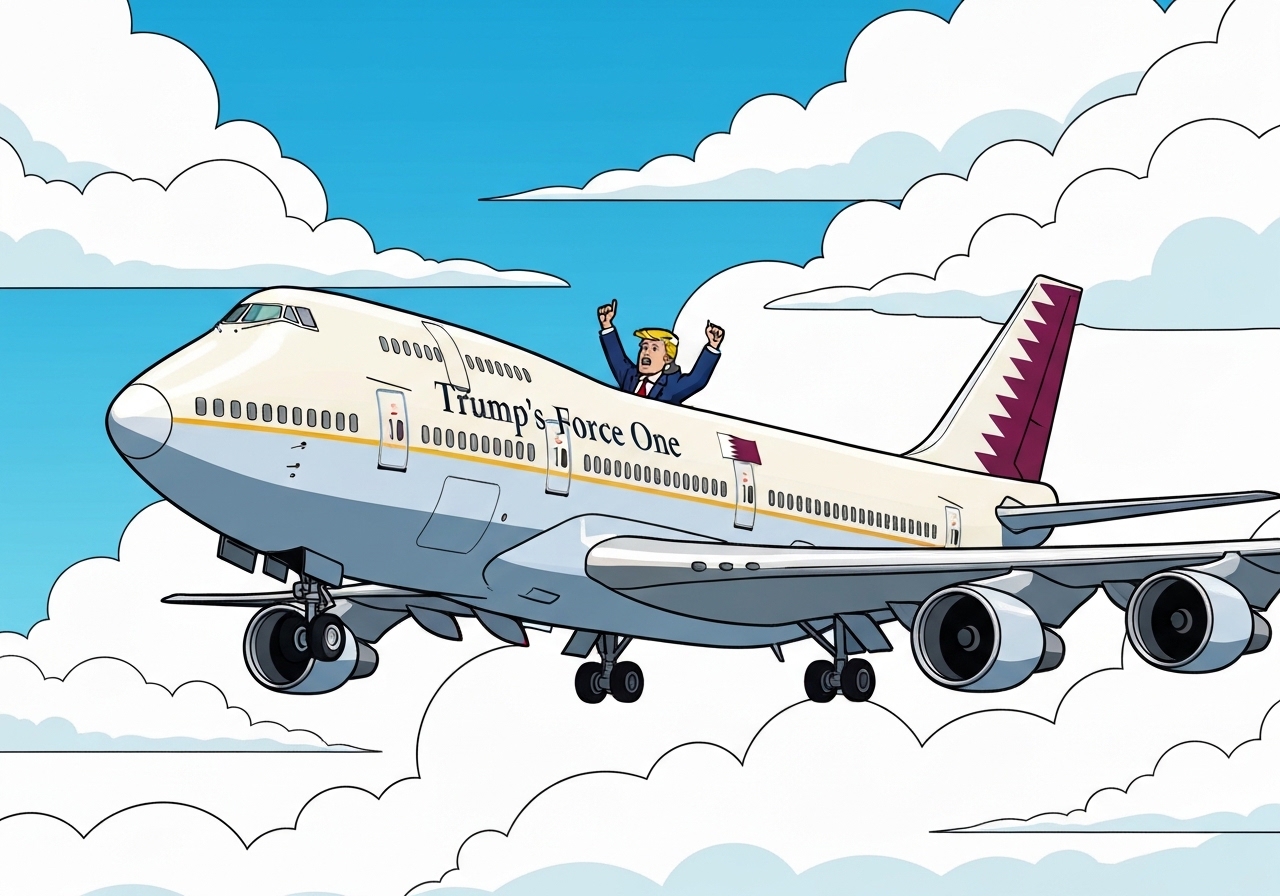
The U.S. Air Force said on Jan. 22, 2026 that a Boeing 747-style jet donated by the Qatari royal family could be delivered to support presidential airlift duties no later than summer 2026. The plane, provided last spring, must undergo retrofitting and security inspections before entering service and could temporarily replace two 35-year-old presidential aircraft. The announcement follows an in-flight turnback of the current Air Force One over a reported minor electrical issue and renewed scrutiny from lawmakers and watchdog groups over accepting a high-value foreign gift. The Defense Department and White House have said they are accelerating technical work while defenders and critics debate the ethics and security implications.
Key Takeaways
- The Air Force confirmed an expected delivery of the donated VC-25 “bridge” aircraft no later than summer 2026 to support the presidential airlift mission.
- The jet was donated by Qatar’s royal family in spring 2025 and is a Boeing 747-style aircraft requiring significant retrofits to serve as Air Force One.
- The donated plane would supplement or temporarily substitute for two existing presidential jets that are roughly 35 years old.
- Two purpose-built replacement aircraft remain scheduled for delivery in 2027 and 2028, after procurement delays.
- A recent turnback en route to Switzerland was attributed to a minor electrical issue with the current Air Force One; the president completed the trip on a smaller government aircraft.
- Watchdog groups and congressional Democrats have raised ethics and national-security questions, noting the gift’s estimated value in the hundreds of millions and requesting oversight.
- The Air Force is conducting retrofitting, communications upgrades and sweeps for foreign surveillance devices before acceptance.
Background
The United States maintains specially configured Boeing aircraft—commonly referred to as Air Force One—for presidential travel. The two jets currently assigned to that mission date back about 35 years and have required repeated maintenance and upgrades. A multi-year program to replace the aging fleet has been under way, but deliveries of two newly built presidential aircraft have slipped and are now scheduled for 2027 and 2028.
Against that backdrop, Qatar’s royal family offered a Boeing 747 variant as a donation last spring. The gift was intended to serve as an interim “bridge” aircraft while the new planes are completed. Accepting a costly foreign gift to a sitting president is uncommon and triggered immediate scrutiny from ethics watchdogs and some lawmakers concerned about precedent, influence and the cost of bringing the jet up to operational and security standards.
Main Event
On Jan. 22, 2026 an Air Force spokesperson confirmed the service is prioritizing retrofitting and expects to put the VC-25 bridge aircraft into the presidential airlift rotation by summer 2026 at the latest. The service said work includes installing secure communications, defensive systems where required, and removing or hardening any nonconforming equipment.
Before the aircraft can be accepted, Pentagon teams will conduct technical inspections and electronic sweeps to detect any unauthorized surveillance or foreign technical vulnerabilities. CBS News and other outlets reported these checks as a precondition to formal acceptance; the Air Force emphasized that security certification is required before operational use.
The donated jet could reduce reliance on the current twin jets, both approaching four decades of service, and give the presidential fleet extra capacity during the multi-year replacement program. Officials described the arrangement as a temporary measure to ensure mission continuity while new aircraft are finished and crews are trained on updated systems.
Analysis & Implications
Domestically, the gift has crystallized partisan scrutiny of foreign contacts and gifts to a sitting president. Ethics watchdogs have argued the donation creates at least the appearance of influence; supporters counter that the aircraft was offered to the U.S. government and that the Air Force, not the White House, will operate and certify the plane. The legal framework for accepting foreign gifts to federal agencies is narrow but allows transfers with approvals and conditions.
From a national-security perspective, retrofitting a foreign-donated jet poses technical and operational challenges. Military and civilian aviation specialists note that secure presidential communications and defensive measures are specialized installations; integrating them into a donor airframe requires time, funding and certification. That process increases near-term costs for taxpayers even if the airframe itself was donated.
On the diplomatic front, accepting assistance from a Gulf monarchy could be framed as pragmatic logistics cooperation or criticized as entangling. The decision may prompt congressional hearings, policy reviews and firmer guidance on future offers of high-value equipment from foreign governments. Internationally, it sets a visible precedent for in-kind military or governmental assistance.
Comparison & Data
| Item | Detail |
|---|---|
| Donated jet | VC-25 (Boeing 747-style), donated spring 2025; targeted delivery by summer 2026 |
| Current presidential jets | Two airframes ~35 years old; operational limitations and recent maintenance incidents |
| Replacement program | Two new aircraft scheduled for 2027 and 2028 delivery |
These dates illustrate an interim window in 2026 when the donated aircraft could fill capacity gaps. The donated plane avoids waiting for the 2027–2028 replacements but requires taxpayer-funded retrofits and certification before it becomes fully operational for the presidential mission.
Reactions & Quotes
Ethics and watchdog groups have sharply criticized the acceptance of a high-value gift from a foreign government, calling for inquiries into potential conflicts of interest and taxpayer costs.
The fact that taxpayers are now funding a fifth Air Force One, originating from a foreign monarchy, is a staggering abuse of public trust, fiscal priorities, and national security interests.
Virginia Canter, Democracy Defenders Fund (watchdog)
The White House and some allies have defended the donation as practical and cost-saving in the short term; supporters emphasize the Air Force’s operational control over the aircraft and an expedited technical review.
If we can get a 747 as a contribution to our Defense Department to use during a couple of years while they’re building the other ones, I think that was a very nice gesture.
President Donald J. Trump (statement, 2025)
Air Force officials have focused statements on the technical timeline and safety checks, stressing that no aircraft enters the presidential fleet without passing required certifications.
The Air Force remains committed to expediting delivery of the VC-25 bridge aircraft in support of the Presidential airlift mission, with an anticipated delivery no later than summer 2026.
U.S. Air Force spokesperson (official statement)
Unconfirmed
- The total retrofit cost and which exact budget lines will fund upgrades have not been publicly disclosed.
- Whether the donated aircraft contained any embedded foreign surveillance hardware prior to U.S. inspections has not been publicly confirmed.
- The precise delivery date within summer 2026 and the length of the aircraft’s interim use are contingent on completion of technical work and certification.
Bottom Line
The donated Qatari 747 could serve as a pragmatic stopgap that eases immediate strain on an aging presidential fleet, but it brings trade-offs: retrofit costs fall to U.S. authorities, and acceptance raises ethics and security questions that will likely draw congressional scrutiny. The Air Force’s stated summer 2026 timeline makes a temporary transition possible, contingent on thorough inspections and system upgrades.
Observers should watch for formal acceptance paperwork, detailed cost disclosures and any congressional oversight actions. How the Pentagon documents the national-interest rationale and manages technical certification will shape whether this move is treated as routine logistics or a precedent-setting diplomatic and oversight test.
Sources
- CBS News (news report, Jan. 22, 2026)
- The Wall Street Journal (news report referenced by Air Force spokesperson)
- U.S. Air Force (official service website)