
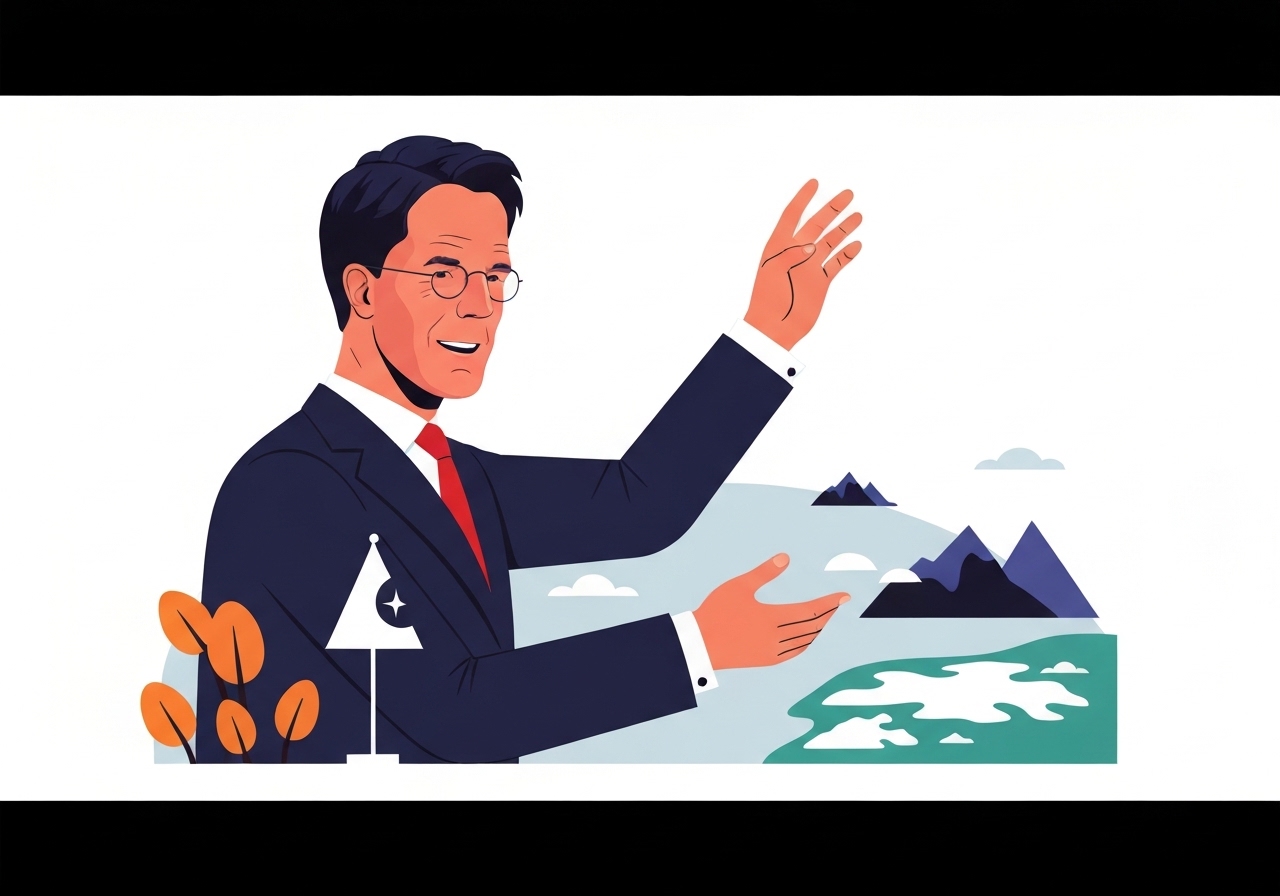
At the World Economic Forum in Davos on January 22, 2026, NATO secretary-general Mark Rutte met with US President Donald Trump and helped defuse an immediate crisis over Greenland, according to public statements and on-the-record interviews. Trump publicly ruled out using military force to seize the Danish territory and announced a framework for talks that he said would move negotiations forward. The meeting followed days of alarm among European capitals about the president’s aggressive rhetoric, and it appears to have cooled tensions that had threatened NATO unity and transatlantic trade relations. Details of the agreement remain limited, but the encounter elevated Rutte’s profile as a bridge between Washington and Europe.
Key Takeaways
- On January 22, 2026, at Davos in the Swiss Alps, President Trump met NATO chief Mark Rutte and subsequently said he would not use force to take Greenland.
- Trump announced a tentative framework for talks and said he would abandon plans to impose tariffs on European countries that opposed his Greenland ambitions.
- Mark Rutte, 58, who served as the Netherlands’ prime minister from 2010 to 2024 for 14 years, has positioned himself as a key interlocutor with the US president.
- Rutte has publicly praised several Trump policies, including US strikes on Iran and pressure for increased European defense spending, and has exchanged friendly texts shared by Trump on social media.
- Last year’s NATO summit (2025) resulted in a unanimous commitment by members to raise defense spending to post–Cold War levels, a shift credited in part to US pressure.
- Officials say the Greenland framework’s specifics are scarce; NATO and EU leaders planned further discussions, including an emergency EU summit called for Thursday, January 23, 2026.
- A NATO spokesperson told reporters that Rutte did not offer any compromise on Danish sovereignty during conversations with the president.
Background
The Greenland episode erupted after President Trump intensified rhetoric about acquiring the Arctic island, prompting alarm across Europe and within NATO. The prospect of a US demand for control over Greenland touched a geopolitical nerve because Greenland is an autonomous territory of Denmark and hosts strategic Arctic assets. European leaders feared escalatory language could destabilize alliance cohesion and spur retaliatory trade measures that would roil markets.
Mark Rutte’s emergence as a mediator reflects a broader pattern in which individual leaders cultivate personal channels to the White House to advance diplomatic objectives. During his 14-year premiership, Rutte cultivated relationships in Washington and across capitals; critics at home have questioned the tone of his private outreach, but supporters argue it yields practical gains. The wider context includes NATO’s recent policy shifts on burden-sharing and Arctic security and a renewed focus on deterrence following heightened tensions in Europe and the Middle East.
Main Event
At Davos, President Trump delivered remarks that included criticism of European officials on multiple issues, yet he explicitly ruled out military means to acquire Greenland. After a private meeting with Mark Rutte, Trump said the two had reached a possible framework on Greenland and announced he would not levy tariffs on European nations that opposed his earlier statements. Officials have not published the text of any agreement, and both sides described discussions in guarded terms.
A NATO spokesperson told reporters that Rutte did not propose any compromise on Danish sovereignty during the meeting, underscoring that Denmark’s position remains central. In a separate interview with Fox News, Rutte said the talks concentrated on Arctic security and on ways to implement the president’s stated vision for protecting Greenland and the wider Arctic region. European capitals continue to coordinate, with the European Union convening an emergency summit to assess next steps.
The personal rapport between Rutte and Trump figured prominently in the outcome. Rutte’s earlier public interventions — notably a jocular remark at a prior NATO gathering that was repeated by Trump — and a string of cordial private messages shared by the president helped create a tone conducive to de-escalation. When journalists pressed Rutte for specifics after the Davos meeting, he described the exchange as a “very good meeting” and directed reporters to President Trump’s social posts for further detail.
Analysis & Implications
Rutte’s role illustrates how individual diplomacy can affect alliance dynamics in real time. When formal channels are strained or slow, a trusted intermediary with direct access to a president known for valuing personal ties can shape immediate outcomes. That dynamic can produce rapid de-escalation, but it also raises questions about transparency, democratic oversight, and long-term durability of ad hoc agreements.
For Europe, the short-term gain is the avoidance of an open clash that could have triggered tariffs, market shocks, or a deeper rift within NATO. The announcement that the president ruled out force and deferred the matter to negotiations reduces an immediate security risk. However, the persistence of the president’s stated demand for control over Greenland means the underlying dispute remains unresolved and could resurface politically or diplomatically.
Strategically, the episode highlights the Arctic’s rising importance. Climate change, new shipping routes, and resource interests have heightened competition in the region, prompting NATO and EU members to reassess security postures. Any bilateral talks involving the United States, Denmark, and Greenland will intersect with alliance prerogatives and regional governance frameworks, making multilayered diplomacy essential.
Comparison & Data
| Year | Event |
|---|---|
| 2010–2024 | Mark Rutte served as Netherlands prime minister for 14 years |
| 2025 | NATO summit concluded with members agreeing to raise defense spending to post–Cold War highs |
| 2026-01-22 | Davos meeting: Trump and Rutte discuss Greenland; Trump rules out military annexation |
The table places the Davos meeting in recent context: Rutte’s long tenure and NATO’s 2025 policy shifts help explain why European capitals accepted a mediated, alliance-level approach rather than immediate confrontation. Although the figures above are descriptive rather than quantitative, they show the sequence that produced the current diplomatic posture.
Reactions & Quotes
European leaders and analysts offered measured responses, balancing relief at immediate de-escalation with caution about unresolved issues. Many governments welcomed the retreat from force but emphasized that sovereignty questions and multilateral processes must guide future steps.
“I’m not popular with you now because I’m defending Donald Trump, but I really believe we can be happy that he is there.”
Mark Rutte (Davos panel)
Rutte’s remark, made at a Davos panel on European defense, was framed as a defense of engaging directly with the president to secure pragmatic outcomes. The comment drew criticism from some European audiences but also underscored his public rationale for personal diplomacy.
“He knows that personal relationships go a long way with this administration.”
Torrey Taussig (Atlantic Council, former Pentagon NATO adviser)
Taussig’s assessment reiterates a widely held view among analysts: informal channels and rapport can be decisive when dealing with a leader who privileges direct personal influence over institutional process.
“They called me ‘Daddy,’ right? Last time. A very smart man said, ‘He’s our Daddy.’”
Donald Trump (Davos speech)
Trump invoked a prior viral exchange in which Rutte had defused tension with a lighthearted remark. The reference signaled that past personal moments continued to shape the interpersonal dynamic that influenced the Davos outcome.
Unconfirmed
- The precise contents of the so-called “framework” for Greenland negotiations discussed at Davos have not been published and remain unverified.
- It is not yet confirmed whether Trump’s public statement about abandoning tariffs reflects a binding pledge or a short-term rhetorical de-escalation.
- The extent of Rutte’s role in drafting any bilateral or multilateral text is unclear; official accounts describe his part as facilitative but do not detail authorship or terms.
Bottom Line
The Davos meeting on January 22, 2026, provided a momentary easing of tensions between Washington and European allies by removing the immediate prospect of military action over Greenland and signaling a willingness to pursue negotiations. Mark Rutte’s intervention demonstrated how personal diplomacy can secure short-term stability when institutional channels are under strain.
Yet the episode leaves open substantive questions: the content and durability of any agreement, the legal and political process required for changes to Greenland’s status, and the long-term implications for alliance governance. Policymakers should view the Davos outcome as a pause rather than a resolution, and they will need transparent, multilateral mechanisms to manage the Arctic’s strategic competition going forward.