
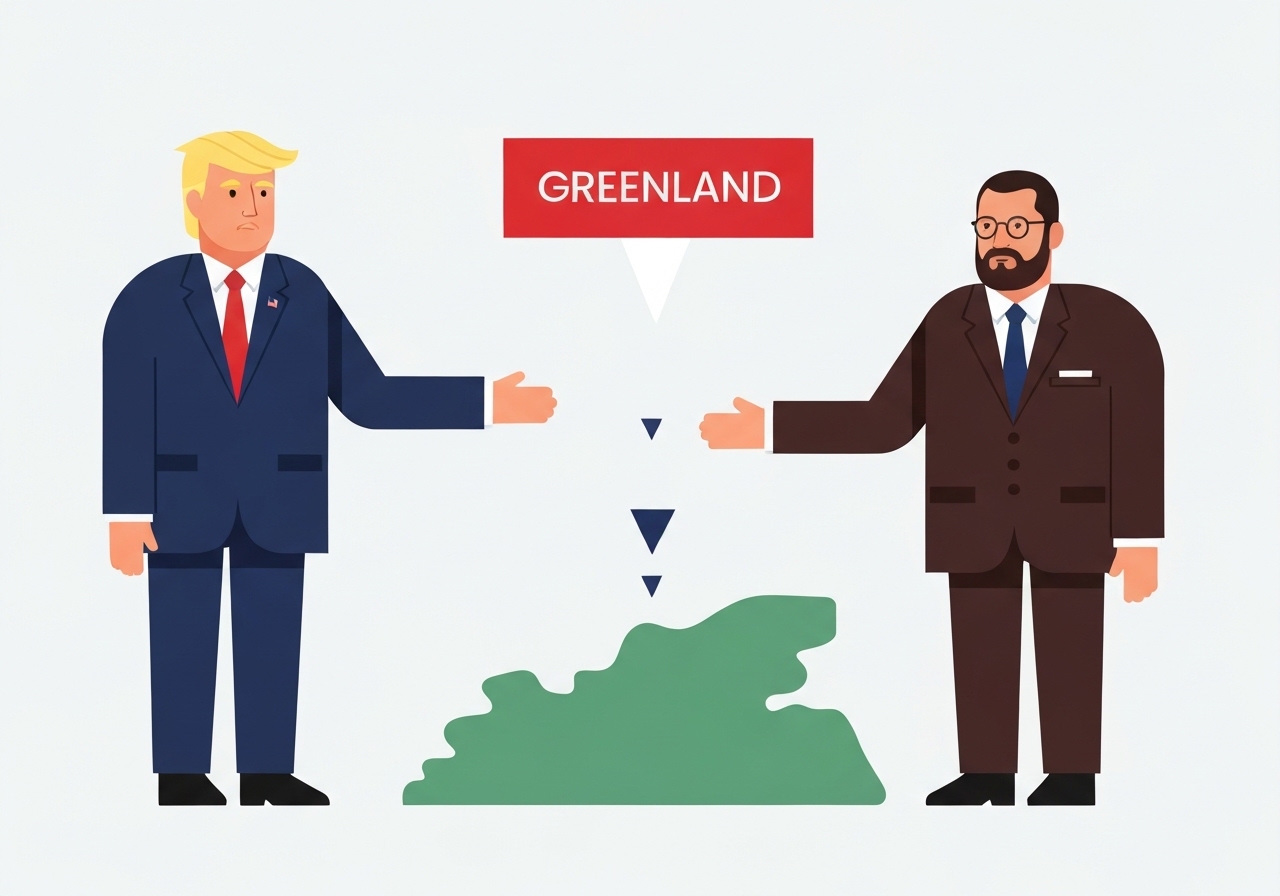
— President Donald Trump said he had reached a framework agreement with NATO leadership on Greenland and the wider Arctic, and publicly withdrew threats of new tariffs and the use of force to secure American control of the territory. The announcement came hours after Mr. Trump addressed the World Economic Forum in Davos and followed separate discussions in Brussels among senior NATO military officials about possible arrangements for U.S. basing. Officials and the president offered few concrete details; the statement signaled a retreat from the possibility of military or trade confrontation with European allies over Greenland.
Key takeaways
- On Jan. 21, 2026, President Trump announced a framework deal on Greenland and the Arctic with NATO leadership, naming Mark Rutte in his post on Truth Social.
- Trump said he would not use force to take Greenland and withdrew threats of additional tariffs against European allies who resisted his prior push for U.S. control.
- Western officials said senior NATO military officers met in Brussels on the same day to discuss options, including the idea of U.S. sovereignty over land for bases, according to three senior officials familiar with the talks.
- The president described the framework broadly as beneficial to the United States and all NATO nations but provided no text or timetable for implementation.
- Greenland — an autonomous territory of Denmark with strategic Arctic positioning — remains under Danish sovereignty; any change would require complex legal, parliamentary and local approvals.
- The announcement reduced immediate tensions between Washington and key European partners but left major questions about legal authority, Greenlandic consent and the scope of the proposed framework.
Background
Greenland occupies a strategic position in the Arctic, with air and maritime access across polar routes and proximity to North American and Russian territories. The island is an autonomous territory within the Kingdom of Denmark; Denmark retains formal sovereignty while Greenland exercises extensive self-government over domestic affairs. Interest in Greenland has periodically surged because of its location, mineral resources and growing accessibility as ice cover diminishes.
U.S. attention to Greenland has a recent spike: in 2019, the Trump administration publicly explored buying the island, a proposal that drew broad criticism in Copenhagen and Nuuk and was rejected as unrealistic. Since then, Arctic geopolitics have intensified as NATO, the European Union, Russia and China all expand activity in the region. Military planners have emphasized Greenland’s value for early-warning systems, refueling and as a staging area for transatlantic operations.
The NATO alliance has faced repeated tests over burden‑sharing and the balance between U.S. strategic priorities and European sovereignty concerns. Any rearrangement of territory or basing rights in Greenland would require negotiations not only between Washington and Copenhagen, but also consultations with Greenland’s government and its population — actors who have shown sensitivity to sovereignty and resource control in past negotiations.
Main event
On Jan. 21, 2026, after speaking in Davos at the World Economic Forum, President Trump posted that he and NATO leadership, including Mark Rutte, had “formed the framework of a future deal with respect to Greenland and, in fact, the entire Arctic Region.” The post gave no legal text, timeline or description of concessions, but the timing followed a day of closed NATO meetings in Brussels.
Western defense officials told reporters that senior military officers from NATO member states discussed contingencies for basing and territorial compromises in the Arctic during deliberations in Brussels the same day. According to three senior officials familiar with those discussions, the idea of U.S. sovereignty over specific tracts of land to host bases was tabled as one option among several, though officers described it as politically sensitive and legally complex.
Mr. Trump capped the developments by explicitly withdrawing an earlier threat to impose tariffs on some European allies that resisted his Greenland initiative, and he said he would not use force to acquire territory. The president framed the move as a pragmatic pivot: a framework that could be “a great one for the United States of America, and all NATO Nations,” while offering no further details on concessions to Denmark or Greenland.
Officials in Brussels and Washington emphasized that discussions so far were exploratory. NATO secretariat officials declined to confirm the full scope of the consultations; a NATO spokesman said alliance meetings routinely examine strategic scenarios across member territories but would not characterize the talks as a finalized agreement.
Analysis & implications
Strategically, the announcement reduces the near‑term risk of a public rupture between the United States and key European allies. Removing a tariff threat and abandoning talk of force de‑escalates a scenario that could have produced trade disruptions and strained NATO cohesion at a moment when alliance unity is prized amid heightened tensions with Russia.
Legally and politically, however, the president’s statement creates more questions than answers. Greenlandic self-government, Danish sovereignty and international law constrain any transfer of territory or sovereignty. A credible near‑term transfer of sovereignty to the United States would require Danish legislative approval, Greenlandic consent via local institutions, and likely a constitutional path that has no modern precedent in NATO history.
Operationally, negotiating basing rights or enhanced access without changing sovereignty is a more plausible path. NATO and bilateral basing agreements can grant broad rights for construction, permanent presence and logistics while leaving legal title unchanged. Such solutions would be faster to implement but could still provoke local resistance in Greenland and diplomatic friction in Copenhagen if perceived as circumventing Greenlandic authority.
Geopolitically, stabilizing U.S.-European relations over Greenland would allow NATO to focus on shared defense priorities across the Arctic, including surveillance, search-and-rescue and maritime security. It may also limit Moscow’s opportunity to exploit transatlantic disagreement. Conversely, opaque negotiations risk domestic backlash in Greenland, feeding narratives of external powers deciding the island’s future without meaningful local participation.
| Year | Event |
|---|---|
| 2019 | U.S. president publicly floated buying Greenland (proposal rejected by Denmark/Greenland) |
| 2026-01-21 | President Trump announced a NATO-linked framework on Greenland/Arctic; NATO officers held Brussels talks |
The table summarizes visible public milestones. While 2019 is a recorded episode in which the U.S. executive branch proposed acquisition, the 2026 announcement is currently a framework statement without documented agreements, legal instruments or ratified deals.
Reactions & quotes
All sides signaled cautious relief at the de‑escalation but underscored uncertainty about next steps. Below are representative short statements and the context around them.
“This solution, if consummated, will be a great one for the United States of America, and all NATO Nations.”
President Donald J. Trump (Truth Social post)
Trump’s post framed the development as mutually beneficial, but offered no details about concessions, timelines or legal mechanisms to implement any change affecting Greenland.
“Senior military officers reviewed possible options in Brussels today, including basing arrangements; discussions were exploratory and not a finalized transfer of sovereignty.”
Senior Western official (anonymized)
Officials familiar with the NATO meetings described the conversations as strategic planning rather than a concluded pact, emphasizing that military staff often assess contingencies that political leaders must then translate into policy.
“Greenlanders welcomed the de‑escalation but remain cautious about outside proposals that affect their homeland and rights.”
Local Greenland observer (civil society)
On the ground, civil society groups and local officials have in past expressed wariness of deals reached without Greenlandic participation; that sentiment persisted after the Jan. 21 announcement.
Unconfirmed
- No public text of the alleged “framework” has been released, and its precise legal terms remain unconfirmed.
- Whether the framework contemplates formal transfer of sovereignty for any tracts of land to the United States is not verified and would remain legally contentious.
- It is not confirmed how Greenlandic institutions or the Danish parliament have been consulted or whether they have agreed to specific provisions.
Bottom line
The Jan. 21, 2026 announcement signaled a tactical retreat from the prospect of trade and military confrontation between the United States and European allies over Greenland. By withdrawing tariff threats and ruling out the use of force publicly, the administration reduced immediate bilateral friction, but left the substantive questions unresolved.
Any durable arrangement will require clear legal instruments, transparent negotiation with Denmark and Greenland, and domestic political support on all sides. The most feasible near‑term outcome is a set of enhanced basing or access agreements that preserve Danish sovereignty while expanding U.S. operational rights — a solution that would be faster to implement than a sovereignty transfer but could still generate controversy in Nuuk and Copenhagen.
Watch next for formal statements from Denmark and Greenland, any published text of the framework, and whether NATO or national parliaments initiate legal processes or consultations. The substance — not the rhetoric — will determine whether the development stabilizes Arctic security cooperation or becomes a recurring source of diplomatic friction.
Sources
- The New York Times — U.S. newspaper reporting (article on Jan. 21, 2026)
- NATO — Official (NATO statements and press releases)
- Government of Greenland (Naalakkersuisut) — Official (Greenland government information)