
Lead
On Jan. 22, 2026, a U.S. magistrate judge in Minnesota declined to sign a criminal complaint seeking charges against independent journalist Don Lemon after a protest at a St. Paul church, and the judge struck or refused a separate face‑obstruction charge against two local activists. The decision came during a hearing before Magistrate Judge Douglas Micko, who previously served as a federal public defender. The Justice Department has since signaled it may pursue alternate paths to bring charges, while the attorney general and other federal officials have publicly defended the arrests. The immediate result was that Lemon was not approved for charging by the magistrate and two defendants were released under conditions pending further proceedings.
Key Takeaways
- Magistrate Douglas Micko declined to approve a complaint against Don Lemon on Jan. 22, 2026, after reviewing the government’s submission and related arrest documents.
- Attorney General Pam Bondi traveled to Minnesota as the Justice Department sent additional prosecutors and law‑enforcement resources to the Twin Cities amid protests over ICE operations.
- Two protesters — Chauntyll Louisa Allen and Nekima Levy Armstrong — were charged with conspiring to interfere with constitutional rights, but a second FACE Act charge was crossed out on warrants with a handwritten note reading “NO PROBABLE CAUSE.”
- Both Allen and Armstrong were released with conditions: remain in Minnesota, avoid the church property, and have no contact with alleged victims or witnesses.
- Federal prosecutors conceded at the hearing they had not yet provided copies of the arrest warrants to defense counsel, prompting the magistrate to pause proceedings until documents were produced.
- The magistrate denied the government’s request to detain Allen and Armstrong; he found the record did not show use or threat of force sufficient to support a FACE Act detention argument.
- The Civil Rights Division attorneys on the case include Robert Keenan and Orlando Sonza; outside scrutiny of the division’s case selection increased after similar charge rejections in other districts in 2025.
- Observers note the ruling raises immediate questions about press protections and the standard the Justice Department applies when elevating local incidents to federal criminal complaints.
Background
The dispute stems from a Jan. 18–19 period of heightened public unrest in the Twin Cities after the Jan. 7, 2026, fatal shooting of Renee Good, a U.S. citizen, by an ICE officer — an incident that prompted repeated protests and clashes with deployed federal immigration personnel. The Trump administration had sent thousands of ICE and Border Patrol agents to the Minneapolis–St. Paul area in an effort officials described as targeting violent crime and enforcing immigration laws; residents and civil‑rights advocates countered that the deployments inflamed tensions and created civil‑liberties concerns.
Protesters entered Cities Church in St. Paul after they said they recognized an Immigration and Customs Enforcement official among the service’s leaders. The interruption led some congregants and families to leave. Several people who participated in the demonstration were later arrested on federal charges; the government framed some counts as interfering with religious exercise and others as civil‑rights conspiracies.
Main Event
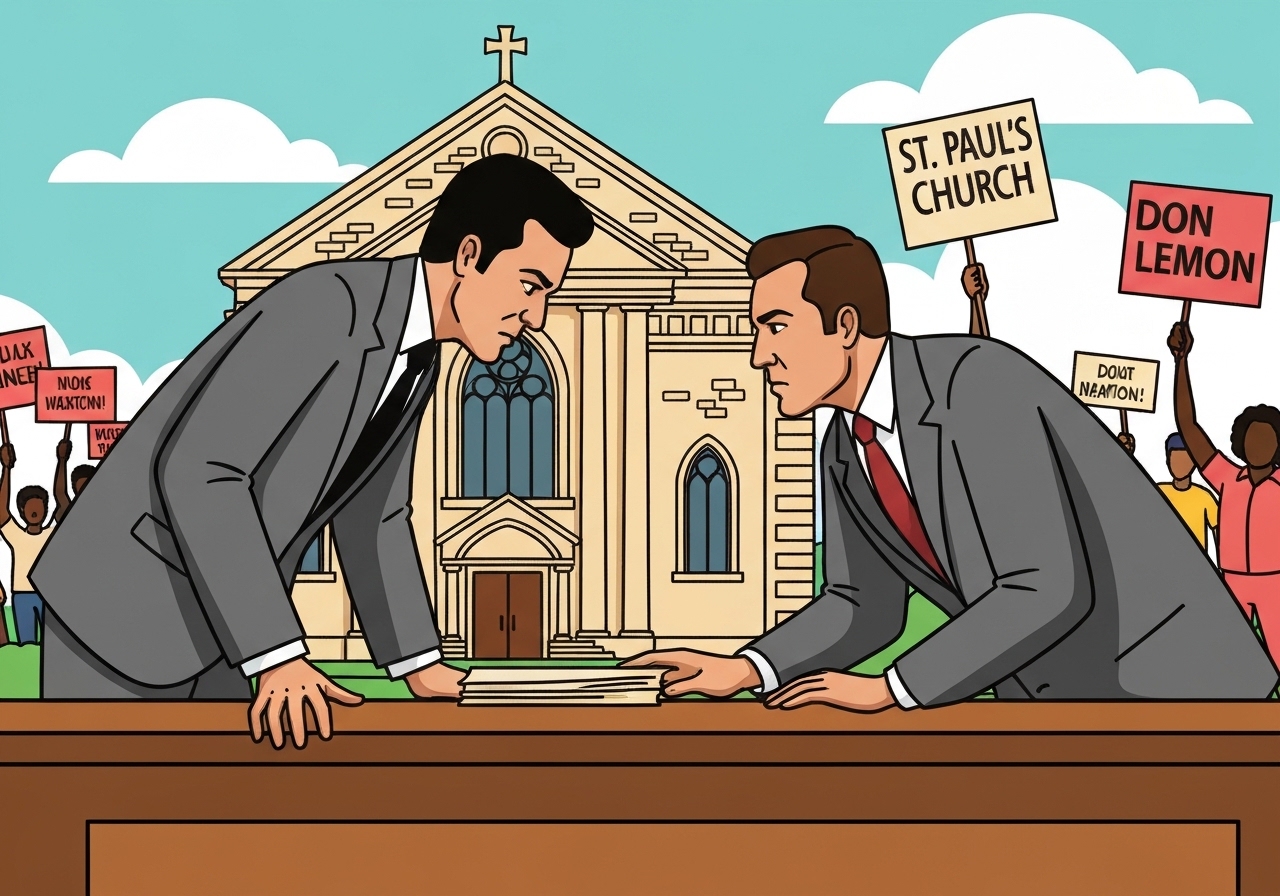
At a Jan. 22 hearing in St. Paul, Magistrate Judge Douglas Micko reviewed arrest warrants and criminal complaints presented by attorneys from the Justice Department’s Civil Rights Division. Micko declined to sign a complaint authorizing charges against Don Lemon, the independent journalist who attended and recorded parts of the protest and who has said he was acting in a reporting capacity. A copy of one arrest warrant obtained by reporters showed a second FACE Act count physically crossed out with “NO PROBABLE CAUSE” in the margin.
Federal prosecutors announced arrests earlier that morning: Chauntyll Louisa Allen, a member of the St. Paul School Board; Nekima Levy Armstrong, a civil‑rights activist the government alleged helped organize the protest; and a third person, William Kelly. In court, prosecutors pursued conspiracy charges under a federal civil‑rights statute that criminalizes conspiring to deprive others of constitutionally protected rights.
During the hearing, prosecutors acknowledged they had not yet provided copies of the arrest warrants to the two women and their counsel, prompting Micko to recess until documents were delivered. When the proceeding resumed, the judge denied the government’s request to detain Allen and Armstrong, citing a lack of persuasive evidence that the alleged conduct rose to the level of a crime of violence or justified pretrial detention.
Micko ordered the two activists released on conditions: remain in Minnesota, avoid the church property, and have no contact with specified witnesses or victims. Prosecutors also secured a 24‑hour sealing order for the criminal complaints, which the court granted despite the public attention surrounding the arrests.
Analysis & Implications
The magistrate’s refusal to sign a complaint against Lemon underscores a recurring tension between aggressive federal charging strategies and gatekeeping by judicial officers. Magistrate judges serve as an early filter for probable cause; Micko’s decision signals judicial skepticism about the sufficiency of the government’s factual showing in at least some of these protest‑related matters. That skepticism may constrain the Civil Rights Division’s ability to elevate local protests into a series of federal criminal cases without more robust evidence of specific criminal conduct.
For press freedom advocates, the ruling provides a short‑term procedural victory: a judge explicitly declined to endorse charging a journalist for attending and recording a protest inside a house of worship. It does not, however, foreclose other prosecutorial options — such as gathering additional evidence, seeking a grand jury indictment, or pursuing state charges — so the protection is conditional rather than absolute.
Politically, the episode places the Justice Department in a difficult posture. Attorney General Pam Bondi’s visible presence in Minnesota and public statements defending the arrests reflect a broader administration effort to emphasize law enforcement responses to protest and civil unrest. Yet repeated judicial pushback — and the 2025 D.C. statistic showing an elevated dismissal rate in a prior surge of federal criminal complaints — may fuel critiques that the department is prioritizing headline cases over legally sustainable prosecutions.
Practically, defense attorneys will seize procedural gaps exposed at the hearing — late production of warrants and the magistrate’s written “NO PROBABLE CAUSE” finding on a FACE count — as grounds to press for dismissals or suppressions if the government pursues further charges. The contested mix of high political stakes and evolving case law on protest conduct suggests prolonged litigation and possible appellate review if charges are pursued further.
Comparison & Data
| Subject | Charge Status at Hearing |
|---|---|
| Don Lemon | Magistrate declined to sign complaint (no charging authorization) |
| Chauntyll Allen | Conspiracy charge signed; FACE Act count crossed out (“NO PROBABLE CAUSE”) |
| Nekima Levy Armstrong | Conspiracy charge signed; FACE Act count crossed out (magistrate notation) |
The table summarizes the immediate court action on Jan. 22, 2026. It shows that while some conspiracy counts advanced to the complaint stage, the government’s attempt to apply the FACE Act in these arrests met judicial resistance. That split outcome highlights how different statutory theories can produce divergent outcomes at the probable‑cause gatekeeping stage.
Reactions & Quotes
Defense counsel framed the ruling as a confirmation of core press protections and a check on federal prosecutorial reach. Shortly after the hearing, Lemon’s attorney provided a concise public statement asserting the judge’s action validated Lemon’s role as a reporter and signaled strong First Amendment protections at play.
“The magistrate’s actions confirm the nature of Don’s First Amendment‑protected work this weekend in Minnesota as a reporter.”
Abbe Lowell, counsel for Don Lemon (statement)
The Civil Rights Division and its allies defended the arrests as necessary to protect congregants and enforce federal civil‑rights law. On media appearances, senior department officials cautioned that being a journalist does not categorically insulate someone from criminal liability if their conduct crosses a legal line.
“Being a journalist is not a badge or a shield that protects you from criminal consequences.”
Harmeet Dhillon, Assistant Attorney General (public comment)
Locally, community members reacted with a mix of relief and concern — relief that the magistrate rejected at least part of the government’s theory, and concern that the underlying tensions between residents and federal immigration enforcers remain unresolved. Protest organizers said the arrests were an escalation that chilled civic protest; some congregants said the disruption felt threatening, illustrating the case’s deep social polarization.
Unconfirmed
- The anonymous claim that “the attorney general is enraged” reflects a source characterization reported to the press and is not documented by an on‑the‑record statement from Attorney General Pam Bondi.
- Whether the DOJ will seek a grand‑jury indictment of Don Lemon or other participants has not been confirmed; prosecutors indicated other avenues may be possible but no subsequent charging action had been filed as of Jan. 22, 2026.
- Protesters’ assertion that an ICE official served as a pastor at the church was reported by demonstrators but has not been independently confirmed in court filings presented at the Jan. 22 hearing.
Bottom Line
The magistrate’s ruling on Jan. 22, 2026, is a procedural check on the Justice Department’s effort to treat a high‑profile protest as a source of federal criminal cases. It illustrates how judicial scrutiny at the charging stage can shape the trajectory of politically sensitive prosecutions and place evidentiary burdens on prosecutors who seek to elevate local incidents to federal offenses.
For journalists and protest organizers, the decision provides a cautious precedent that attendance and recording of demonstrations within a house of worship may not, by itself, justify immediate federal criminal complaints — but it leaves open the possibility of further investigation or alternative charges. For the Justice Department, repeated judicial pushback will likely increase the need for meticulous factual development before pursuing additional high‑visibility cases.