
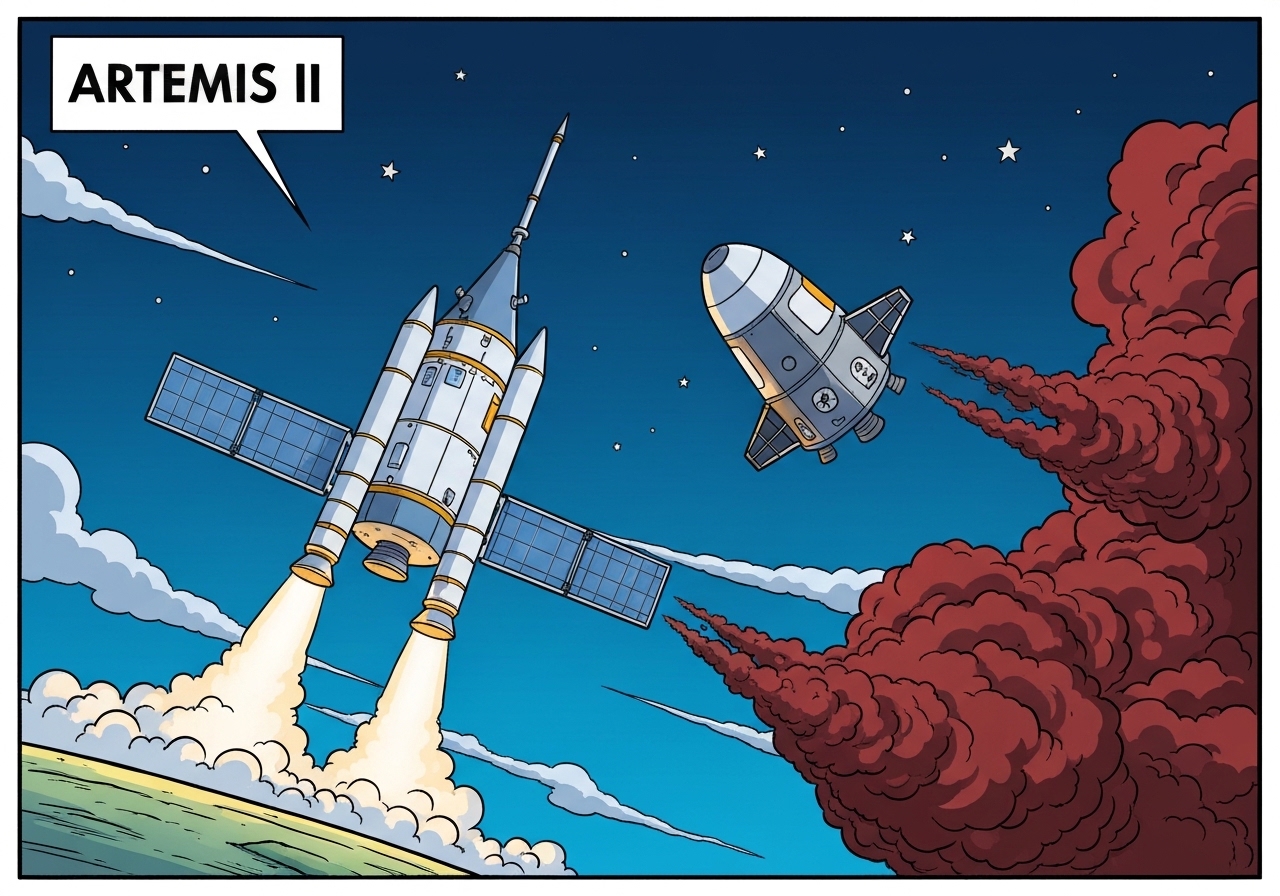
NASA is preparing to send four astronauts on a lunar flyby as soon as February 6 aboard the Orion capsule for Artemis II, even though the vehicle’s heat shield retains a known manufacturing flaw found after the uncrewed Artemis I flight in 2022. Agency leaders say modifications to the reentry profile and months of analysis reduce risk and will bring the crew home safely; some former NASA engineers and independent experts disagree and urged postponement. The debate centers on how Avcoat, Orion’s ablative skin, behaved during Artemis I and whether the same material—installed differently on Artemis II—can tolerate the mission’s reentry loads.
Key Takeaways
- Artemis II is planned for as early as February 6 with four crew: Reid Wiseman, Victor Glover, Christina Koch and Jeremy Hansen (Canadian Space Agency).
- Orion’s heat shield uses Avcoat ablative material; the Artemis I 2022 test returned with unexpected chunking and cracks that prompted a NASA investigation and a 2024 inspector general report.
- NASA decided not to replace Artemis II’s installed heat shield because it was already fitted; program managers instead revised the reentry trajectory to reduce stress on the Avcoat layer.
- The Orion program cost is about $20.4 billion and has taken roughly 20 years to mature, drawing industry criticism for schedule and budget growth.
- Technical roots date to a 2009 decision to use Avcoat and a 2015 license of Avcoat production to Lockheed Martin via Textron Systems; manufacturing changes moved from a honeycomb fill to large blocks for producibility.
- About 6% of Artemis I’s heat shield had permeable areas that did not crack; Artemis II’s shield currently has no permeable zones, raising questions about how gas pressure and charring will behave on reentry.
- Reentry subjects Orion to speeds over 30 times the speed of sound and surface temperatures above 5,000°F (2,760°C), where controlled Ablation is essential for crew safety.
Background
The Orion capsule is the crewed element of NASA’s Artemis program, intended to return humans to lunar vicinity after decades. The vehicle’s heat shield uses Avcoat, an ablative material with a heritage back to the Apollo program; NASA selected Avcoat in 2009 for its track record and then adapted manufacturing approaches for modern production. A full-scale uncrewed test, Artemis I, flew in 2022 and revealed damage to the Avcoat layer that was not expected under design assumptions.
Following Artemis I, NASA launched a formal inquiry and the agency’s Office of Inspector General released images and findings in 2024 showing pitting and larger-than-anticipated fragments missing from the heat shield. Investigation teams analyzed the material’s inability to vent gases fast enough and concluded that trapped gases contributed to spalling—the detachment of chunks—during the high-energy reentry. Because the Artemis II capsule already had its heat shield installed prior to Artemis I’s flight, managers faced a choice between delaying to replace hardware or changing operational parameters.
Main Event
In late 2025 and early 2026, program managers converged on a plan: proceed with Artemis II using the existing heat shield while altering the reentry profile to limit the specific loading that produced the Artemis I damage mode. The Orion stack was rolled to the pad atop the Space Launch System (SLS) rocket on January 17, and final flight readiness reviews and risk assessments are scheduled in the days before the planned February 6 window.
Officials including acting deputy associate administrator Lakiesha Hawkins and commander Reid Wiseman have publicly expressed confidence that the combination of investigation results, lab testing, and the revised reentry trajectory provides acceptable margins for crew safety. NASA’s Tiger Team and independent review panels presented analyses intended to account for gas generation, charring rates and mechanical response of the Avcoat blocks under the modified profile.
Not all technical reviewers agree. Several former NASA engineers and some heat-shield specialists argue the modeling and test data are insufficient to predict crack propagation and secondary failure modes. Critics contend the primary analytical tool used by the Tiger Team—the Crack Indication Tool (CIT)—relies on simplifying assumptions and cannot fully predict how cracks grow under coupled thermochemical and structural loads.
NASA leaders maintain that lab tests, historical material data and alignment between model predictions and Artemis I observations justify the agency’s decision to fly. They also say subsequent heat shields for future missions will use revised, more permeable manufacturing techniques to address the underlying gas-trapping issue.
Analysis & Implications
The core engineering question is whether altering flight operations can mitigate a manufacturing-driven material behavior. If the modified reentry profile keeps Orion away from the specific pressure–temperature regime that produced large-scale spalling in 2022, the mission may return with only predictable, controlled ablation. That outcome would validate an operations-first approach: accept a known hardware imperfection but manage it through trajectory design.
However, if the Avcoat layer on Artemis II behaves unpredictably—producing larger fragments or initiating crack growth that was not captured in tests—the mission could see progressive degradation during reentry. While experts familiar with the capsule point to underlying composite structure beneath the Avcoat as a contingency layer, relying on that composite was never intended as the primary protection strategy and would represent a degraded-return scenario.
Beyond this mission, the episode raises programmatic questions about how NASA balances producibility, schedule and cost against conservative engineering margins. Decisions made in the development phase (production method changes in 2015, for example) reduced manufacturing complexity but introduced new uncertainties in flight behavior. If Artemis II returns safely, managers may be tempted to treat that success as confirmation of risk posture; critics warn that a single successful outcome does not eliminate systemic vulnerabilities.
International and commercial partners are watching closely. The presence of a Canadian crew member, Jeremy Hansen, and the high-profile nature of the Artemis program mean that perceived safety trade-offs could influence partner confidence, future procurements and public trust in crewed exploration programs.
Comparison & Data
| Feature | Artemis I (2022) | Artemis II (2026) |
|---|---|---|
| Avcoat permeability | ~6% permeable area (localized) | 0% permeable area |
| Design approach | Block Avcoat installed after honeycomb change | Same block design; manufacturing unchanged |
| Result after reentry | Pitting and chunks missing; inspector general images (2024) | Expected to show cracking but operational controls planned |
| Mitigation | Investigation + modeling | Modified reentry trajectory (lower skip/loft) |
The table summarizes published technical points: Artemis I exposed a gas-trapping and spalling mechanism, while Artemis II relies on a flight-path mitigation rather than hardware replacement. Engineers cite controlled ablation as the designed behavior, but the observed fragmentation in 2022 fell outside those expectations, prompting the operational tradeoffs now being debated.
Reactions & Quotes
Some former astronauts and heat-shield specialists who reviewed the data defended NASA’s path after seeing the Tiger Team findings and lab correlations.
“After seeing the Tiger Team’s alignment of test data and analysis, I have confidence the team understands the failure modes well enough to protect the crew,”
Dr. Danny Olivas, former NASA astronaut and independent reviewer
Other experts remain unconvinced, warning that available models do not capture multi-physics crack growth and that programmatic pressures have historically produced biased risk acceptance.
“Proceeding with crew when the analysis relies on simplifying assumptions is, in my view, the wrong choice,”
Dr. Charlie Camarda, former NASA engineer and astronaut
NASA leadership emphasized safety and the steps taken to regain margin ahead of final authorization.
“We have modified our reentry profile and regained margin to safety for Artemis II,”
Jared Isaacman, NASA administrator
Unconfirmed
- No public document has released complete Tiger Team source code or the full datasets used to tune the Crack Indication Tool; independent validation of the models remains limited.
- It is not publicly confirmed whether every Artemis II heat-shield block passed identical lab tests to those replicated for Artemis I—NASA has reported testing but has not published the full matrix of test conditions.
Bottom Line
NASA has elected to fly Artemis II with the currently installed Orion heat shield, arguing that a revised reentry profile and months of testing and analysis restore acceptable safety margins for the four crewmembers. The decision reflects an operational mitigation strategy rather than a hardware correction, driven in part by the timing and producibility constraints of a large, costly program.
Experts remain divided. Some reviewers who studied the data say laboratory alignment with models and an underlying composite structure provide sufficient contingency; others argue that existing tools cannot capture all of the coupled physical processes that drive crack growth and chunking. The coming mission will test both the material behavior and the agency’s approach to balancing technical, schedule and budget pressures.
For observers and partners, the critical signals to watch are post-flight forensic data, the transparency of NASA’s modeling and test datasets, and whether future heat shields are produced with the permeability fixes NASA has announced. A safe return will quiet concerns temporarily; transparent publication of the full analyses will be necessary to resolve them long term.