
Lead
On Sunday a high-speed collision in Andalusia, near Córdoba and Adamuz, killed 45 people and has prompted three days of national mourning. The crash — involving a private Iryo train and a Renfe service — has shaken public confidence in Spain’s 3,900 km AVE network, long regarded as one of the world’s largest and safest. Within days a string of separate incidents, a trainee driver’s death in Catalonia and local service disruptions, amplified scrutiny of maintenance, investment and safety oversight. Officials, investigators and unions have all announced inquiries or actions while long-term questions about capacity and upkeep are now central to the national debate.
Key Takeaways
- Fatal collision: Two high-speed trains collided in Andalusia last Sunday, killing 45 people and prompting a national period of mourning.
- Network scale: Spain’s high-speed network totals about 3,900 km (2,400 miles), second only to China in track length.
- Recent incidents: In the same week a trainee driver died in Catalonia after a wall collapse, another train struck a rock and a carriage was hit by a crane, causing minor injuries.
- Passenger growth: Around 22 million travellers use Spain’s high-speed services annually, roughly double the number before rail liberalisation in 2020 and 17 times the 1992 figure.
- Investments and rankings: The government reports €700m spent updating the Madrid–Andalusia line recently, but a 2024 Allianz pro Schiene index placed Spain lowest among 14 European countries for per-capita rail infrastructure spending.
- Operational response: Some high-speed lines have had temporary speed limits imposed and local drivers in Catalonia refused to work, producing two days without local rail services.
- Union action: The Semaf drivers’ union has called a nationwide three-day strike in February, citing network deterioration.
Background
Spain’s AVE network, launched with the Madrid–Seville line in 1992, positioned the country as a global model for high-speed rail. The system’s expansion — reaching roughly 3,900 km — was hailed for reducing road and air journeys; in 2009, then-US president Barack Obama cited the Madrid–Seville link as an example when outlining ambitions for US high-speed rail. Liberalisation in 2020 introduced operators such as France’s Ouigo and Italy’s Iryo, increasing competition, lowering fares and expanding passenger volumes.
That growth has created new operational pressures. New lines into Galicia, Burgos and along the Mediterranean added route length and maintenance burden, while passenger numbers rose sharply: about 22 million annual users now compared with much lower figures a decade ago. Experts and engineers warn that adding capacity is only part of the task—sustained maintenance and targeted funding are essential to keep a sprawling, high-speed network safe and reliable.
Political dynamics complicate decisions on spending and oversight. Regional tensions, notably with Catalonia over suburban services, and questions about allocation between new construction and upkeep, have been ongoing. The government points to recent upgrades and increased maintenance budgets since 2018, while critics and some industry indices highlight lower per-capita infrastructure spending than several European peers.
Main Event
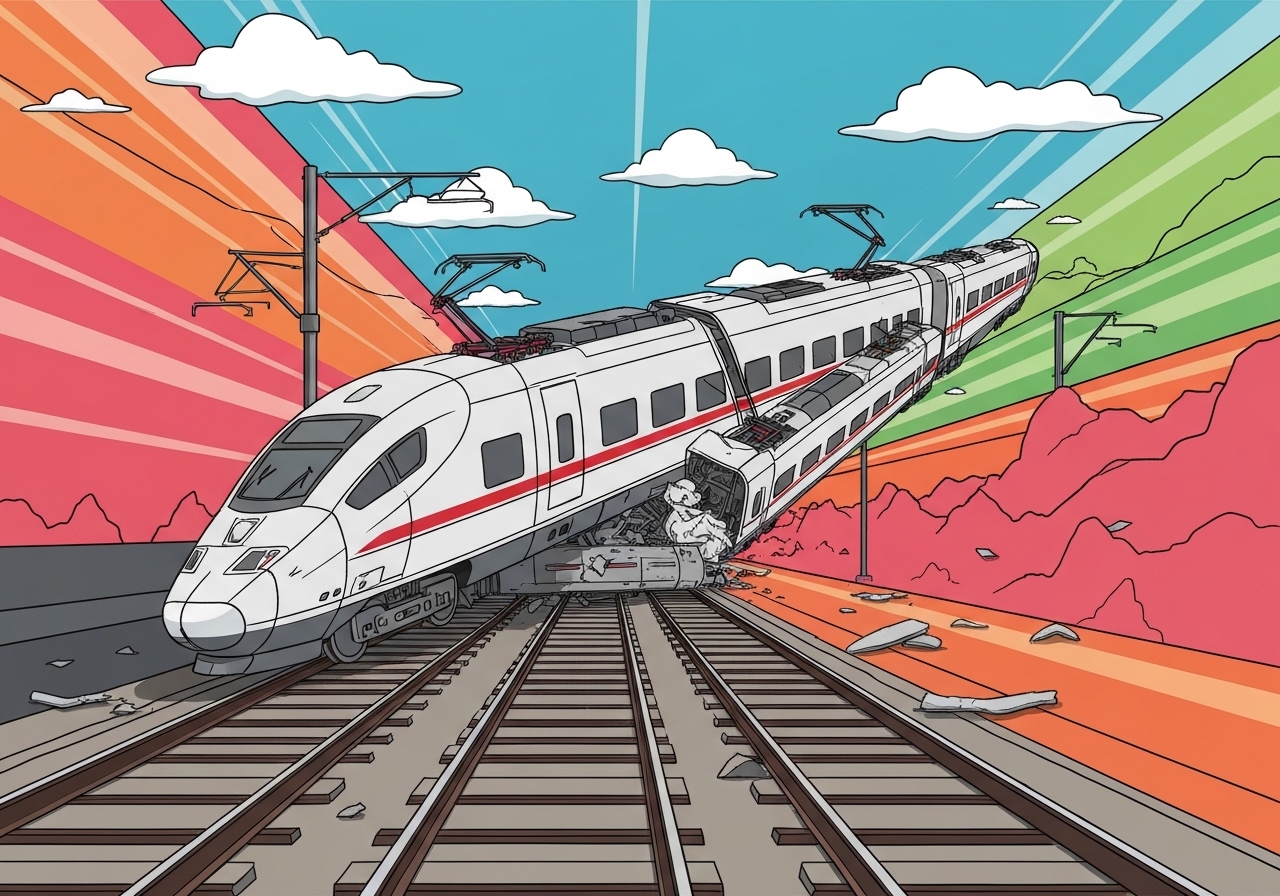
Last Sunday the rear three carriages of an Iryo-operated high-speed train derailed at speed on a straight section of track and were struck by an oncoming Renfe service, which took the main force of the collision. The crash site is in Andalusia near Córdoba and Adamuz; emergency services and investigators found 45 fatalities and multiple injuries. A delayed recognition that two trains were involved — rather than a single derailment — raised immediate concerns about the sequence of emergency notifications and the coordination of rescue operations.
Preliminary work by Spain’s rail accident investigation commission (CIAF) reported grooves on wheels of the Iryo train and earlier trains that suggest a fracture in the rail predated the derailment. Authorities say sabotage and deliberate interference appear unlikely at this stage, though investigations by the government, the Guardia Civil and independent bodies continue. Transport Minister Óscar Puente cautioned that the evidence points to an atypical problem not previously observed on the network.
Within 48 hours of the Andalusia crash, a separate tragedy occurred near Barcelona: heavy rain caused a wall to collapse onto a suburban line, killing a trainee driver and derailing a local service. On the same day another local train hit a rock; no injuries were reported in that incident. Days later a narrow-gauge train suffered minor passenger injuries when a crane struck a carriage, adding to a fraught week for rail operators.
Operationally, the incidents prompted temporary speed reductions on several high-speed routes and local work stoppages. Train drivers in Catalonia refused to operate in protest after the trainee’s death, causing two days without some local services. The drivers’ union Semaf announced a nationwide strike for three days in February, citing the “constant deterioration of the rail network.”
Analysis & Implications
The accident has exposed a fragile intersection of rapid expansion, competitive pressure and the reality of maintenance budgets. Liberalisation and increased ridership have improved consumer choice and lowered fares, but they have also intensified traffic and wear on infrastructure. Experts warn that newly built lines require continuous, sometimes costly, upkeep; failing to match infrastructure expansion with proportional maintenance risks degrading system reliability and safety over time.
Public confidence matters as much as technical fixes. Polling and social media reactions show growing reluctance among some travellers to use trains, and visible mourning and protests amplify political pressure. A loss of trust can depress ridership, complicate fare policies and sway political fortunes—especially as opposition parties seize on safety narratives to challenge incumbent officials.
Policy responses are likely to combine short-term operational measures and longer-term funding and governance shifts. Immediate steps may include targeted inspections, speed restrictions and operational audits; longer-term options include ring-fenced maintenance funding, strengthened independent accident inquiry mandates and accelerated safety upgrades. European funding rules and national budget priorities will shape what is feasible in the coming months.
Comparison & Data
| Metric | Value |
|---|---|
| High-speed network length | 3,900 km |
| Annual high-speed passengers | ~22 million |
| Average delay (July 2025, Renfe) | 19 minutes |
| Per-capita infrastructure spending rank (2024) | 14th of 14 (Allianz pro Schiene) |
These figures illustrate a network that is extensive and heavily used but where punctuality and per-capita investment have shown strains. The 19-minute average delay reported by Renfe in July 2025 marks a notable decline in reliability. Combined with the low per-capita investment ranking, the data support arguments that upkeep has not scaled in step with network growth and usage.
Reactions & Quotes
Local residents and small businesses near Córdoba expressed shock and a new wariness about train travel, even on lines they once trusted. A shop-owner across from Córdoba city hall, where flags flew at half-mast, framed the mood as one of altered confidence rather than panic.
“Since the high-speed line was built, 30-something years ago, we never had any problems, it worked perfectly and was fantastic.”
Alberto Montavez Montes, Córdoba shop-owner (resident comment)
The transport minister defended recent investments while acknowledging the scale of the challenge, urging caution in interpreting preliminary findings. He highlighted recent renovation spending on the Madrid–Andalusia stretch but stopped short of assigning a final cause until investigations conclude.
“We’re not looking at a problem of lack of maintenance, we’re not looking at a problem of obsolete [infrastructure], and we’re not looking at a problem of lack of investment.”
Óscar Puente, Spain’s Transport Minister (official statement)
Political leaders used the crisis to press competing narratives: the prime minister described the accident as causing “irreparable” damage while still calling the high-speed network a national achievement. Opposition parties and some unions accused the government of downplaying risks and urged clearer accountability and fresh funding.
“The accident has caused irreparable damage, but the high-speed network remains a source of national pride.”
Pedro Sánchez, Prime Minister (public comment)
Unconfirmed
- Final cause of the Andalusia collision: CIAF has reported wheel grooves suggesting a pre-existing rail fracture, but no definitive, final cause has been published yet.
- Role of maintenance levels: While some indicators point to underinvestment per capita, a direct causal link between funding levels and the crash remains to be established by investigators.
- Sabotage or deliberate interference: Officials say sabotage appears unlikely, but formal conclusions are pending the full investigative report.
Bottom Line
The deadly Andalusia collision has punctured Spain’s long-held image as a rail success story and brought systemic issues into sharp focus: the balance between expanding networks and consistently funding their upkeep; the operational pressures of liberalisation and higher passenger volumes; and the political consequences of perceived safety lapses. Immediate priorities will be completing thorough, independent investigations and taking visible steps to restore safety and public confidence.
Longer term, policymakers must decide whether to reallocate funds toward maintenance, strengthen independent oversight, or redesign operational rules to reduce stress on critical infrastructure. The coming weeks will show whether Spanish authorities move decisively to match the network’s ambition with sustained investment and governance changes that prevent similar tragedies.
Sources
- BBC News (international media report summarising investigations and reactions)
- Renfe (national rail operator — official data and punctuality figures)
- Allianz pro Schiene (European rail industry association — 2024 per-capita spending index)