
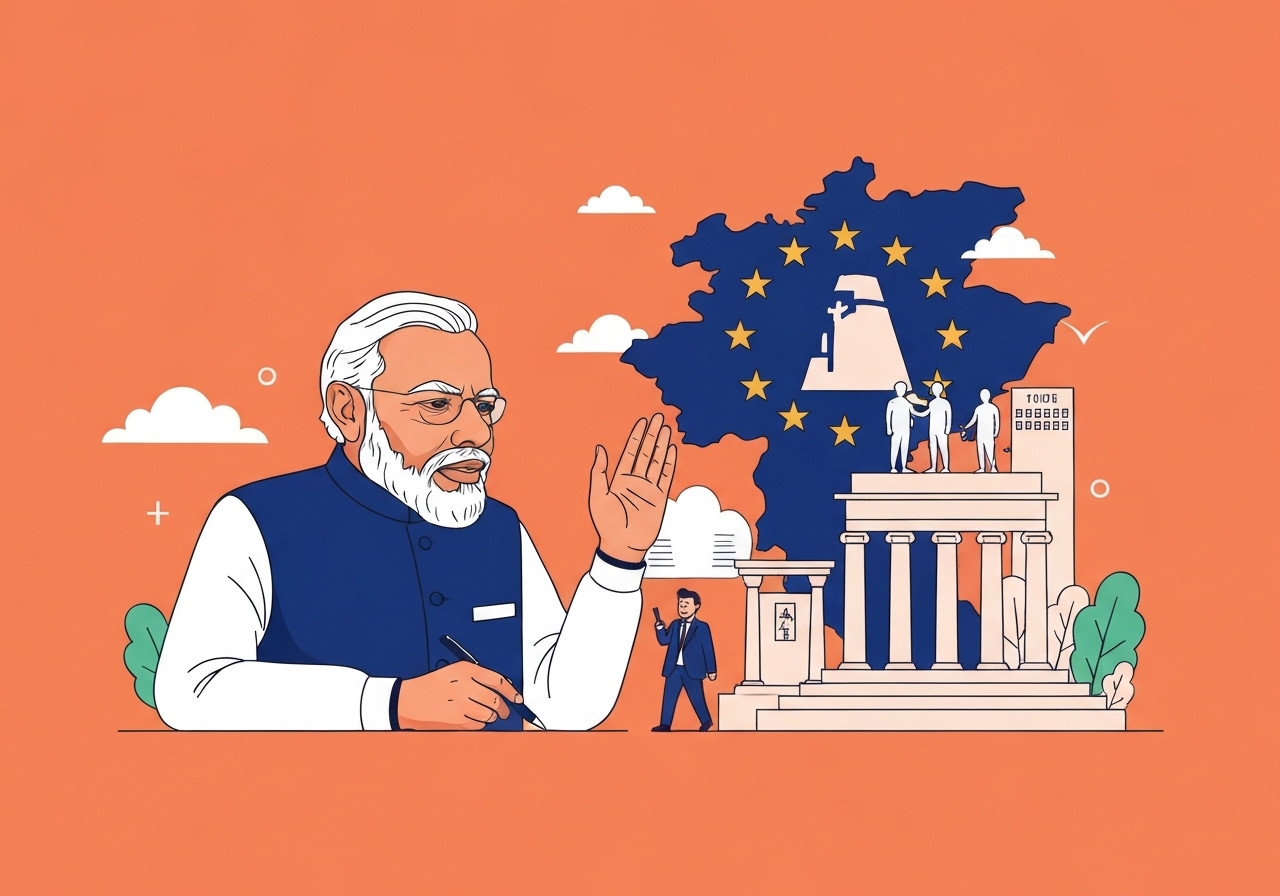
Lead: India and the European Union announced on Monday that they have concluded a long-sought free trade agreement, Prime Minister Narendra Modi said at India Energy Week in New Delhi. The pact, described by Indian officials as a “landmark” deal, was negotiated over nearly two decades and relaunch efforts began in 2022. The arrangement is expected to create preferential access to markets covering about 2 billion consumers and to complement India’s recent pacts with the U.K. and EFTA. Details were set to be disclosed in a joint India-EU statement later the same day by Modi and European Commission President Ursula von der Leyen.
Key Takeaways
- The India-EU free trade agreement was announced on Monday and was negotiated intermittently for nearly 20 years, with talks relaunched in 2022.
- The EU accounts for roughly 25% of global GDP and about one-third of global trade; goods exchanged with India exceeded €120 billion (about $140 billion) in 2024.
- The deal is expected to open a combined market of about 2 billion consumers and to bolster sectors cited by Modi, including textiles, gems and jewelry, leather and footwear.
- Sensitive items such as agriculture and autos delayed progress historically; negotiators flagged these as the most difficult areas to resolve.
- India’s total goods trade with the EU stood at $136 billion for the year ended March 2025; trade with six major EU markets was $43.8 billion over nine months to December 2024.
- This is India’s fourth major trade pact since steep U.S. tariffs were applied in August 2025; New Delhi has recently concluded agreements with the U.K., Oman and New Zealand.
- Analysts say the agreement will not substitute for a potential India-U.S. deal but provides an important alternative market for exporters facing higher U.S. tariffs.
Background
Negotiations between India and the EU have been episodic since the early 2000s, shaped by competing domestic priorities and political sensitivity on both sides. For Brussels, opening markets while protecting European farmers and industry has long been a priority; for New Delhi, safeguarding smallholder agriculture and nascent manufacturing capacity has been central. Talks were formally relaunched in 2022 with renewed political will on both sides to reach a comprehensive arrangement that addresses tariffs, technical barriers, and regulatory cooperation.
Geopolitics and shifting trade alliances have added urgency. With U.S.-China tensions and protectionist measures affecting established channels, India has accelerated outreach to alternative partners. New Delhi’s trade strategy after the imposition of steep U.S. tariffs in August 2025 has emphasized diversification — negotiating pacts with the U.K., EFTA partners, Oman and New Zealand — and the EU agreement is the most consequential of these efforts due to the bloc’s economic scale.
Main Event
On the morning of the announcement, officials from New Delhi and Brussels confirmed that negotiators had closed text across core chapters and agreed a phased implementation timetable. Modi praised negotiators from sectors such as textiles and jewelry, saying the deal would provide tangible relief to exporters. The formal signing precedes a joint press statement that the two leaders planned to deliver at the India-EU summit later in the day.
Officials participating in the talks attributed the breakthrough to sustained technical working groups that resolved rules-of-origin and phased liberalization for automobiles and agricultural products. Both capitals emphasized safeguards and gradual tariff rollbacks to manage domestic adjustment. The agreement also includes provisions for regulatory cooperation on standards, a key area for reducing non-tariff barriers that hamper trade in machinery, chemicals and electronics.
Brussels framed the pact as part of a broader EU approach to trade that prioritizes sustainability and resilience. At Davos on Jan. 20, Ursula von der Leyen underscored the bloc’s preference for “fair trade over tariffs” and for partnerships that advance environmental and labor standards. New Delhi sought guarantees that the agreement would protect its policy space for industrial development and social objectives.
Analysis & Implications
Economically, the pact could meaningfully expand market access for India’s labor-intensive exports — textiles, leather goods and jewelry — which face competition and regulatory hurdles abroad. For EU exporters, India presents demand growth in machinery, transport equipment and chemicals. The balance of benefits will depend on the final tariff schedules, quotas and rules-of-origin, which determine how goods qualify for preferential treatment.
Politically, the deal signals a deepening of India-EU ties at a moment when global trade is being reshaped by strategic competition. For New Delhi, the agreement reduces dependence on any single market after punitive U.S. measures in August 2025 and strengthens its bargaining position in future negotiations with other partners. For the EU, the pact reinforces a strategy of diversifying supply chains and securing partners that share priorities on sustainability and standards.
Short-to-medium-term disruption is possible in sensitive domestic sectors. Agriculture and the automotive industry were long-standing sticking points because tariff cuts can quickly unsettle local producers. Both sides have built in transition measures and safeguard clauses to limit abrupt exposure; however, domestic politics in EU member states and India’s states will shape the speed and depth of liberalization.
On services and investment, the agreement may include commitments to ease market access for certain professional and business services, and stronger investment protections. If so, it could increase bilateral FDI flows over time. Yet successful implementation will require robust dispute-settlement mechanisms and ongoing regulatory coordination to prevent market fragmentation.
Comparison & Data
| Metric | Value | Period |
|---|---|---|
| India–EU goods trade | €120+ billion (≈ $140bn) | 2024 |
| India total goods trade with EU | $136 billion | Year ended March 2025 |
| India exports to 6 major EU markets | $43.8 billion | 9 months to Dec 2024 |
| India exports to U.S. (comparison) | $65.88 billion | 9 months to Dec 2024 |
| India trade surplus — U.S. | $45.8 billion | 2024 |
| India trade surplus — EU | $25.8 billion | 2024 |
The table highlights why the EU is a strategic partner: it is a comparably large market, though India’s surplus with the U.S. in 2024 ($45.8 billion) remained higher than with the EU ($25.8 billion). That gap underscores why analysts say an India-U.S. arrangement would be distinct in impact; nevertheless, the EU pact diversifies destinations for Indian exports and may boost European investment into India’s manufacturing and services sectors.
Reactions & Quotes
European and Indian officials framed the agreement as a step toward deeper economic and strategic ties. Brussels emphasized standards and sustainability, while New Delhi highlighted export opportunities for key labor-intensive sectors. Analysts noted both sides still face domestic political constraints on market opening.
“This is a significant milestone that balances market access with necessary protections for sensitive sectors,”
Ursula von der Leyen, President of the European Commission (official comment)
Experts cautioned the deal is the product of protracted compromise; some industries will gain faster access than others. Observers said the agreement is unlikely to replace the strategic importance of an India-U.S. economic relationship but will materially improve alternatives for exporters.
“Given current constraints, this is among the best large deals available to both sides,”
Hosuk Lee Makiyama, Director, European Centre for International Political Economy (expert analysis)
Industry groups in textiles and jewelry welcomed the move as a potential boost to shipments, while farmer groups in several EU member states asked for clarity on safeguard provisions. Modi’s remarks, delivered in Hindi and translated for the summit, emphasized benefits to small businesses and exporters across sectors such as leather and footwear.
Unconfirmed
- Exact tariff-reduction schedules for agriculture and automobiles remain undisclosed until the joint statement and implementing texts are published.
- The degree of services liberalization, visas for professionals, and specific investment protections have not yet been confirmed publicly.
- Details on the dispute-settlement mechanism and whether domestic safeguard triggers will be unilateral or jointly administered are still pending clarification.
Bottom Line
The India-EU free trade agreement represents a strategic and economic milestone for both parties: for India, a major alternative market at a time of higher tariffs elsewhere; for the EU, a partner for supply-chain diversification and trade built on sustainability standards. The pact’s ultimate economic impact will hinge on the technical details — tariff timetables, rules-of-origin and non-tariff measures — that determine which sectors gain fastest.
Policymakers will now face the task of translating political agreement into enforceable implementing texts and domestic measures to smooth sectoral adjustment. Stakeholders from farmers to manufacturers and services firms will be watching the published schedules closely, because the distribution of benefits and costs will shape political support and implementation speed in both India and EU member states.
Sources
- CNBC — News report summarizing the announcement and immediate reactions.
- European Commission — Official institutional site (official statements and press material on EU trade policy).
- Prime Minister’s Office, India — Official government portal for statements and releases (official clarifications expected).