
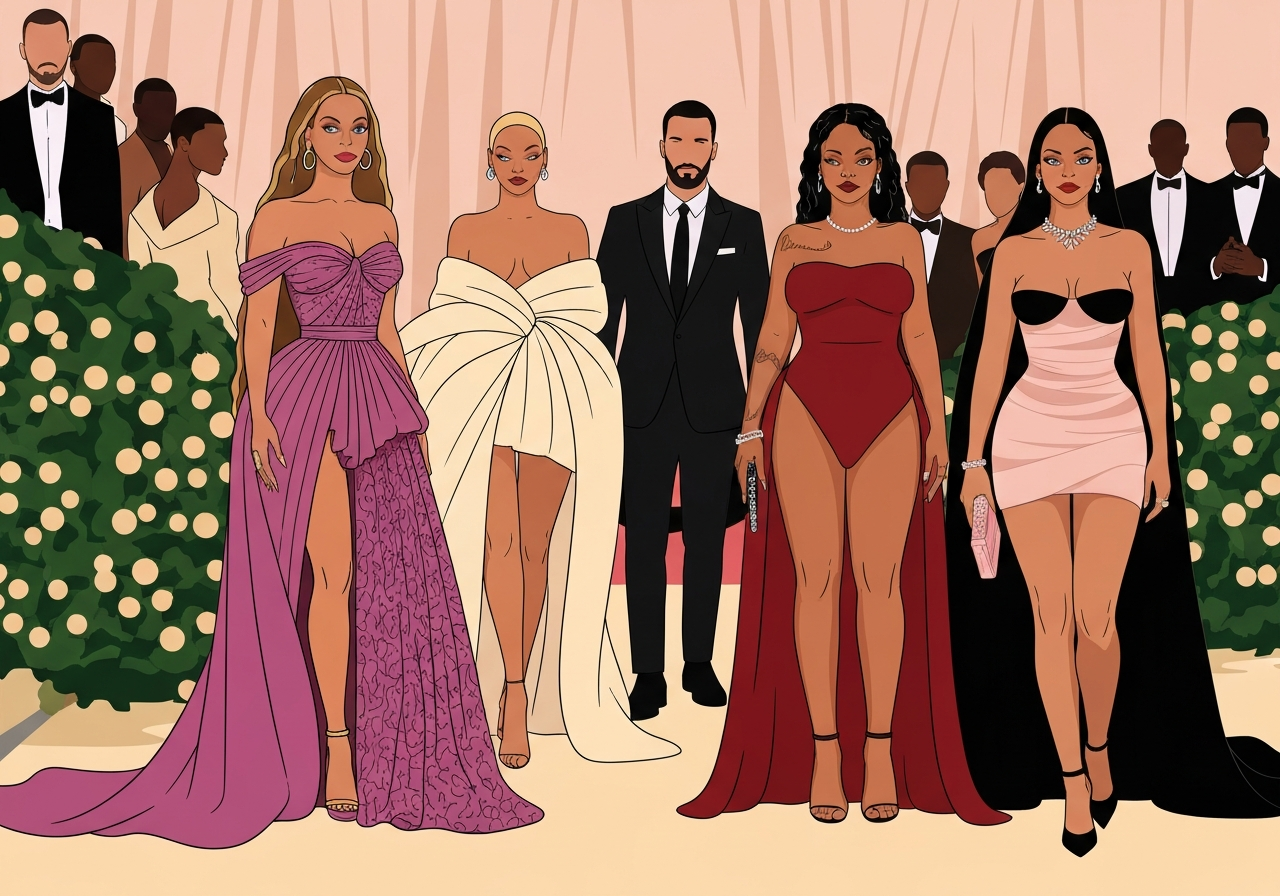
Lead: On May 4, 2026, the Metropolitan Museum of Art in New York hosted the annual Met Gala, this year organized around the Costume Institute exhibition themed “Costume Art.” Co-chairs Beyoncé, Nicole Kidman and Venus Williams led a guest list of roughly 400 attendees as celebrities delivered theatrical, on-theme red-carpet statements. The evening included a private preview of the museum’s upcoming exhibition (public opening May 10), a formal dinner and the customary no-phones policy inside the museum. High points ranged from Beyoncé’s skeletal-inspired ensemble to Rihanna’s Maison Margiela arrival and a brief security incident on the steps.
Key Takeaways
- The Met Gala took place May 4, 2026, at The Metropolitan Museum of Art in New York, tied to the Costume Institute’s exhibition “Costume Art,” which opens to the public on May 10.
- About 400 guests were reported on the invited list, including co-chairs Beyoncé, Nicole Kidman and Venus Williams, and host-committee chairs Anthony Vaccarello and Zoë Kravitz.
- Beyoncé arrived in a skeleton-inspired look with a feather train; Rihanna attended in Maison Margiela and walked the carpet alongside ASAP Rocky.
- Blue Ivy Carter, 14, attended the Met Gala for the first time with parents Beyoncé and Jay-Z; Zendaya was absent though her stylist Law Roach attended.
- Vogue reported the plated dinner by Olivier Cheng Catering included a burrata appetizer, a rack of lamb main and three different desserts for guests.
- Arrivals officially start around 5:30 p.m.; many celebrities arrive later in the evening—Rihanna and others have arrived near or after 10 p.m. in past years.
- Security intervened when an individual attempted to approach the red carpet; police prevented any close contact with celebrities.
- The museum enforces a strict no-phone, no-social-media policy inside the building during the Gala.
Background
The Met Gala is an annual fundraising event for the Costume Institute at The Metropolitan Museum of Art and functions as both a high-profile fashion moment and a preview for the Institute’s spring exhibition. Traditionally held on the first Monday in May, the Gala pairs a theme drawn from the Institute’s exhibition with a celebrity-led guest list selected by Vogue. Anna Wintour remains the deciding force behind invitations, even as titles and roles within Condé Nast evolved in recent years.
Recent years show the event alternating between retrospective homages and cultural reframings: 2023 celebrated Karl Lagerfeld, 2024’s “Sleeping Beauties: Reawakening Fashion” foregrounded nature-inspired couture, and 2025’s “Superfine: Tailoring Black Style” centered Black designers and menswear. These themes shape not only red-carpet aesthetics but also industry discourse around heritage, representation and the museum’s curatorial priorities.
Co-chairs and the host committee play a public role in shaping narrative and attendance. The 2026 committee blended music, sports, film and fashion figures—an explicit effort to demonstrate fashion’s multisector cultural reach while driving ticketed fundraising and press attention for the Costume Institute.
Main Event
Red-carpet arrivals began in the early evening, with many high-profile appearances concentrated after 7 p.m. Beyoncé, one of the event’s co-chairs, drew sustained attention for a look that combined anatomical references with a feathered train—an interplay that mirrored the exhibition’s examination of bodies and dress. Rihanna arrived later in the evening and posed with ASAP Rocky; her Maison Margiela outfit was among the most-photographed looks of the night.
Designers and celebrities leaned into the theme in varied ways: Madonnas’ Saint Laurent ensemble featured theatrical accessories including a pirate-ship hat, while Irina Shayk wore a concept built from jewelry and timepieces instead of traditional fabric. Athletes and entertainers—Joe Burrow in navy, Venus Williams as co-chair, and Olympic skater Eileen Gu—also translated the theme into sculptural or sports-inflected statements.
Several first-timers and younger attendees made note-worthy debuts: Blue Ivy Carter attended at age 14 for the first time; models and emerging actors staged dramatic stair-top reveals; and Tina-era veterans like Cher and Madonna added generational texture. Zendaya, a frequent Met Gala presence, did not attend this year; her stylist Law Roach appeared on the carpet in her stead.
Inside the museum, guests were offered a private dinner and preview of the Costume Institute exhibition prior to its public opening on May 10. According to Vogue, the plated dinner served by Olivier Cheng Catering included a burrata appetizer, a rack of lamb main course and three dessert options—details that underscore the event’s blend of hospitality and spectacle.
Analysis & Implications
Symbolically, the 2026 theme “Costume Art” foregrounds a long-running conversation about the embodied nature of fashion: how garments shape and are shaped by the body, and how museum presentation reframes wearable objects as artworks. By juxtaposing archival costume with contemporary avant-garde pieces, the exhibition and Gala together suggest a curatorial attempt to map continuity between historical dress and present-day couture provocation.
Economically, the Gala continues to operate at the intersection of philanthropy, branding and commercial spectacle. A guest list that mixes luxury-brand ambassadors, studio executives and wealthy patrons keeps the Costume Institute solvent and raises the public profile of participating designers. At the same time, the event intensifies scrutiny around access and inequality—the same stars who celebrate couture also appear in political debates over taxation and civic priorities, as illustrated by the reported absence of Mayor Zohran Mamdani.
For designers and brands, the Gala remains a global marketing moment: Maison Margiela, Saint Laurent, Chanel and other maisons benefited from hours of press and social coverage despite the museum’s internal phones-off rule. That policy shifts attention toward curated press images and controlled releases, reinforcing the power of official photography and licensing in shaping the night’s visual record.
Culturally, the Gala’s mix of costume, celebrity and performance affects how audiences read fashion as art. When an icon like Beyoncé stages a sculptural, body-referential look, it elevates discussion beyond trend to questions about anatomy, narrative and display. The presence of younger attendees and first-timers also signals how the Met Gala remains a generational touchstone for defining mainstream haute-culture moments.
Comparison & Data
| Year | Theme | Dress Code / Focus |
|---|---|---|
| 2023 | Karl Lagerfeld: A Line of Beauty | Tribute looks; house references |
| 2024 | Sleeping Beauties: Reawakening Fashion | Garden of Time; nature-inspired couture |
| 2025 | Superfine: Tailoring Black Style | Tailored menswear; focus on Black designers |
| 2026 | Costume Art | Exploration of body, costume and art |
This quick comparison shows an arc from single-designer tributes and nature-driven themes toward curatorial projects that foreground identity, tailoring and now the relationship between body and clothing. Each theme shifts the Gala’s public conversation—sometimes incentivizing certain genres of design (e.g., menswear in 2025) and sometimes encouraging theatrical craftsmanship or archival display.
Reactions & Quotes
Organizers and participants framed the night as both spectacle and scholarship:
“Costume Art will present a dynamic and scholarly conversation between garments from The Costume Institute and an array of artworks,”
Max Hollein, CEO of The Met (statement on the exhibition)
This statement was used by museum officials to explain the exhibition’s curatorial intent and its relationship to the Gala.
“I’m thinking about art in motion… sports and fashion and femininity and whimsy,”
Eileen Gu, on her dress
Gu described her Iris van Herpen design as a conceptual blend of movement and surrealism during red-carpet remarks.
“Tonight is not about being quiet with the fashion. It’s really about being loud,”
Jessica Neises, senior fashion editor at Cosmopolitan
Neises anticipated bold and colorful statements, a prediction borne out across many carpet looks.
Unconfirmed
- Reports that specific performers would appear at the Temple of Dendur during dinner were not confirmed by museum press; historically performers attend, but exact acts were not officially announced.
- Anecdotes about individual guests taking hidden mirror selfies inside bathrooms (commonly attributed to high-profile attendees like Kylie Jenner) are based on past behavior and have not been independently verified for this evening.
- Some informal reports about the attempted red-carpet approach described the person as quickly contained; full details about motives or charges were not available at press time.
Bottom Line
The Met Gala 2026 reinforced the event’s dual identity as a fundraising gala and a public-facing staging ground for curatorial ideas—this year centering how clothing and the human form converse under the rubric “Costume Art.” High-profile co-chairs and a star-studded guest list guaranteed media attention, while the museum’s phones-off policy and controlled previews ensured the exhibition remained the institutional focal point beyond immediate spectacle.
Looking forward, the Costume Institute’s exhibition opening to the public on May 10 will allow scholars and general audiences to evaluate the objects beyond red-carpet imagery. For brands and designers, the Gala continues to deliver global visibility; for the museum, it remains an essential source of philanthropic support and a platform to advance conversations about fashion’s history and contemporary cultural role.
Sources
- CBS News — media coverage and live updates from the red carpet (news organization).
- Vogue — reporting on Gala logistics and meal details (fashion magazine).
- The Metropolitan Museum of Art — official museum and Costume Institute information (official institution).