
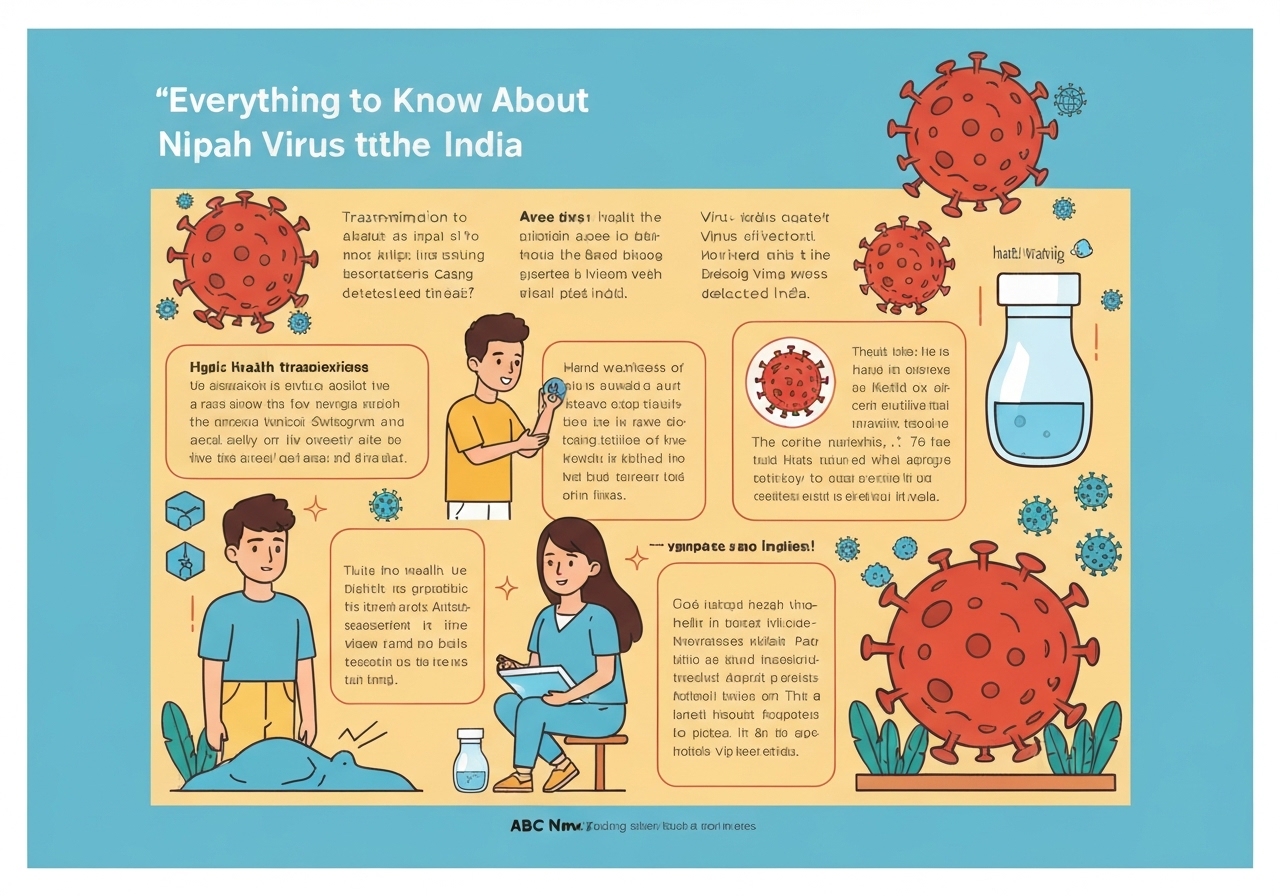
Lead: Two confirmed cases of Nipah virus were reported in West Bengal, India, earlier this month, prompting heightened screening and surveillance in several nearby countries. The World Health Organization identified the two cases as 25-year-old nurses, one woman and one man, and Indian authorities have deployed an outbreak response team while the US Centers for Disease Control and Prevention says it is monitoring the situation. Thailand and Nepal have intensified checks at international points of entry, and public health agencies stress that while Nipah has a high case fatality rate historically, global spread remains unlikely at this time. This article explains symptoms, transmission, current response actions, and what treatments are being studied.
Key Takeaways
- Two laboratory-confirmed Nipah cases were reported in West Bengal, India; both patients are 25-year-old nurses, one female and one male, according to WHO statements.
- Incubation typically ranges from 4 to 14 days; early symptoms include fever, headache and respiratory signs that can mimic common infections.
- Severe progression can include encephalitis, seizures and coma within 24 to 48 hours of neurologic onset; reported case fatality ranges from about 40% to 75%.
- No licensed antiviral or vaccine is broadly available; care is supportive, though a monoclonal antibody has completed phase I testing and is in limited compassionate use.
- Regional responses include airport screening at Bangkok international airports starting Jan 25, 2026, and intensified surveillance in Nepal and other neighboring nations.
- Transmission is zoonotic primarily via fruit bats and can occur through direct contact with infected animals or with bodily fluids of infected people; health-care exposures have been linked to lapses in standard precautions.
- Global health agencies, including WHO and the CDC, are tracking the event but assess the chance of a worldwide emergency as low based on current information.
Background
Nipah virus is a zoonotic pathogen first identified in 1999 after outbreaks among pigs and humans in Malaysia and Singapore. Reservoir hosts are fruit bats of the Pteropodidae family, which can shed virus in saliva, urine and other secretions. Human outbreaks since 1999 have varied by geography and scale, with repeated spillovers in South Asia linked to animal exposures or contaminated food. The virus can spread between people through close contact and exposure to infectious bodily fluids, which has occasionally led to clusters in families and health-care settings.
Public health responses to Nipah emphasize rapid detection, isolation of cases, contact tracing and strict infection prevention and control in clinical environments. The high case fatality rate reported across outbreaks has made Nipah a priority for research into therapeutics and vaccines, but progress has been incremental and many candidate medicines remain in early stages of testing. Environmental pressures, including habitat loss and changes in animal behavior, have been hypothesized to increase human contact with bat populations that harbor the virus, raising concerns about recurrent spillover.
Main Event
Indian health authorities confirmed two cases of Nipah virus in West Bengal this month after laboratory testing and epidemiologic investigation, notifying the World Health Organization and initiating an outbreak response. Local teams have undertaken contact identification and monitoring, and hospitals in the area have reinforced infection control measures such as using personal protective equipment and isolating suspected patients. The Department of Health and Human Services informed ABC News that Indian officials deployed a response team, while the US CDC reports active monitoring and communication with local counterparts.
Neighboring countries quickly adjusted border health measures: Thailand instituted screening at Suvarnabhumi and Don Mueang airports for flights arriving from West Bengal beginning Jan 25, 2026, and Nepal increased surveillance at its entry points. These measures focus on identifying symptomatic travelers and educating health workers about recognition and reporting. Health authorities stressed that screenings are precautionary and intended to slow any cross-border seeding while local investigations proceed.
Clinically, Nipah infection can begin with nonspecific symptoms that resemble influenza or other common infections, which complicates early identification. In a subset of cases the disease progresses to severe neurologic illness including seizures and encephalitis; some patients who survive may have long-term neurological effects. Preliminary reports from the West Bengal investigation indicate close-contact exposures in health-care settings are being assessed to determine routes of transmission for the two confirmed cases.
Analysis & Implications
From a public health perspective the detection of two confirmed cases in West Bengal is significant but does not, by itself, indicate a large-scale epidemic. Nipah outbreaks historically have been focal and associated with identifiable animal-human exposures or breakdowns in infection control. Rapid contact tracing and strict adherence to standard precautions in clinics can substantially limit onward transmission, which is why health authorities emphasize immediate containment actions.
Economically and socially, localized Nipah events can strain health systems, divert resources from routine care and trigger travel or trade anxieties, particularly in regions with limited surge capacity. The airport screening measures and heightened surveillance in neighboring countries illustrate a precautionary approach that balances disease control with minimizing unnecessary disruption. Overreaction, however, risks causing avoidable economic harms; targeted, evidence-based interventions are preferable to blanket travel bans.
Scientifically, the event underscores gaps in therapeutic and vaccine availability. Although monoclonal antibodies and repurposed antivirals such as remdesivir show promise in preclinical or early clinical contexts, none are yet established as standard, widely available treatments. Continued investment in clinical trials, improved diagnostic access and One Health surveillance linking animal and human data will be key to reducing the frequency and impact of future spillovers.
Comparison & Data
| Metric | Reported Values |
|---|---|
| Incubation period | 4 to 14 days |
| Historic case fatality range | Approximately 40% to 75% |
| First identified | 1999, Malaysia and Singapore |
The table above summarizes widely cited clinical and historical metrics for Nipah. Incubation estimates and fatality ranges come from WHO and CDC synthesis of outbreak data; precise mortality can vary by outbreak depending on case ascertainment, health-care access and supportive care quality. Comparing outbreaks highlights that rapid detection and early supportive care are associated with better outcomes.
Reactions & Quotes
The scientific community and public health officials have offered cautious commentary while investigations continue.
It is very unlikely that the current detection in India will precipitate a global emergency, though vigilance is warranted in clinical settings where standard precautions lapse.
Dr. Diana Finkel, Rutgers New Jersey Medical School
Dr. Finkel noted that many health-care linked transmissions are preventable with proper use of gloves, masks and other routine protections, reinforcing the practical steps hospitals can take now.
Changes in bat habitat and movement patterns likely influence spillover risk, and we should examine ecological drivers alongside clinical surveillance.
Dr. Peter Rabinowitz, University of Washington Center for One Health Research
Dr. Rabinowitz framed the event within a One Health perspective, urging integrated monitoring of animal reservoirs to anticipate and reduce human exposures.
Unconfirmed
- Whether additional undetected Nipah infections exist in West Bengal beyond the two confirmed cases remains under investigation and unverified publicly.
- The precise exposure pathway for the two nurses has not been fully disclosed in official reports and is still being determined by investigators.
- The effectiveness of remdesivir or other candidate antivirals in human Nipah cases has not been established; current evidence is limited to animal studies or early reports.
Bottom Line
The detection of two confirmed Nipah cases in West Bengal warrants attention and immediate public health action, but current evidence does not suggest imminent global spread. Key priorities are thorough contact tracing, strict infection control in clinical settings and transparent public communication to prevent panic while enabling informed precautionary steps.
Longer term, reducing the risk of future Nipah spillovers will require sustained investment in One Health surveillance, clinical trial evaluation of promising therapeutics and measures that address environmental drivers of zoonotic emergence. For now, travelers and clinicians should be informed of symptoms and reporting channels, and health systems should reinforce standard protective practices.
Sources
- ABC News — (news report synthesizing WHO and local statements)
- World Health Organization — (official fact sheet)
- Centers for Disease Control and Prevention — (official clinical and epidemiologic guidance)
- Rutgers New Jersey Medical School — (academic profile and expert commentary)
- University of Washington Center for One Health Research — (academic One Health perspective)