
Lead
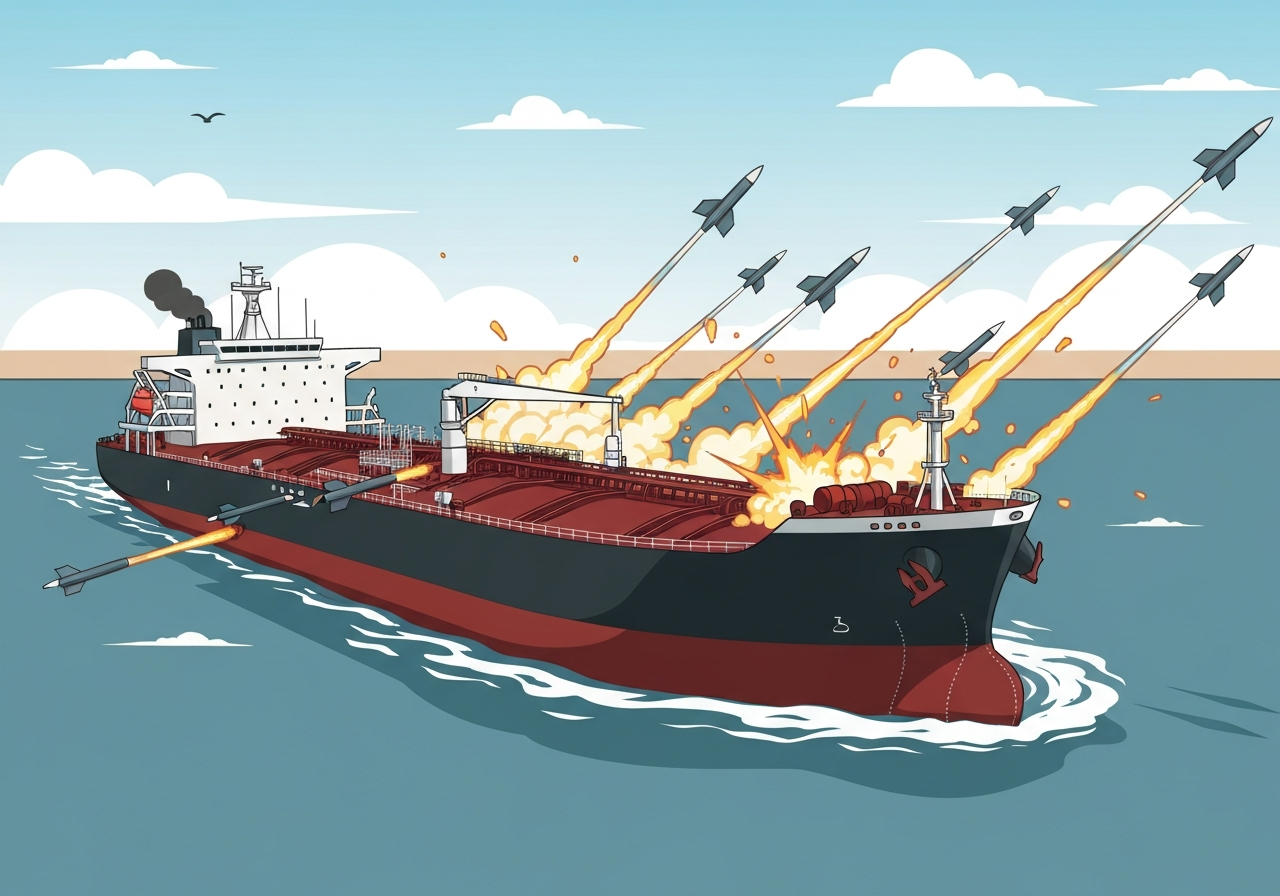
On Monday, Iranian forces struck at least one commercial vessel in the Strait of Hormuz, the United Arab Emirates said, after reporting that two drones targeted an ADNOC-owned tanker. The U.K. Maritime Trade Operations Center separately reported a merchant ship on fire about 14 nautical miles west of Mina Saqr; the cause remains unverified. The United States simultaneously launched “Project Freedom,” saying U.S. forces would guide stranded merchant ships through an “enhanced security area” and CENTCOM reported two U.S.-flagged vessels had transited. No immediate fatalities were reported, but the episode has sharply raised tensions and moved energy markets.
Key Takeaways
- The UAE said two Iranian drones targeted an ADNOC tanker in the Strait of Hormuz on Monday; there were no immediate reports of injuries.
- UKMTO received a report of a commercial vessel on fire roughly 14 NM west of Mina Saqr; the cause has not been verified by independent sources.
- U.S. Central Command said Project Freedom began Monday and that two U.S.-flagged merchant ships and U.S. guided‑missile destroyers transited the strait to “restore transit.”
- Iranian state outlets denied U.S. claims that ships had safely passed and warned that unpermitted transits would be met with force.
- The UAE reported four cruise missiles were launched toward its territory earlier Monday; three were intercepted over territorial waters and one landed at sea, the ministry said.
- Oil prices rose sharply: U.S. crude traded near $104.12 a barrel and Brent near $111.23 amid initial 5% moves, later settling to increases of about 2–3%.
- Project Freedom was described by CENTCOM as including guided‑missile destroyers, over 100 aircraft, unmanned platforms and roughly 15,000 service members.
- South Korean and other flags were reported in possible additional incidents; officials in Seoul were working to verify reports of a cargo ship explosion.
Background
The current episodes are rooted in the wider U.S.-Israel campaign and Iran’s retaliatory responses that began with open hostilities on Feb. 28, 2026. A U.S.-Iran ceasefire took effect on April 8, 2026, but maritime friction persisted: Washington imposed a naval blockade on Iranian ports and Tehran, in turn, has maintained control over transit in the Strait of Hormuz and threatened or attacked vessels it says violate its rules.
The Strait of Hormuz is a choke point for global energy flows—about one‑fifth of the world’s oil moves through it in normal times—so interruptions have immediate effects on prices and supply chains. Regional states, Western navies and global shippers have repeatedly warned that attacks on commercial shipping risk broad economic fallout and could draw foreign militaries into direct confrontation.
Main Event
The UAE Ministry of Foreign Affairs reported that two drones targeted an ADNOC tanker while it transited the strait; the ministry called the action an “Iranian terrorist attack” but said there were no reported casualties. Separately, UKMTO posted that a commercial ship was on fire roughly 14 nautical miles west of Mina Saqr and advised nearby vessels to keep distance; UKMTO noted the cause was not yet verified and that it receives alerts directly from merchant crews and operators.
Hours earlier, CENTCOM announced the launch of Project Freedom, establishing an “enhanced security area” south of usual shipping lanes and urging mariners to coordinate with Omani authorities because of anticipated high traffic and unexploded hazards. CENTCOM said two U.S.-flagged merchant ships transited the strait alongside U.S. guided‑missile destroyers as part of initial efforts to restore passage.
Iranian state media and the Islamic Revolutionary Guard Corps strongly disputed CENTCOM’s account, saying no commercial vessels had recently passed and warning that ships attempting transit without Iranian permission would face force. Iran’s Fars and IRIB also reported warning shots and “cruise missile warning shots” at nearby U.S. warships; CENTCOM rejected claims that any U.S. ship had been struck.
In addition to the ADNOC tanker report, South Korean and other sources said a commercial vessel suffered an explosion in its engine room; South Korean agencies and the company HMM were working to confirm whether the incident was caused by attack, mine, or accident. Market responses were immediate: equity futures slipped and oil futures spiked as traders priced in renewed supply risk.
Analysis & Implications
Militarily, Project Freedom signals a U.S. willingness to use naval power to reopen key maritime routes, but its practical mechanics and legal basis remain partly opaque. CENTCOM described escorts, a security zone and heavy force posture—elements that can deter small-scale harassment but also increase the risk of miscalculation if Iranian forces choose to contest transits directly.
Politically, the episode exposes a gap between ceasefire rhetoric and control of critical access points. Tehran treats the Strait as a lever for pressure; Washington views reopening the route as essential to global stability and allied reassurance. Third‑party states such as France and the U.K. have pushed for coordinated approaches, while some European leaders have expressed reluctance to join operations they characterize as “unclear.”
Economically, even limited attacks raise insurance costs, reroute cargoes and lift energy prices. The immediate jump in crude benchmarks illustrates how sensitive markets are to disruptions in Hormuz; sustained interference could deepen inflationary pressures and strain economies that rely on Gulf energy.
Diplomatically, the incident complicates nascent mediation efforts—Pakistan facilitated a transfer of crew from the seized Iranian ship Touska as a confidence‑building measure—and could either push parties back to negotiation over transit protocols or entrench a more militarized status quo if deterrence fails.
Comparison & Data
| Event | Date | Confirmed Impact |
|---|---|---|
| Joint U.S.-Israel strikes on Iran (start of wider conflict) | Feb. 28, 2026 | Escalation of regional hostilities |
| U.S.-Iran ceasefire | Apr. 8, 2026 | Ceasefire reduced U.S. strikes but maritime blockade remained |
| Project Freedom announced / extended ceasefire comment | Apr. 21–May 4, 2026 | U.S. plans to escort merchant ships; CENTCOM mobilizes assets |
| Current drone/missile reports and vessel fire | May 4, 2026 | ADNOC tanker targeted; commercial vessel fire reported 14 NM west of Mina Saqr |
The table places Monday’s incidents in a short timeline. While the ceasefire on April 8 curtailed broader strikes, maritime restrictions and a U.S. naval blockade have left the Strait contested and shipping constrained.
Reactions & Quotes
UAE and regional bodies condemned the strikes and framed them as violations of international navigation norms; the Gulf Cooperation Council called the attacks “piracy” and demanded accountability.
“We are assisting efforts to restore transit for commercial shipping.”
U.S. Central Command (CENTCOM)
CENTCOM’s brief statement accompanied its announcement of Project Freedom and the reported transits of two U.S.-flagged merchant vessels under Navy cover.
“Violating vessels will be stopped with force.”
Islamic Revolutionary Guard Corps spokesperson (IRGC)
The IRGC warning underscores Tehran’s position that any passage must follow Iranian transit protocols, a stance that directly conflicts with U.S. escort plans.
“There has been no exchange of fire between United States Forces and Iran since April 7, 2026.”
U.S. presidential communications to Congress
That assertion frames U.S. officials’ view that Project Freedom is a defensive, humanitarian measure—but it also highlights the fragility of the ceasefire when maritime incidents recur.
Unconfirmed
- Whether the UKMTO-reported vessel fire was caused by Iranian attack, accidental ignition, or secondary explosion remains unverified.
- Claims that a U.S. warship was struck by missiles were denied by CENTCOM and lack independent confirmation.
- Reports that a South Korean-flagged cargo ship was attacked are under investigation and not yet conclusively attributed to hostile action or other causes.
Bottom Line
Monday’s incidents show that maritime flashpoints remain central to the wider U.S.-Iran confrontation despite a land-focused ceasefire. Project Freedom is an explicit U.S. attempt to reassert freedom of navigation, but the operation risks direct clashes unless a diplomatic framework for coordinated transit is negotiated with regional actors.
For shippers and markets, the immediate takeaway is continued volatility: insurance premiums, rerouting costs and commodity price swings are likely while the strait’s status is disputed. The coming days will test whether Project Freedom deters further attacks or prompts an escalatory response that broadens the crisis.
Sources
- CBS News (news outlet live updates)
- U.S. Central Command (CENTCOM) (official military statements)
- Reuters (international news agency)
- UAE Government / Ministry statements (official statements)
- IRIB / Fars (Iranian state media)