
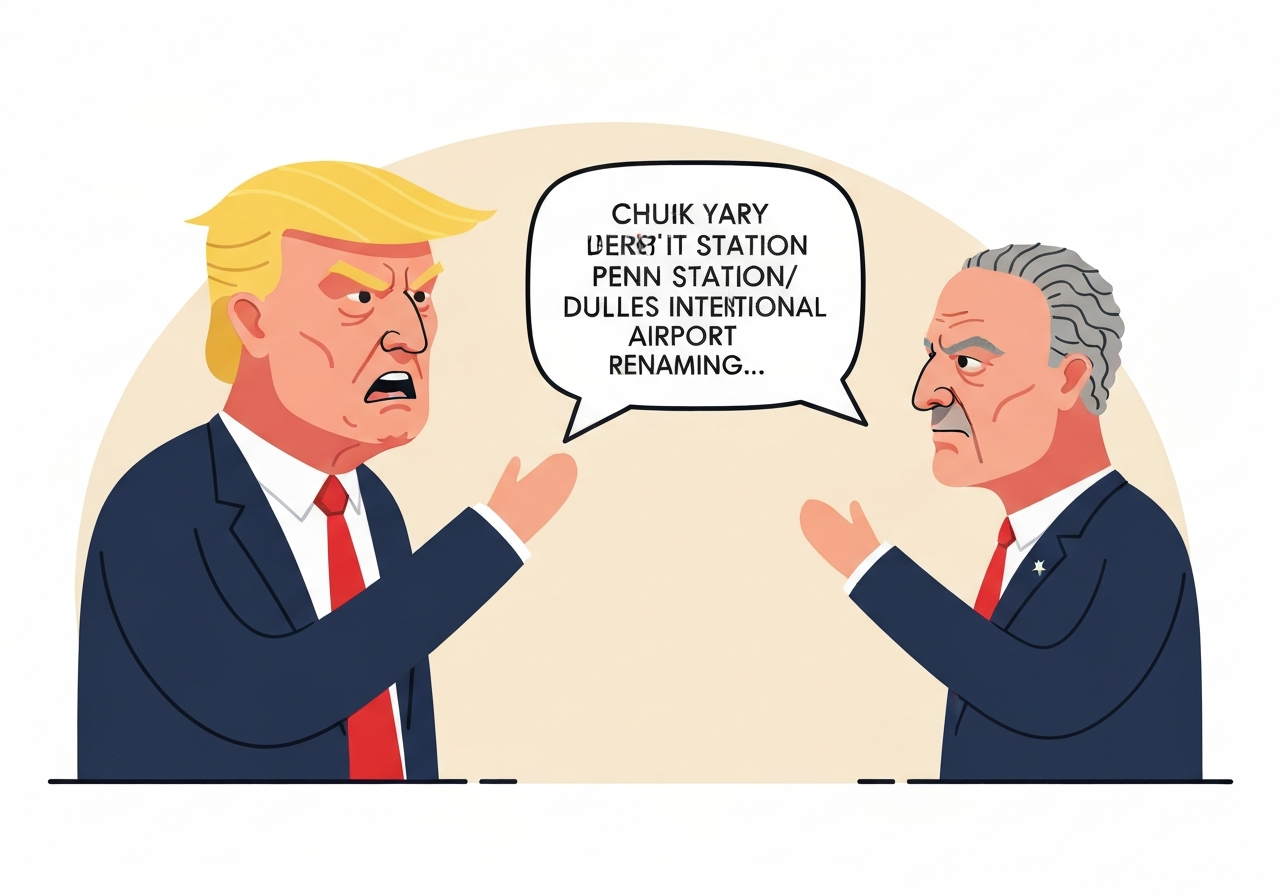
Lead: Last month, President Donald Trump told Senate Minority Leader Chuck Schumer he would lift a freeze on the more than $16 billion in federal funding for the Gateway rail tunnel linking New York and New Jersey — but only if New York’s Penn Station and Washington’s Dulles International Airport were renamed after him. Schumer rejected the request, telling the president he lacked the authority to make such a change. The administration has continued to withhold the earmarked money, and New York and New Jersey filed suit earlier this week alleging the suspension is unlawful. Project leaders warn work could be paused and staff layoffs would follow if funds are not released.
Key Takeaways
- President Trump reportedly told Sen. Chuck Schumer in January 2026 he would unfreeze more than $16 billion allocated to the Gateway tunnel if Penn Station and Dulles Airport were renamed after him.
- Two people familiar with the conversation described the exchange; neither the White House nor Schumer’s office confirmed the offer publicly.
- New York and New Jersey sued the federal government earlier this week, alleging the funding suspension is unlawful and risking project delays.
- The Gateway commission says it may need to pause construction and lay off roughly 1,000 workers unless the money is released.
- Construction on the Hudson River rail tunnel predates Trump’s return to office; the federal government was expected to cover a significant portion of the remaining cost.
- Some conservative lawmakers have introduced bills to rename Dulles after Trump, but such legislation has not advanced in Congress.
- Trump has pursued multiple initiatives and branding efforts since returning to the White House, including programs and proposals that carry his name.
Background
The Gateway program is a long-planned effort to build a new rail tunnel under the Hudson River connecting New York and New Jersey, intended to replace aging infrastructure and expand capacity for regional and national rail service. Federal support has been central to completing the project; more than $16 billion in federal funding was earmarked to help finish construction. Work on the Gateway tunnel began before Trump’s 2025 return to the presidency, and the project has often relied on a mix of state, federal and regional funding commitments.
Late in 2025 the Trump administration announced a hold on the federal contribution, a move that New York and New Jersey officials quickly characterized as politically motivated. In the months since, Democratic leaders have worked to secure the release of the funds while state officials warned contractors and workers about potential stoppages. The episode coincides with an expansive drive by the president to affix his name to a range of programs and institutions, from policy initiatives to cultural and defense projects, a pattern that aides and critics have both highlighted.
Main Event
According to two people familiar with the exchange, the president told Schumer last month that he would remove the freeze on Gateway funding only if the senator agreed to rename Penn Station and Dulles Airport after him. Schumer responded that he did not have the authority to fulfill such an unusual demand. A spokesperson for Schumer declined to comment for this report; the White House did not respond to requests for comment.
The federal hold affects over $16 billion in earmarked funds that were expected to support tunnel construction and associated work. Officials at the Gateway development body have signaled that payroll and procurement decisions are conditioned on receiving the federal portion, and they have warned of layoffs of roughly 1,000 workers if the pause endures. In response to the funding suspension, New York and New Jersey filed suit earlier this week alleging the administration’s action is unlawful and seeking relief to move the project forward.
Some Republican lawmakers have already introduced bills to rename Dulles as the “Donald J. Trump International Airport,” but those measures have not progressed in the GOP-controlled Congress and currently face long odds. The dispute has amplified concerns among local officials, labor groups and transit advocates about project continuity, regional economic impacts and the precedent set by linking federal funding decisions to personal requests.
Analysis & Implications
The reported request highlights two intertwined dynamics: the leverage federal appropriations afford the presidency over major infrastructure projects, and the president’s ongoing effort to stamp his name on public institutions. If a sitting president conditions funding on naming rights, it would represent a marked departure from historical norms and could prompt both legal and political pushback. For states dependent on federal disbursements, the tactic raises questions about how infrastructure priorities are set and enforced.
Practically, the immediate risk is operational. A pause in the federal contribution can force contractors to slow or suspend work, driving up costs and delaying completion timelines. Those delays ripple across supply chains and labor markets; the commission’s warning of roughly 1,000 potential layoffs is a concrete near-term effect. Longer-term, repeated use of executive leverage in this way could chill cooperative federal-state project planning, making multi-jurisdiction projects harder to finance and deliver.
Legally, the states’ lawsuit will test administrative authority and the boundaries of executive discretion over earmarked funds. Courts will scrutinize whether the freeze followed proper procedure and whether it was motivated by permissible policy considerations. Even if the judiciary eventually rules against the administration, litigation itself can delay funding decisions for months and amplify uncertainty for contractors and commuters who rely on improved rail capacity.
Comparison & Data
| Item | Detail |
|---|---|
| Federal funds at issue | More than $16 billion earmarked for Gateway tunnel |
| Potential layoffs | Roughly 1,000 workers warned by Gateway commission |
| Timing of reported request | Conversation took place last month (January 2026) |
| Legal response | New York and New Jersey sued the administration earlier this week (Feb 2026) |
This table summarizes the most quantifiable elements: the federal funding amount, the commission’s workforce warning, the timing of the reported exchange and the states’ legal action. Those numbers frame the dispute’s scale and help explain why regional officials responded quickly with litigation.
Reactions & Quotes
“We will soon have to pause work and potentially lay off roughly 1,000 workers if the funding is not released,”
Gateway Program Development Corporation (official warning)
“I do not have the power to do that,”
Senate Minority Leader Chuck Schumer (reported response to Trump)
“Legislation to rename Dulles has been introduced by some Republican lawmakers, but it has not advanced in Congress,”
Congressional sponsors/press reports
Unconfirmed
- The precise language and full context of the president’s offer are based on accounts from two people familiar with the conversation and have not been officially confirmed by the White House.
- The motive behind the administration’s funding suspension—whether driven by policy priorities, budgetary concerns or political considerations—remains contested and is the subject of the states’ legal complaint.
- It is not yet confirmed whether Congressional or administrative pathways exist that would lead to any renaming measures being enacted within the current term.
Bottom Line
The reported exchange between President Trump and Sen. Schumer places an unprecedented personal demand at the center of a large, already delayed infrastructure program. Beyond the immediate personnel and schedule risks to the Gateway tunnel, the episode raises broader governance questions about how federal funds are allocated and whether personal or political considerations are being injected into technical, multi-jurisdiction projects.
In the short term the states’ lawsuit and congressional dynamics will shape whether funding resumes and when construction can proceed. For stakeholders—commuters, laborers, transit agencies and regional planners—the key outcome to watch is whether courts or negotiations restore the earmarked funds quickly enough to avoid layoffs and more costly delays. Longer term, the dispute could shift how states approach federal partnerships if political leverage becomes a prominent risk factor.
Sources
- CNN — Major national news outlet (original report provided by the user)
- Punchbowl News — Political news newsletter (initial reporting credited in coverage)
- Gateway Program Development Corporation — Official project authority (project statements and warnings)