
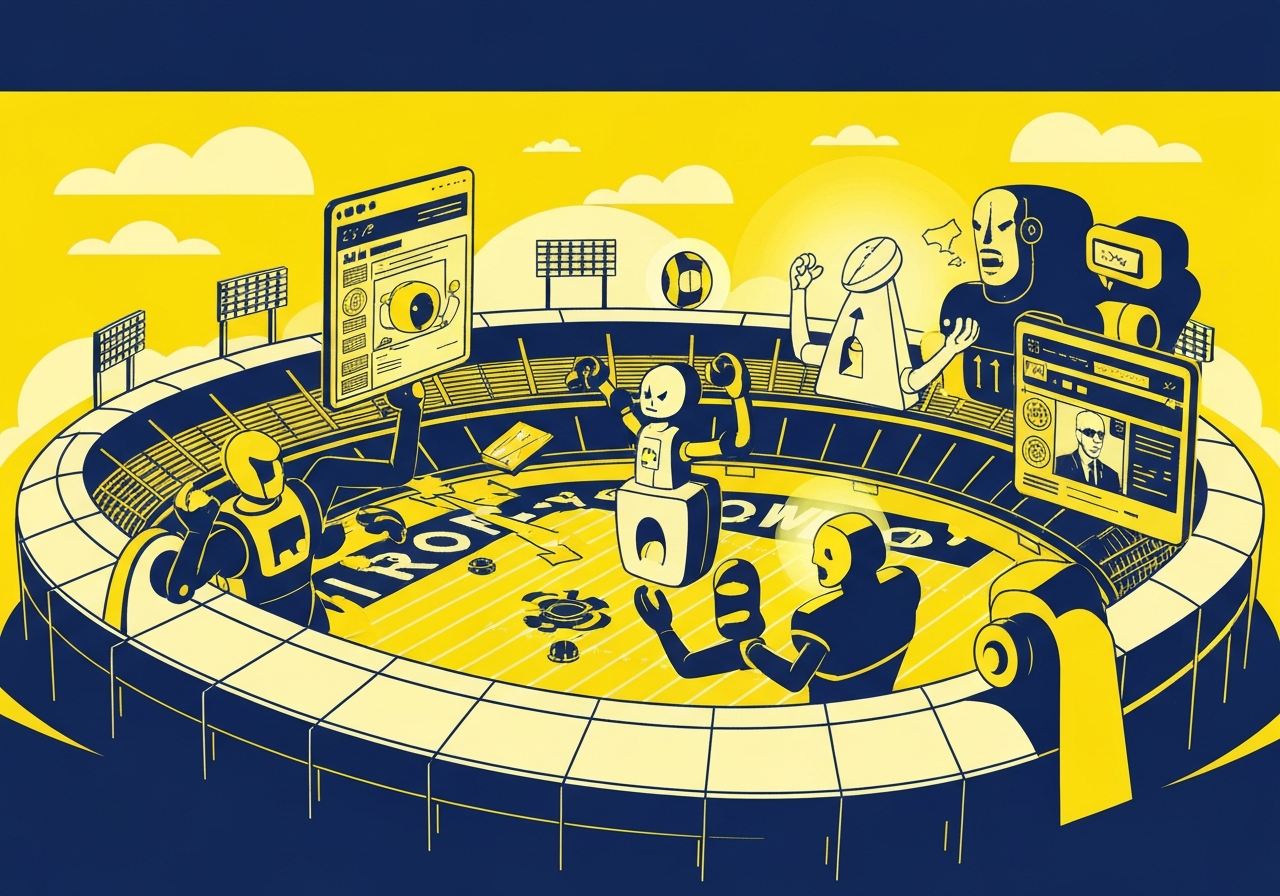
AI companies are making their most visible Super Bowl push yet, buying high-priced broadcast time ahead of the 2026 game to showcase tools for consumers and businesses to an expected audience of up to 130 million viewers. Advertisers paid a record average of $8 million for a 30‑second spot this year, with some inventory quoted as high as $10 million and additional production costs often far higher. The competition intensified in the week before the game when Anthropic ran an ad criticizing OpenAI’s decision to place ads inside ChatGPT, prompting a high-profile response from OpenAI’s CEO and drawing added attention to the ad slate. Both deep-pocketed tech giants and smaller startups are using the event to shape public debate about AI and to demonstrate product readiness at scale.
Key Takeaways
- Super Bowl ad rates averaged a record $8 million for 30 seconds this year; top slots reached about $10 million, not including production costs.
- Broad reach: networks expect up to 130 million viewers, making the game a major platform for AI messaging to consumers and enterprises.
- Anthropic and OpenAI exchanged high-visibility messages before kickoff; OpenAI is returning after a 60‑second debut spot last year.
- Major tech firms—Google (Gemini), Amazon (Alexa+ with Chris Hemsworth) and Meta (Oakley Meta AI glasses)—bought time alongside startups.
- Startups such as Genspark (ad with Matthew Broderick), Base44 and Wix promoted new AI productivity and app‑building products.
- Several ads used AI in production: Artlist.io ran a fully AI‑generated spot reportedly produced in five days for a few thousand dollars; Xfinity used AI to de‑age film actors.
- Some traditional categories, notably automakers, scaled back Super Bowl spending, freeing inventory for tech and other advertisers.
Background
The Super Bowl has long been a showcase for mass‑market advertising, but the 2026 game marks a qualitative shift: AI vendors are not just buying placement, they are centering an emerging technology narrative. For decades, major brands used the broadcast to debut expensive, high‑production spots; this year, the combination of public interest in AI and the ability to create strikingly fast, AI‑augmented production has drawn both incumbents and newcomers. Media buyers report that some traditional buyers—automakers among them—are reducing allocations, which created space and urgency for AI sellers to secure premium inventory.
The broader context includes intensified competition among large AI platform providers and startups seeking differentiation in features and trust messaging. Last year’s high‑profile AI ad entries helped normalize tech brands at the game; this season, companies used the platform not only to demonstrate capabilities but also to shape public perceptions about safety, privacy and utility. Regulatory scrutiny and public debate over ad‑funded AI products—such as ads within chat interfaces—have raised the stakes for how companies position themselves during widely watched moments.
Main Event
The pregame narrative accelerated when Anthropic released an ad that critiqued OpenAI’s decision to place advertisements inside ChatGPT, a move that provoked a direct response from OpenAI’s CEO and amplified attention to both campaigns. OpenAI, which ran a 60‑second advertisement last year, is back on the slate, signaling continued investment in mass‑market awareness. Those exchanges turned the marketing battle into a storyline about business models and user experience as much as product features.
Google continued its multi‑year presence by returning with spots that highlight Gemini AI, following previous seasons that featured Pixel camera features like Guided Frame and Magic Eraser. Amazon positioned Alexa+ with a comedic spot starring Chris Hemsworth that leans into consumer anxieties about AI at home. Meta opted to promote hardware integration—Oakley Meta AI glasses—emphasizing access to Meta’s AI tools rather than a chatbot pitch.
Smaller vendors bought time to introduce products to mainstream audiences: Genspark aired an ad featuring Matthew Broderick to promote an AI productivity platform; Base44 highlighted no‑code app development powered by AI; Wix showcased Harmony, a new AI design assistant for websites. Artlist.io ran a notable entirely AI‑generated 30‑second ad it says was purchased and produced within a week for a few thousand dollars—illustrating how production pipelines can be dramatically cheaper and faster when AI plays a central role.
Brands outside tech also leaned on AI. Svedka Vodka returned to the Super Bowl for the first time in decades after a prior ban on liquor advertising, reviving a Fembot character augmented with AI trained on TikTok dance data. Absolut also purchased time. Meanwhile, Xfinity used AI visual effects to make the cast of 1993’s Jurassic Park appear younger in a new commercial, showing how legacy IP can be repurposed with modern tools.
Analysis & Implications
The concentration of AI advertisers at the Super Bowl has several effects: it accelerates mainstream familiarity with AI features, forces rapid public debate over monetization and trust, and influences expectations for product launch strategies. When major platforms make messages in a 30‑second spot, they shape not only consumer interest but also developer and enterprise perceptions—potentially speeding adoption cycles for widely applicable tools. The public exchanges between companies can serve as free amplification; critiques of rivals often dominate coverage and social conversation, providing attention that rivals would otherwise have to buy.
Economically, the influx of AI buyers into pricey ad inventory validates marketing forecasts that emerging tech can justify premium media buys to reach broad cohorts quickly. However, the mix of expensive placements and lower‑cost AI production (as with Artlist.io) may catalyze a bifurcation in how brands allocate budgets: large firms will continue to invest in reach and celebrity talent, while some entrants will use AI to produce cost‑efficient creative at scale. The net effect could be a restructuring of production budgets and agency relationships across the industry.
Regulatory and reputational risks are also salient. Ads that foreground controversial product choices—such as in‑chat advertising—invite scrutiny from policymakers and consumer groups. The visibility of high‑profile disputes between vendors could accelerate calls for clearer disclosures about data use, targeting, and the role of ads in ostensibly conversational AI products. Brands that fail to anticipate these concerns may face reputational costs that outweigh short‑term marketing gains.
Comparison & Data
| Item | 2026 Super Bowl | Typical production |
|---|---|---|
| Average 30s spot cost | $8,000,000 | — |
| Peak slot reported | ~$10,000,000 | — |
| Typical production baseline | — | Starts at $1,000,000 |
| Audience (estimated) | Up to 130,000,000 viewers | — |
The table summarizes benchmark pricing and audience reach reported for the 2026 game and a common production‑cost baseline. Production budgets often exceed the $1 million starting point—especially when celebrities or complex effects are involved—so total campaign costs can be several times the media buy alone. At the same time, a handful of advertisers demonstrated that AI‑driven creative can be produced in days for a small fraction of conventional budgets, suggesting notable variance in total spend profiles.
Reactions & Quotes
Anthropic’s Super Bowl spot directly challenged the decision to run ads inside a major chat product, framing the debate around user experience and monetization.
Anthropic (advertisement)
OpenAI’s CEO publicly responded to Anthropic’s message, a back‑and‑forth that increased media attention on both companies’ campaigns.
OpenAI (CEO response)
Industry observers noted that automakers pulling back freed up inventory, enabling a larger share of tech and smaller advertisers to secure premium spots.
Ad industry analyst (statement)
Unconfirmed
- Specific creative budgets for individual spots (beyond reported media rates) have not been publicly disclosed and may vary widely depending on talent and effects.
- Reported production costs for fully AI‑generated ads (e.g., claims of “a few thousand dollars”) are based on company statements and have not been independently audited.
- Exact viewership numbers for specific ads and their direct impact on conversions or long‑term user behavior remain uncertain until firms release campaign metrics.
Bottom Line
The 2026 Super Bowl crystallized a turning point: AI vendors used the event both to sell products and to contest business models and public expectations about the technology. Record media prices and continued celebrity appeal mean the Super Bowl will remain a costly but potent platform for shaping mainstream narratives about AI. For incumbents, the game is a venue to consolidate brand and feature leadership; for startups, it offers rare mass exposure that can accelerate awareness and fundraising momentum.
Going forward, expect a hybrid production landscape: high‑budget, star‑driven spots alongside rapid, AI‑created content that can be produced at low cost. Regulators and consumer advocates will likely pay closer attention to how firms commercialize AI in widely consumed channels, making transparency and responsible messaging important strategic considerations for advertisers and platform operators alike.
Sources
- CNBC — news report summarizing Super Bowl ad buys and examples.