
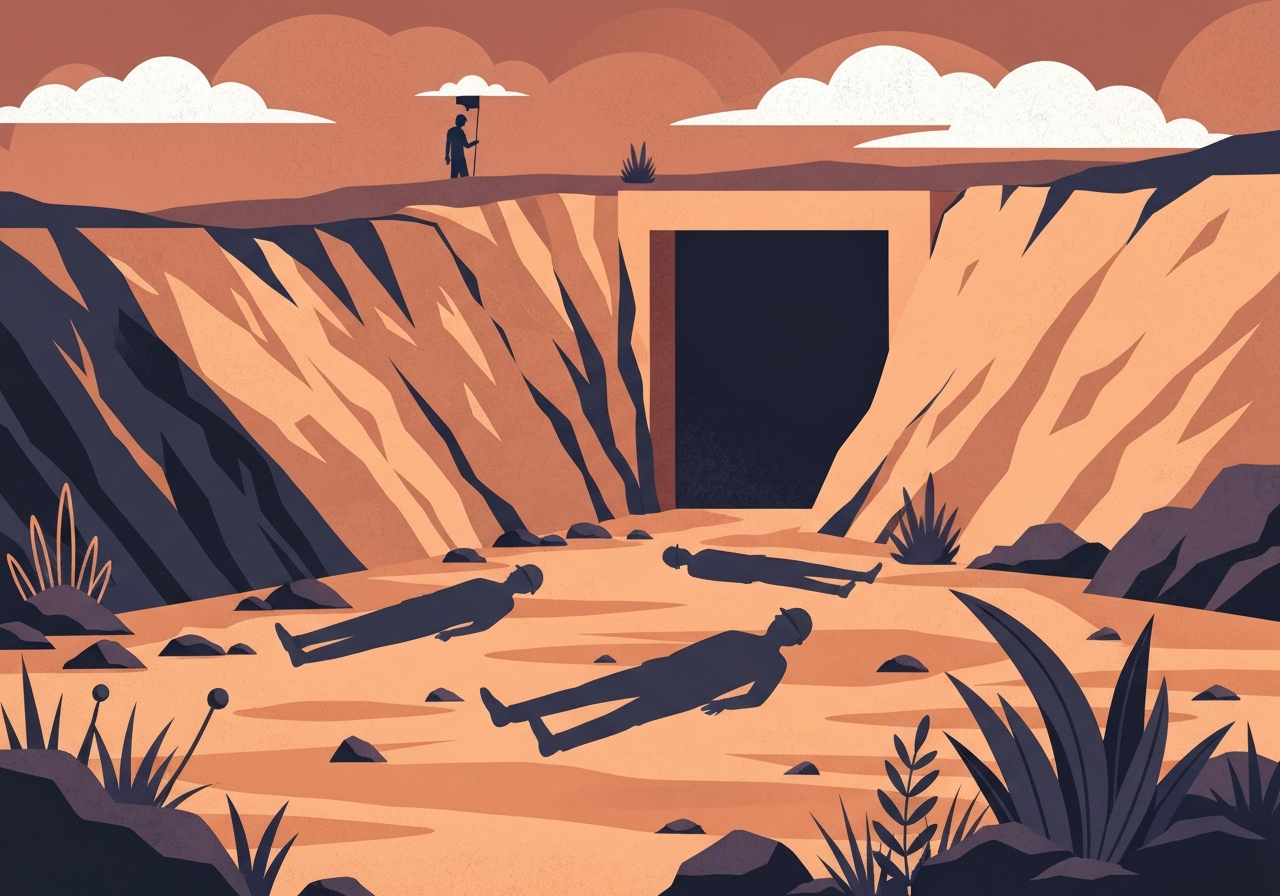
Mexican authorities on Friday announced the discovery of bodies and human remains in El Verde, Concordia, Sinaloa, in the same area where a search is underway for 10 people abducted from a Canadian-owned mine. The Attorney General’s Office said it could not immediately quantify all recovered remains but noted that one body showed characteristics matching a person reported missing. The state prosecutor and the Navy said the search operation also led to four arrests and the dismantling of 10 camps allegedly used by cartel members. The missing workers were taken from the Vizsla Silver mining site in a Jan. 28 abduction that prompted a federal deployment to the state.
Key Takeaways
- Authorities announced bodies and remains were found in El Verde, in the municipality of Concordia, Sinaloa.
- The Attorney General’s Office said one recovered body had characteristics of one of the 10 people reported missing.
- Four suspects have been arrested in connection with the disappearances, according to federal authorities.
- The Mexican Navy reported dismantling 10 camps in the same area that were allegedly used by cartel members.
- The victims were reported abducted on Jan. 28 from facilities operated by Vancouver-based Vizsla Silver.
- The federal government increased troop deployments and launched an operation to locate the missing workers.
- Sinaloa has seen an ongoing turf war between rival cartel factions for more than a year, affecting mining and rural communities.
Background
Sinaloa state, in northwest Mexico, has long been contested by organized-crime groups because of trafficking routes and lucrative local resources. In recent years cartels have targeted businesses, including mines, for extortion, theft of ore and other criminal revenue streams. Mining sites—especially those producing gold and silver—can be isolated and lightly defended, making them vulnerable to armed groups seeking quick profit or leverage.
Vizsla Silver, a Vancouver-based exploration and mining company, reported on Jan. 28 that 10 people had been abducted from its Concordia-area facilities and said it was working with authorities and its own crisis teams. The federal government responded by increasing security forces in the state and launching coordinated operations to find the workers. Local officials say the mountainous terrain around Concordia has been a flashpoint in an intra-cartel conflict for more than a year.
Main Event
On Friday, the Mexican Attorney General’s Office issued a statement saying bodies and remains were located in El Verde, a community near the Vizsla Silver site. The statement did not specify the total number of bodies or remains recovered, but it noted that one body had characteristics consistent with one of the 10 missing persons. Forensic identification and formal confirmation of identity were not reported in the initial announcement.
The Sinaloa state prosecutor’s office confirmed the geographic location as El Verde and said security forces, including the Navy, conducted searches in the vicinity of the mine. The Navy reported dismantling 10 camps in the area that it described as used by cartel members, part of the broader operation to disrupt armed groups operating around mining infrastructure.
Federal forces also reported the arrest of four people suspected of involvement in the disappearances. Authorities have not publicly released the identities of those detained or detailed the charges they will face. Officials said evidence gathered at the sites is being processed by investigators and that additional operations remain ongoing.
Analysis & Implications
The discovery of bodies near Concordia underscores the growing security risks that mining companies and local communities face in parts of Mexico. Beyond immediate human tragedy, such incidents can chill investment, raise insurance and security costs, and disrupt local economies that depend on mining jobs and related services. Companies operating in contested areas are increasingly required to coordinate with federal and local security forces, and to maintain contingency and crisis-response plans.
Politically, the case puts pressure on federal and Sinaloa state authorities to demonstrate effective control over contested territories and to produce timely, transparent forensic results. The arrests and dismantling of camps signal a tactical response, but analysts warn that temporary raids seldom end the underlying competition between cartel factions. Long-term stabilization typically requires sustained security presence combined with judicial follow-through and community support measures.
Internationally, the abduction of foreign-affiliated workers draws attention from investors and government partners in Canada and elsewhere. Diplomats and corporate stakeholders will likely demand clear forensic outcomes and accountability for suspects. If the remains are formally identified as the missing workers, the case could prompt calls for deeper scrutiny of corporate security practices and for improved protections for labor in remote extractive operations.
Comparison & Data
| Key dates/events | Details |
|---|---|
| Jan. 28, 2026 | Vizsla Silver reported abduction of 10 people from its Concordia facilities. |
| By Feb. 6, 2026 | Authorities announced discovery of bodies/remains in El Verde; four arrests; 10 camps dismantled. |
| Ongoing | More than one year of turf fighting between rival Sinaloa cartel factions in the region. |
The timeline shows a rapid escalation from the Jan. 28 abduction to a multi-agency search that led to arrests and site operations within days. While raids and arrests are measurable short-term outcomes, historical data from Sinaloa suggest that territorial disputes often persist despite periodic security sweeps. Analysts note that durable reductions in violence usually require both security and socioeconomic interventions.
Reactions & Quotes
The Attorney General’s Office framed the discovery as part of an active investigation, while cautioning that formal identification processes were pending.
“One of the bodies recovered had characteristics of one of the people reported as missing,”
Mexican Attorney General’s Office (official statement)
Vizsla Silver notified authorities immediately after the Jan. 28 abduction and said it activated crisis-management protocols.
“The company alerted authorities and mobilized crisis-management and security response teams,”
Vizsla Silver (company statement)
The Navy emphasized operational actions taken on the ground, including the dismantling of multiple camps believed to be used by organized-crime groups active in the area.
“Navy forces dismantled 10 camps in the area tied to cartel activity,”
Mexican Navy (operational report)
Unconfirmed
- Exact number of bodies or sets of remains recovered has not been publicly specified by authorities.
- Formal forensic identification confirming whether the recovered remains belong to the 10 missing workers is pending.
- Motives and the full chain of responsibility for the abduction—beyond arrests announced—remain under investigation.
Bottom Line
The discovery of bodies near the Vizsla Silver site deepens an already grave case: 10 people taken on Jan. 28 remain at the center of an active criminal investigation that has produced arrests but not yet full answers. Authorities have reported operational progress—arrests, camps dismantled and recovered remains—but key confirmations, including forensic identifications, are still outstanding.
For local communities and the mining sector, the incident highlights persistent security vulnerabilities in resource-rich but contested regions. Observers will be watching for transparent forensic results and judicial follow-through; absent those, the episode risks becoming another instance of short-term enforcement that does not resolve the long-term drivers of violence in Sinaloa.
Sources
- AP News (news report)
- Vizsla Silver (company website / press statements)
- Mexican Attorney General’s Office (official government agency)