
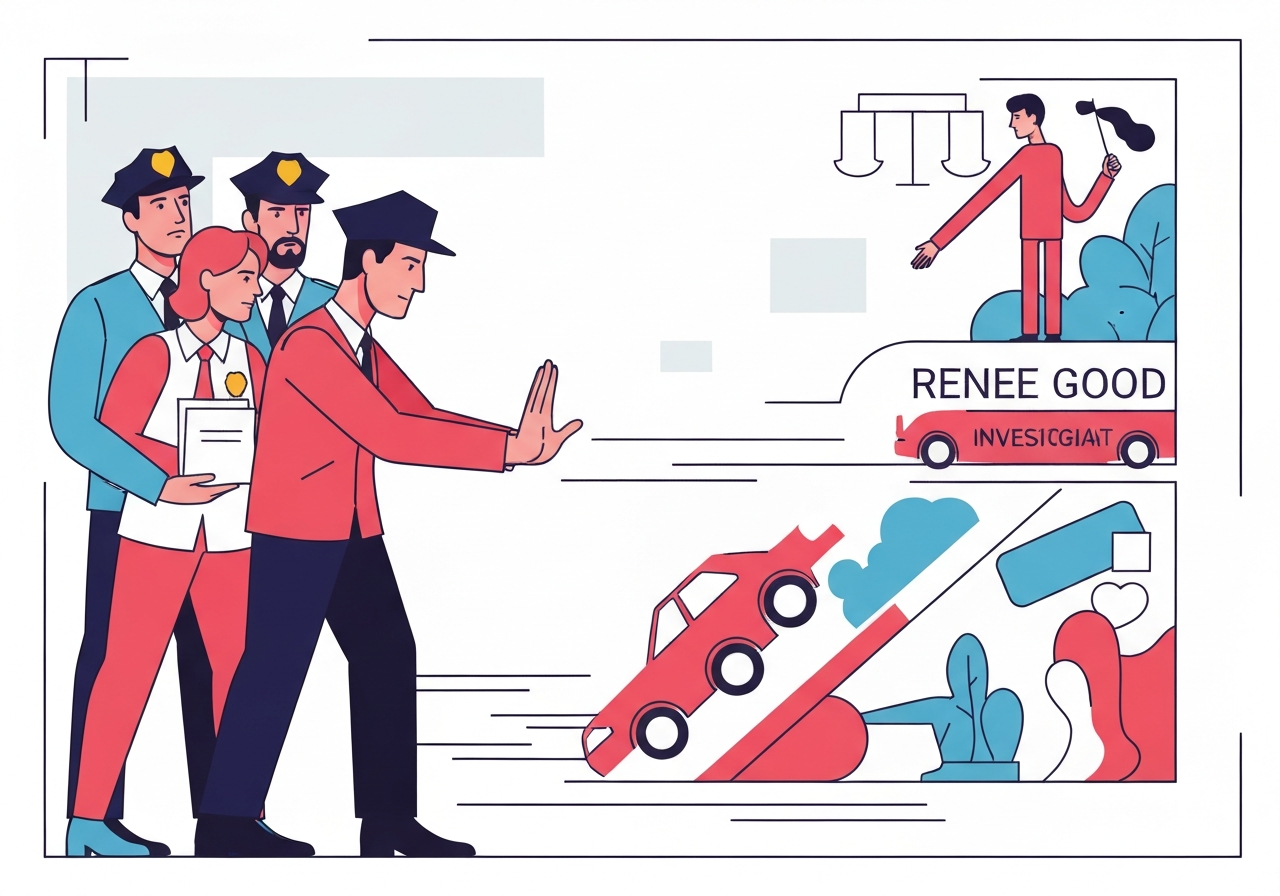
Lead: Federal prosecutors in Minnesota moved within hours after the Jan. 2026 shooting that killed Renee Good to seek a warrant to search her S.U.V., expecting a routine civil‑rights review of an immigration agent’s use of force. According to multiple current and former officials, F.B.I. agents arrived with a signed warrant but were told to stop after senior Washington leaders raised objections tied to public statements by President Donald J. Trump. In the days that followed, Department of Justice leaders proposed alternate lines of inquiry and several career prosecutors resigned in protest, leaving the U.S. attorney’s office in Minnesota critically undermanned.
Key Takeaways
- Hours after the Jan. 2026 shooting in Minneapolis, Minnesota federal prosecutors sought a warrant to examine Renee Good’s S.U.V. for blood spatter and other forensic evidence.
- F.B.I. agents reportedly arrived with a warrant but received orders from senior officials in Washington to halt the search; those orders were described to sources as reflecting concern about contradicting the President’s public account.
- President Trump publicly described the incident as Ms. Good having “violently, willfully, and viciously” run over the ICE officer, a statement officials said influenced investigative choices.
- Top Justice Department officials suggested shifting the legal basis for a warrant—first to a possible assault on the agent, later toward investigating Ms. Good’s partner—options some career prosecutors called legally dubious.
- At least six prosecutors, including Joseph H. Thompson, resigned in direct protest of the guidance; roughly a dozen staff departures in total have left the Minnesota U.S. attorney’s office severely short‑staffed.
- Officials have not publicly confirmed whether a subsequent warrant was obtained or whether the vehicle was ultimately searched.
- The episode has heightened tensions between career prosecutors and political appointees and intensified scrutiny of federal handling of civil‑rights reviews tied to law‑enforcement shootings.
Background
The shooting of Renee Good occurred in Minneapolis in January 2026 when an immigration enforcement agent, identified publicly as Jonathan Ross, fired on Ms. Good as she sat in or drove her S.U.V. The Minnesota Bureau of Criminal Apprehension (BCA), the state agency that commonly investigates police‑involved shootings, was set to partner with the F.B.I. on a civil‑rights inquiry to determine whether the use of deadly force was lawful.
Federal policy and long‑standing practice call for independent civil‑rights investigations when an agent or officer uses deadly force to ensure accountability and public trust. In previous high‑profile cases, combined state‑federal teams have collected vehicle and scene evidence quickly to preserve forensic traces such as blood, bullet trajectories and vehicle damage.
The Justice Department under the Trump administration has emphasized support for immigration enforcement officers, and the President’s early public characterization of the incident—saying Ms. Good ‘‘ran over’’ an ICE officer—became a focal point as investigators debated the proper legal framing of a warrant and the scope of any federal probe.
Main Event
According to multiple officials with direct knowledge of the matter, Joseph H. Thompson, a senior federal prosecutor in Minnesota, wrote to colleagues seeking a warrant to search Ms. Good’s vehicle as part of a standard civil‑rights investigation. The plan called for the BCA to work with the F.B.I. to examine physical evidence that could clarify whether the agent’s actions were justified.
When F.B.I. agents arrived with a signed warrant to document blood spatter and bullet strikes, they were told to stand down. Sources said the order originated in Washington and reflected concern that a civil‑rights warrant could conflict with the President’s public statement describing Ms. Good as having deliberately struck the agent.
Department leaders subsequently proposed alternatives. Initially, prosecutors were urged to seek a new warrant predicated on a criminal assault investigation into whether the agent had been attacked. Later guidance shifted toward examining eyewitnesses and Ms. Good’s partner, who had been present that morning and who confronted immigration agents in the neighborhood.
Several career prosecutors, including Mr. Thompson and five colleagues, rejected those routes as legally and ethically problematic. They argued the new strategies appeared to invert the investigative process—reframing the inquiry to align with a predetermined narrative rather than following forensic leads. Their objections prompted resignations that cascaded into a broader staffing crisis at the U.S. attorney’s office in Minnesota.
Analysis & Implications
The episode illustrates how high‑stakes investigations of officer‑involved shootings can become politicized when senior officials publicly take positions before evidence is gathered. When prosecutorial decisions appear to be influenced by political considerations, public confidence in impartial legal review can erode, complicating community relations in places already tense over enforcement practices.
For career prosecutors, the dispute underscored a clash between established investigative norms—rapid scene preservation and neutral evidence collection—and pressure to tailor inquiries to counter or reinforce public statements from elected leaders. That tension can produce legal vulnerabilities: warrants based on weak or after‑the‑fact rationales risk suppression in court and damage prosecutorial credibility.
Operationally, the resignations have near‑term consequences for casework unrelated to the shooting. Losing roughly a dozen prosecutors in a single office reduces capacity for civil and criminal dockets, slows pending investigations, and requires reassigning matters to other districts or to central Justice Department teams, which adds cost and delay.
Politically, the matter may spur oversight. Congressional committees and inspector general offices often probe whether political interference distorted justice‑department processes; such inquiries could examine communications, chain‑of‑command decisions and any correspondence that preceded the orders to halt forensic work.
Comparison & Data
| Item | Count / Date |
|---|---|
| Shooting of Renee Good | Jan. 2026 |
| Initial resignations in protest | 6 prosecutors (including Joseph H. Thompson) |
| Reported total departures from office | About 12 prosecutors |
| Article publication | Feb. 7, 2026 |
The table summarizes the time points and personnel figures reported by officials. The immediate effect—rapid resignations—signals extraordinary internal disagreement; the longer‑term staffing loss (about a dozen) is large for a single U.S. attorney’s office and will likely show measurable case delays in quarterly performance metrics.
Reactions & Quotes
“She violently, willfully, and viciously ran over the ICE Officer,”
President Donald J. Trump
This public characterization by the President was cited by several officials as a central factor shaping Washington’s concern that a civil‑rights warrant might produce findings at odds with the administration’s narrative.
“Career prosecutors viewed the proposed alternative bases for warrants as legally unsound and incendiary in the current climate,”
Former Minnesota federal prosecutor (speaking on background)
Prosecutors who resigned said the suggested reframing of the inquiry risked criminalizing the victim or her associates rather than neutrally pursuing forensic evidence. Their departures followed internal objections that investigators should not be steered toward a particular outcome.
Unconfirmed
- Whether a subsequent, differently grounded warrant was obtained to search Renee Good’s S.U.V. has not been publicly confirmed by officials.
- Attribution of the stop‑order to specific Washington officials—beyond anonymous sources’ naming—remains partially unverified, including precise internal instructions and their authorship.
Bottom Line
The Minnesota episode reveals a brittle seam where law enforcement practice, political messaging and prosecutorial independence intersect. Rapid public statements by senior political figures can reshape investigative choices and, as alleged here, prompt Washington‑level interventions that career lawyers view as improper.
Beyond this single case, the resignations and reported halt to forensic work raise broader questions about how the Justice Department will preserve impartiality in sensitive civil‑rights inquiries. Congress, inspectors general, and the department’s own internal oversight could all play roles in determining whether policies or practices must change to protect independent investigative standards.
Sources
- The New York Times — news reporting and named sourcing.
- U.S. Department of Justice — official department site for policy context (official).