
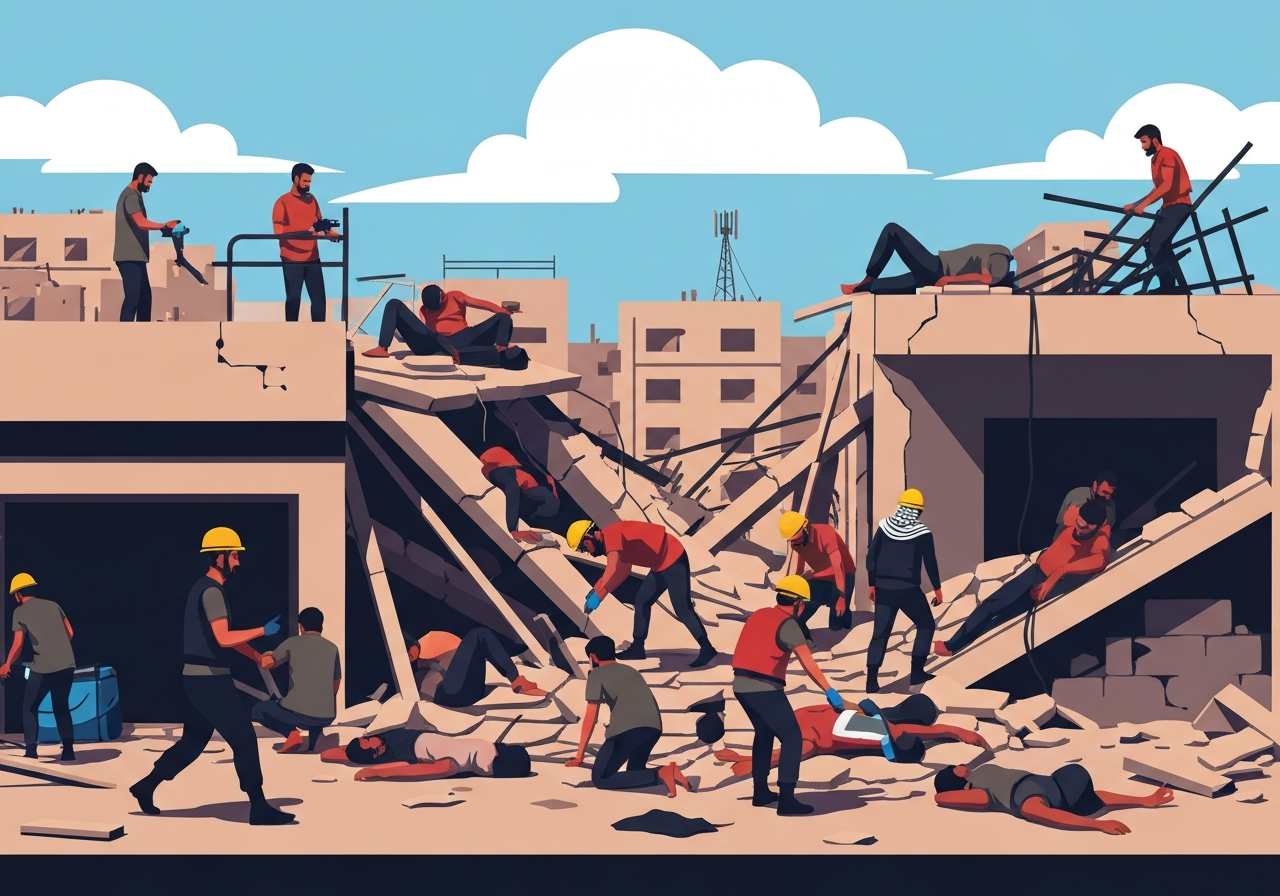
Lead: Rescuers and Gaza health officials say Israeli strikes on Sunday morning killed 11 Palestinians across the Gaza Strip. Palestinian emergency services reported at least six deaths in a northern tent encampment and five in a separate southern strike. The Israel Defense Forces (IDF) said the strikes targeted militants it said had violated a ceasefire by emerging from a tunnel into an area under Israeli control. The incident comes amid ongoing preparations for the second phase of a US-brokered ceasefire plan.
Key takeaways
- At least 11 Palestinians were reported killed in Israeli strikes on Sunday morning, with six deaths in northern Gaza and five in the south, according to Palestinian civil defence and health officials.
- The IDF said the strikes were aimed at “terror targets” and said militants were engaged after leaving a tunnel beneath the Gaza-Israel interface.
- The episode occurred during a fragile ceasefire that came into effect on 10 October; the Hamas-run Gaza health ministry says at least 600 people have been killed since that ceasefire began.
- The broader Gaza death toll since the October 7, 2023 offensive is reported by Gaza authorities at more than 71,820.
- The events unfolded as international actors prepare for a second phase of a US-brokered deal, including a proposed Board of Peace and plans for a technocratic Palestinian administration and reconstruction oversight.
- Israeli Prime Minister Benjamin Netanyahu met US President Donald Trump in Washington this week, discussing regional threats including Iran; President Trump said talks produced “nothing definitive reached.”
Background
The current hostilities trace back to the Hamas-led attack on southern Israel on 7 October 2023, which Israeli authorities say killed about 1,200 people and left 251 civilians taken hostage. Israel responded with a major military campaign in Gaza. Gaza health officials report more than 71,820 deaths in the territory since that campaign began.
A ceasefire took effect on 10 October and has reduced, but not ended, daily violence. Both sides have accused each other of repeated violations; those near-daily incidents have complicated humanitarian access and reconstruction planning. International mediators, led by the United States and backed by UN mandate discussions, are pushing for a phased implementation of longer-term security and governance arrangements for Gaza.
Main event
Early on Sunday, Palestinian civil defence teams and health officials reported multiple strikes across the Gaza Strip. The Palestinian Red Crescent said a strike on a tent encampment in northern Gaza killed at least six people, and health authorities in the south confirmed five fatalities there. Emergency crews described chaotic scenes at both locations as rescuers searched rubble and moved the wounded to hospitals.
The IDF released a statement saying it had struck “terror targets” in response to what it described as ceasefire breaches by Hamas. Israeli officials said militants had emerged from a tunnel into an area the IDF controls and were engaged by soldiers; the military reported fighters were killed during the exchange.
Local civil defence teams and hospital staff said the majority of victims were civilians, including displaced families living in makeshift tent encampments. Medical facilities in Gaza, already under strain from months of fighting and resource shortages, reported receiving multiple casualties and said equipment and medicine remain limited.
The strikes occurred as international planners continued preparations for a second phase of a US-brokered ceasefire framework. That package includes security guarantees, oversight mechanisms and steps toward a new technocratic administration in Gaza to manage day-to-day governance and reconstruction tasks.
Analysis & implications
The deaths underline how fragile the current truce remains: even limited tactical incidents—such as alleged tunnel movements—can rapidly escalate into lethal exchanges. If such encounters become regular, they risk undermining the political momentum for broader stabilization measures and reconstruction financing.
On the humanitarian front, further strikes in populated or displacement sites heighten the already severe protection and medical challenges. Tent encampments host families displaced earlier in the conflict and are particularly vulnerable; repeated damage to such sites reduces shelter capacity and complicates aid delivery.
Politically, the timing of the strikes is sensitive. International efforts to establish a Board of Peace and an interim administrative mechanism depend on a demonstrable reduction in violence and on parties accepting external monitoring. Fresh clashes will likely slow the board’s work and could prompt additional international diplomatic pressure on both sides.
Regionally, the meeting between Israeli and US leaders earlier this week, and ongoing discussions about Iran’s nuclear and missile programs, show the conflict’s linkage to wider security questions. A persistent low-intensity conflict in Gaza can have ripple effects on broader regional alignments and international willingness to commit resources for reconstruction.
Comparison & data
| Metric | Reported figure |
|---|---|
| Deaths in Sunday strikes | 11 |
| Reported post-ceasefire deaths | At least 600 |
| Total Gaza deaths since Oct 7, 2023 | More than 71,820 |
These official figures come from Gaza-run health authorities and local emergency services; international tallies can differ. The “at least 600” figure is specific to the period after the 10 October ceasefire began, underscoring continuing lethal incidents despite the truce. Discrepancies between sources often reflect limited access and differing casualty verification methods.
Reactions & quotes
Officials and aid groups reacted quickly to the strikes and deaths, framing them within broader security and humanitarian concerns.
“We struck terror targets in response to ceasefire breaches,”
Israel Defense Forces (official statement)
The IDF framed the action as a tactical response to alleged militant movement from a tunnel into an area under Israeli control. The military emphasized the operation targeted fighters rather than civilian infrastructure, while acknowledging the complexity of operations near populated zones.
“A strike on a tent encampment killed at least six people,”
Palestinian Red Crescent (local NGO)
The Palestinian Red Crescent described rescue operations at the northern site, noting medics were working under difficult conditions to extract and treat survivors. NGO responders warned that repeated strikes on displacement sites exacerbate the protection crisis for civilians.
“Nothing definitive reached,”
US President Donald Trump (post-meeting comment)
President Trump used this phrasing after meeting Israeli Prime Minister Benjamin Netanyahu in Washington; the comment referred to ongoing talks on regional security issues, including long-standing concerns over Iran’s nuclear and missile programs.
Unconfirmed
- Attribution of all civilian deaths to specific strikes remains under verification; independent confirmation of each casualty is pending.
- The exact number of militants killed in the IDF engagement and whether they exited a tunnel as claimed has not been independently verified.
- The timetable and final composition for the proposed Board of Peace and the February 19 meeting remain subject to change and verification from involved governments and the UN.
Bottom line
The strikes that killed 11 people on Sunday underscore the fragility of the ceasefire and the difficulties of keeping a low-intensity truce intact in a densely populated and contested environment. Even tactical exchanges around tunnels or boundary zones can produce civilian casualties and erode political trust between parties and mediators.
For international efforts to stabilize Gaza and begin reconstruction, the immediate priorities are clearer incident verification, protection of displacement sites, and credible security guarantees that reduce the chance of recurring lethal exchanges. Without such measures, momentum toward a sustainable political and humanitarian settlement will face recurring setbacks.
Sources
- BBC News (news outlet)
- Israel Defense Forces (official military site)
- Palestinian Red Crescent Society (local humanitarian NGO)
- United Nations Security Council (international organization)
- The White House (official statement)