
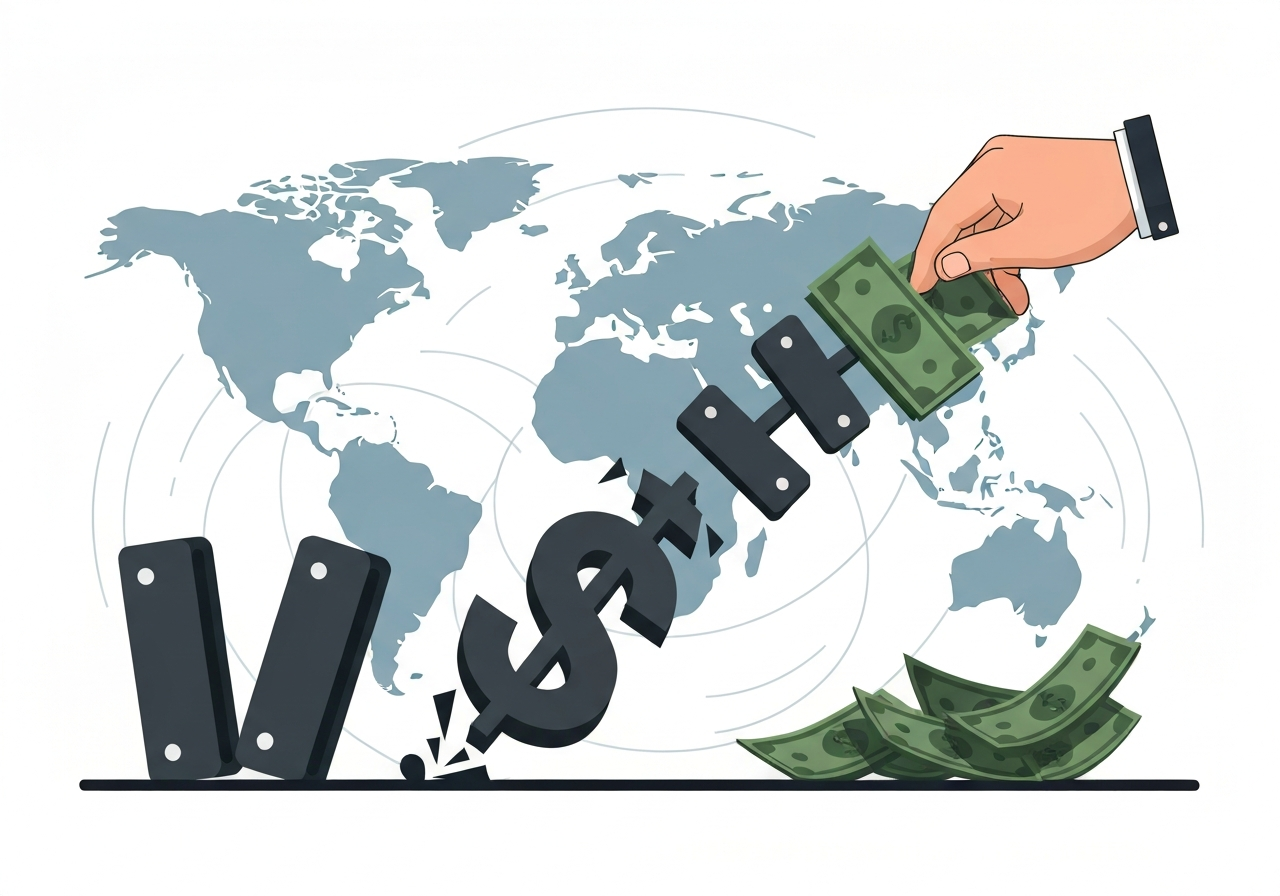
Lead: On February 23, 2026, global markets reacted to President Donald Trump’s newly outlined plan for global tariffs on U.S. imports, prompting traders to pare holdings of U.S. assets and pressuring the dollar. The greenback fell as much as 0.3% in early trading before recovering most losses by midday. U.S. Treasuries moved only modestly, with the 10-year yield holding at 4.07%. Market participants cited heightened policy uncertainty as the primary driver of the moves.
Key Takeaways
- The Bloomberg dollar gauge dropped as much as 0.3% intraday on Feb. 23, 2026 and was largely flat by early afternoon.
- U.S. 10-year Treasury yield remained at 4.07% during the session, showing limited immediate flight-to-safety pressure.
- Traders reduced exposure to U.S. assets after the White House revealed a plan for global tariffs on U.S. imports, increasing trade-policy risk premiums.
- Currency markets moved quickly on headlines, underscoring sensitivity to policy shifts rather than immediate economic-data changes.
- Market moves were described by participants as precautionary re-pricing; no large-scale disorderly selling of Treasuries was evident during the session.
Background
Trade-policy announcements have outsized effects on financial markets because tariffs can alter relative prices, corporate margins and global supply chains. In 2018 and subsequent years, iterations of U.S. trade measures repeatedly tested market tolerance for geopolitical economic shifts, with sharp but often short-lived asset re-pricings. Investors routinely treat tariff proposals as a risk factor that can degrade expected foreign earnings for U.S. multinationals and prompt currency adjustments.
Recent proposals from the White House signaled a new, broader approach to import tariffs, reviving questions about policy direction and implementation timelines. Market participants weigh both the direct impact on trade flows and the indirect consequences for growth, inflation and central-bank outlooks. Those cross-cutting channels are why currency desks and fixed-income traders monitor trade announcements closely for signs of sustained capital flows out of U.S.-dollar assets.
Main Event
The market reaction on Feb. 23 began almost immediately after the White House outlined its tariff concept, with spot FX desks reporting increased selling pressure on the dollar. The Bloomberg dollar gauge initially fell about 0.3% as stop orders and algorithmic flows amplified the move, then steadied as liquidity conditions improved and some buyers stepped in. Dealers noted the move reflected headline-driven positioning rather than a broad reassessment of U.S. macro fundamentals.
Treasury markets showed only modest repricing; the 10-year yield held at 4.07% for much of the session. Traders said demand for cash remained steady, and there were no large-scale shifts into safe-haven Treasuries beyond what would be expected from headline risk. Short-term money-market rates and swap spreads reflected some risk repricing but did not signal acute stress.
Options and cross-asset desks reported an uptick in demand for hedges against U.S.-dollar weakness and for protection on equity exposure to trade-sensitive sectors. Institutional investors described the flows as selective — reallocations within portfolios — rather than indiscriminate liquidation of U.S. holdings. That behavior helped blunt a deeper slide in the dollar by mid-afternoon.
Analysis & Implications
Trade-policy uncertainty affects the dollar through several channels: reduced net foreign demand for U.S. goods and assets, shifting profit expectations for multinationals, and altered global growth trajectories. If tariffs were to be implemented at scale, foreign buyers could reassess dollar assets, weighing currency depreciation risk against relative yield advantages. However, the magnitude and persistence of any move depend on policy details and market confidence in enforcement and reciprocity.
For fixed income, tariff-driven growth concerns can push yields lower if investors expect weaker demand and slower inflation, or higher if tariffs accelerate domestic inflation through higher import costs. The muted movement in the 10-year yield at 4.07% suggests markets were initially treating the latest announcement as headline risk rather than an immediate macro shock. That stance could change if the proposal is fleshed out with specific tariff rates and timelines.
Internationally, prolonged tariff escalation could invite retaliatory measures, complicating cross-border capital flows and prompting reserve managers to rebalance. Emerging-market currencies and trade-dependent regions would be particularly sensitive. Central banks outside the U.S. would factor any durable shift in trade momentum into policy deliberations, with potential knock-on effects for currency and bond markets globally.
Comparison & Data
| Instrument | Intraday Move | Reported Level |
|---|---|---|
| Bloomberg dollar gauge | Down as much as 0.3% | Near unchanged by midday |
| U.S. 10-year Treasury yield | Modest moves | 4.07% |
The table summarizes the core market datapoints from the trading session. The dollar’s peak intraday decline of 0.3% was sufficient to trigger short-term rebalancing, while the 10-year yield’s stability indicated limited immediate demand for duration as a safe haven. Together these readings point to headline-driven, not structural, shifts during the day.
Reactions & Quotes
“Traders are actively re-pricing risk around U.S. assets as policy uncertainty rises,”
Market strategist at a global bank
Context: The strategist described the scalpel-like nature of flows — targeted position adjustments in currency and equity exposures rather than blanket asset sales.
“Headline announcements can provoke quick FX moves even when macro fundamentals remain intact,”
Fixed-income desk head (investment firm)
Context: The desk head emphasized that algorithmic and hedge flows often magnify early-session news before reversion occurs.
“Implementation details will determine whether this is a transient shock or a longer-term risk to capital allocation,”
Trade-policy academic
Context: The academic highlighted that the policy’s final shape — rates, scope and retaliation risk — will dictate investor responses beyond the initial headline reaction.
Unconfirmed
- Whether the tariff plan will be implemented as initially outlined or substantially revised remains unconfirmed; final scope and rates are pending.
- The exact timeline for any tariff measures and potential grandfathering or exemptions has not been publicly set and is therefore uncertain.
- The scale of portfolio reallocation by major foreign holders of U.S. assets in response to the plan is not yet verified and may be limited to short-term tactical moves.
Bottom Line
The Feb. 23, 2026 session illustrated how quickly exchange rates and asset allocations respond to trade-policy headlines. While the dollar briefly dipped as much as 0.3%, its recovery and the stability of the 10-year yield at 4.07% indicate markets treated the announcement as headline risk rather than an immediate structural shock.
Investors will watch for concrete policy details and any signs of reciprocal measures abroad to judge whether this episode evolves into a sustained re-pricing of U.S. assets. In the near term, expect intermittent volatility around trade-policy headlines, with persistent moves contingent on implementation specifics and follow-through from global counterparts.