
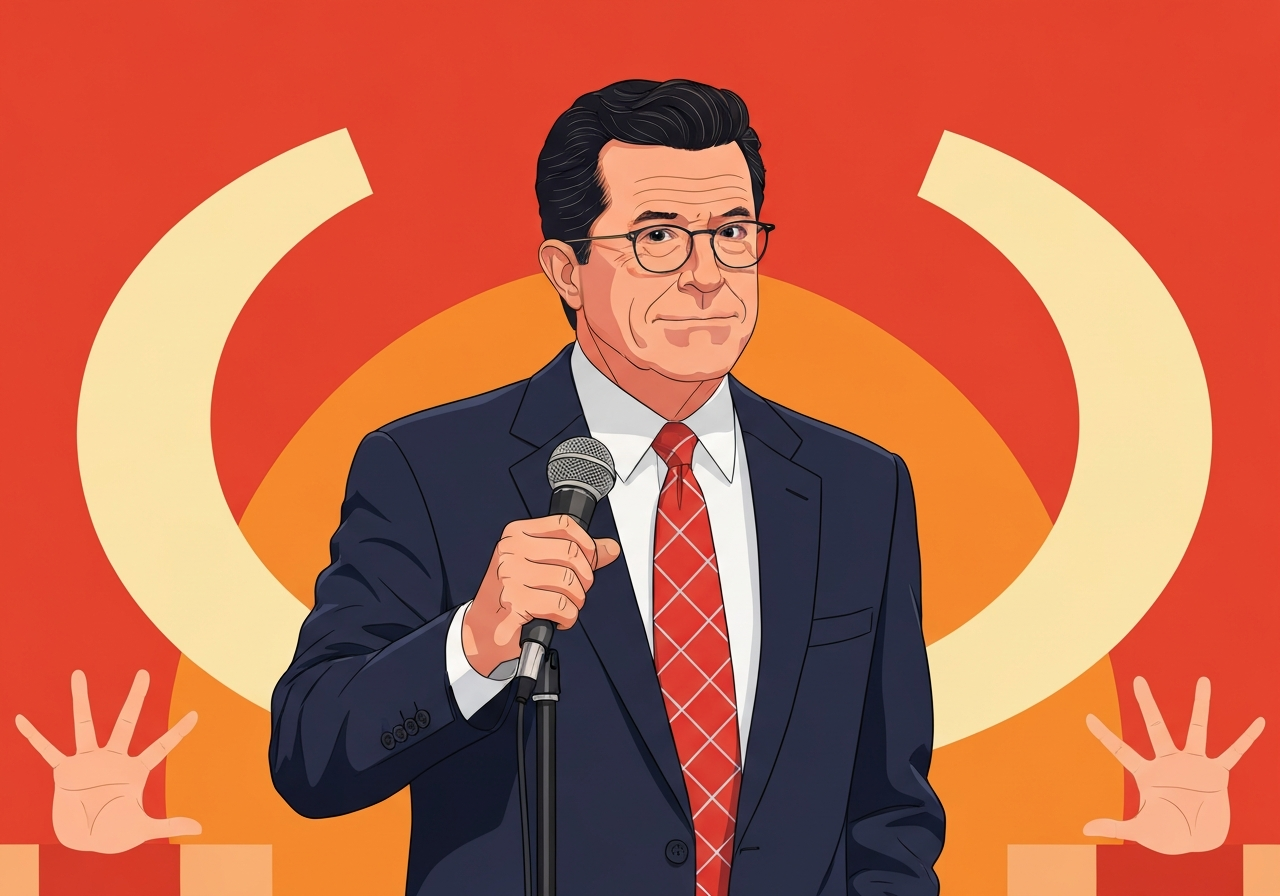
Lead: Stephen Colbert returned to the cameras live for what he called the final live installment of The Late Show immediately after President Donald Trump’s State of the Union address in February 2026. The show began nearly 30 minutes late because the president’s speech ran more than an hour and 45 minutes, the longest SOTU on record. Colbert opened with a Wicked parody and a buoyant tone, quickly pivoting to pointed jokes about the speech’s length, policy claims and the administration’s approval ratings. The segment mixed broad musical satire with sharp political ribbing and a guest appearance later in the program.
Key Takeaways
- Colbert went live following President Trump’s State of the Union on the night in February 2026; the broadcast started about 30 minutes late due to the speech exceeding 1 hour 45 minutes.
- He opened with a Wicked parody and repeatedly referenced the speech’s length as a running joke during the set.
- Colbert said, “These are always kind of rough with Trump,” adding he took an edible before air to steady himself and quipped, “when they go low, we get high.”
- The host highlighted President Trump’s 36% approval rating while lampooning policy claims including a program described as “Trump Account for Kids,” and the administration’s reported removal of 2.4 million people from food-stamp rolls.
- Colbert characterized the address as divisive and unlikely to win over voters disenchanted with the second administration’s turmoil.
- Former CBS News anchor John Dickerson appeared later on the show for a follow-up conversation.
Background
Late-night hosts have a long tradition of responding directly to the president’s prime-time addresses; post-SOTU broadcasts are a staple for political satire. Historically, these episodes compress reaction, analysis and comedy into a single show, aiming to capture viewers still tuned to the political conversation after the speech. The 2026 address stood out because of its exceptional length and the administration’s ongoing controversies, which provided abundant material for satirists.
Colbert has been a frequent and high-profile critic of President Trump across multiple seasons, blending sharp political commentary with theatrical bits and musical send-ups. The Late Show’s production has periodically adjusted format and timing to accommodate major political events; a near half-hour delayed start is uncommon but not unprecedented when a large live audience is seated and networks are still airing the speech. Late-night reaction pieces often function as both entertainment and a rapid form of civic commentary, reaching audiences who may not watch traditional political analysis programs.
Main Event
The show’s opening riff leaned on theatrical parody: Colbert performed a piece inspired by the musical Wicked before turning to direct commentary on the president’s address. He repeatedly cited the speech’s extraordinary duration—more than 1 hour and 45 minutes—and used that as a comedic through-line, noting the broadcast’s delayed start and joking about public figures changing as the night wore on.
In one of the evening’s more personal asides, Colbert said he had taken an edible to steady himself before going live. He framed that comment with the quip, “These are always kind of rough with Trump,” and referenced Michelle Obama’s well-known saying in a riff that reframed the phrase for comic effect. The moment mixed self-deprecating humor with pointed political framing, balancing genuine fatigue about the speech with satire.
Colbert moved from comic bits to policy critique, citing the president’s low approval mark at 36% and mocking claims tied to the administration’s domestic agenda. He singled out a program the president touted, referred to on stage as “Trump Account for Kids,” and criticized the reported reduction of 2.4 million people from food-stamp rolls as part of the administration’s policy record.
He also ridiculed the notion that the president sought to award himself or elevate his legacy through high civilian honors, referencing the idea that the president wanted to give himself the Congressional Medal of Freedom. The tone combined direct policy disagreement with theatrical exaggeration, a standard late-night technique to translate political developments into comedic critique.
Analysis & Implications
Colbert’s post-SOTU set illustrates how late-night television continues to shape public reaction to presidential messaging. By airing immediately after the address, comedians can frame the narrative for viewers who transition from the speech to entertainment programming. That rapid response can reinforce existing perceptions—especially among audiences predisposed to skepticism about the administration.
The emphasis on the speech’s length and on specific claims (approval ratings, child-account proposals, food-stamp reductions) highlights a broader communications challenge for the administration: long-form addresses provide more opportunities for fact-checking and for critics to isolate statements for ridicule. For political communicators, extended speeches can be a double-edged sword—energizing the base while offering opponents material to mobilize dissent.
Colbert’s mixture of humor and policy critique also underscores the narrowing line between entertainment and political discourse. Audiences increasingly receive political analysis through cultural figures; that amplifies the influence of satirists but also poses questions about depth and nuance. When a comedian frames a speech as “dark” and “divisive,” it contributes to public sentiment even as it entertains.
For the upcoming weeks, the administration may face sustained scrutiny from both traditional news outlets and cultural commentators. Late-night reactions often echo in social media and news summaries, potentially shaping the storylines that reporters pursue and the angles that opposition figures emphasize.
Comparison & Data
| Item | Detail |
|---|---|
| President Trump SOTU (2026) | More than 1 hour 45 minutes (reported as the longest SOTU) |
| Late-show start delay | Approximately 30 minutes |
| Administration approval cited on-air | 36% support (as referenced by Colbert) |
The table summarizes the concrete figures cited during the broadcast and in Colbert’s commentary. The speech’s exceptional length dominated the evening’s framing, pushing late-night programming later into the night and giving commentators additional material to lampoon. Approval figures and policy claims (such as the cited removal of 2.4 million people from food assistance rolls) were central to the host’s critique and remain standard metrics for assessing public response.
Reactions & Quotes
Colbert’s remarks drew immediate social-media echo and press response. Before quoting, it’s important to note that late-night material is primarily satirical and intended to provoke and entertain while engaging with policy topics.
“These are always kind of rough with Trump,”
Stephen Colbert
Colbert used that line to frame his pre-show nerves and to justify the edible joke—a blend of comic bravado and political opinion that set the tone for the rest of the segment.
“It was incredibly long,”
Stephen Colbert
This short remark prefaced a string of jokes about the address’s length and its perceived excesses; it also tied into Colbert’s broader critique that long speeches leave openings for satirists and fact-checkers alike.
Unconfirmed
- The claim that the 2026 SOTU is the absolute longest in history is reported in coverage but may require formal record verification by congressional historians or broadcast archives.
- Details of internal White House naming conventions for programs referred to on stage (for example, who coined “Trump Account for Kids”) are described in public remarks but may not reflect internal documents or naming processes.
Bottom Line
Stephen Colbert’s late-night response to President Trump’s lengthy 2026 State of the Union was typical of modern political satire: immediate, performative and pointedly critical. The combination of musical parody and targeted policy jabs reinforced a skeptical reading of the address for viewers tuning in after the speech.
Because late-night commentary reaches large and engaged audiences, these segments are more than entertainment; they help set the tone of public reaction in the hours after major political events. Watchers should treat satire as a prompt to consult reporting and official records when evaluating policy claims and statistics cited on-air.
Sources
- Deadline — media coverage of the broadcast and summary of Colbert’s remarks (journalism).